In Exercises 25–32, find an nth-degree polynomial function with real coefficients satisfying the given conditions. If you are using a graphing utility, use it to graph the function and verify the real zeros and the given function value. n=3; -5 and 4+3i are zeros; f(2) = 91
Verified step by step guidance
1
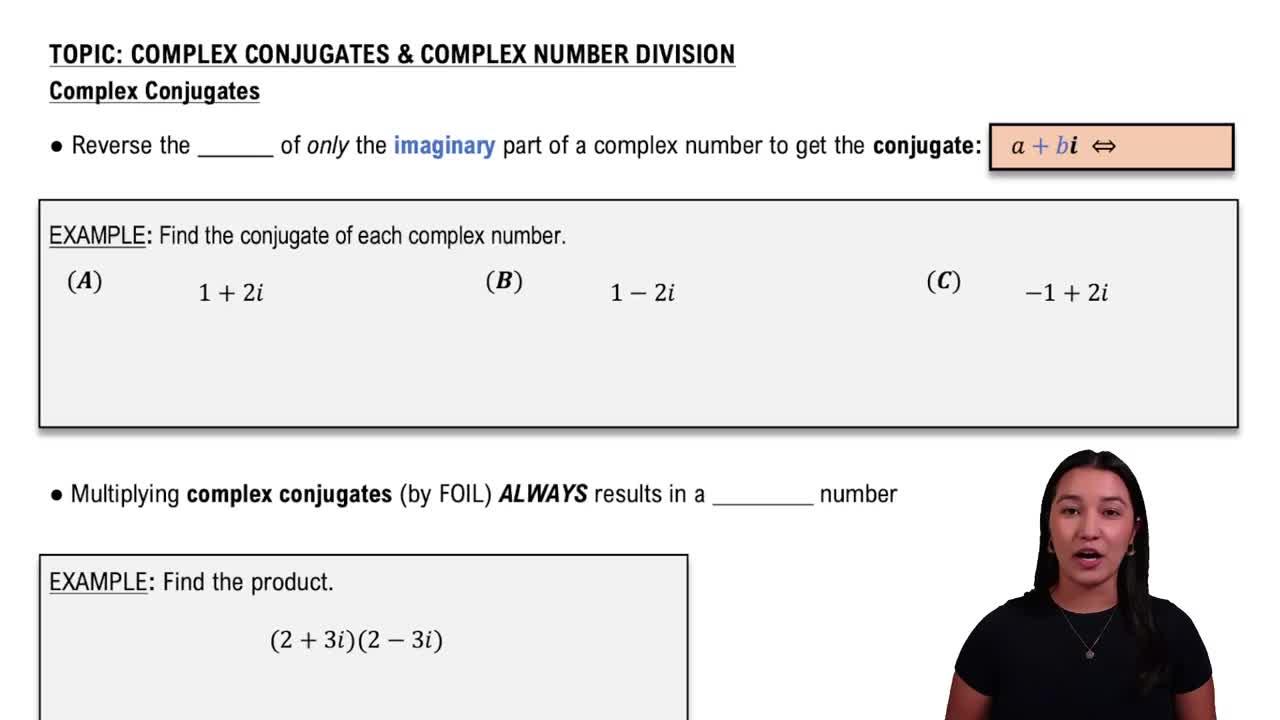
insert step 1: Understand that a polynomial of degree n=3 will have 3 roots. Since the coefficients are real, complex roots must occur in conjugate pairs. Therefore, if 4+3i is a root, its conjugate 4-3i must also be a root.
insert step 2: List the roots of the polynomial: -5, 4+3i, and 4-3i.
insert step 3: Write the polynomial in its factored form using the roots: f(x) = a(x + 5)(x - (4+3i))(x - (4-3i)).
insert step 5: Expand the polynomial: f(x) = a(x + 5)((x - 4)^2 + 9) and use the condition f(2) = 91 to find the value of 'a'.
Verified video answer for a similar problem:
This video solution was recommended by our tutors as helpful for the problem above
Video duration:
7m
Play a video:
Was this helpful?
Key Concepts
Here are the essential concepts you must grasp in order to answer the question correctly.
Polynomial Functions
A polynomial function is a mathematical expression involving a sum of powers in one or more variables multiplied by coefficients. The general form of a polynomial in one variable is f(x) = a_n*x^n + a_(n-1)*x^(n-1) + ... + a_1*x + a_0, where n is a non-negative integer and a_n is not zero. Understanding polynomial functions is crucial for identifying their properties, such as degree, zeros, and behavior at infinity.
In polynomial functions with real coefficients, complex zeros occur in conjugate pairs. This means that if a polynomial has a complex zero of the form a + bi, where a and b are real numbers, then its conjugate a - bi is also a zero. This property is essential for constructing the polynomial when given complex zeros, as it ensures that the polynomial remains a real-valued function.
Evaluating a polynomial function at a specific point involves substituting the value of the variable into the polynomial expression and simplifying. This process is important for verifying conditions such as f(2) = 91 in the given problem. Understanding how to evaluate polynomials helps in confirming that the constructed polynomial meets the specified criteria and behaves as expected at certain points.