If ƒ(x) is a polynomial function with real coefficients, and if 7+2i is a zero of the function, then what other complex number must also be a zero?
Verified step by step guidance
1
insert step 1> Identify that the polynomial function has real coefficients.
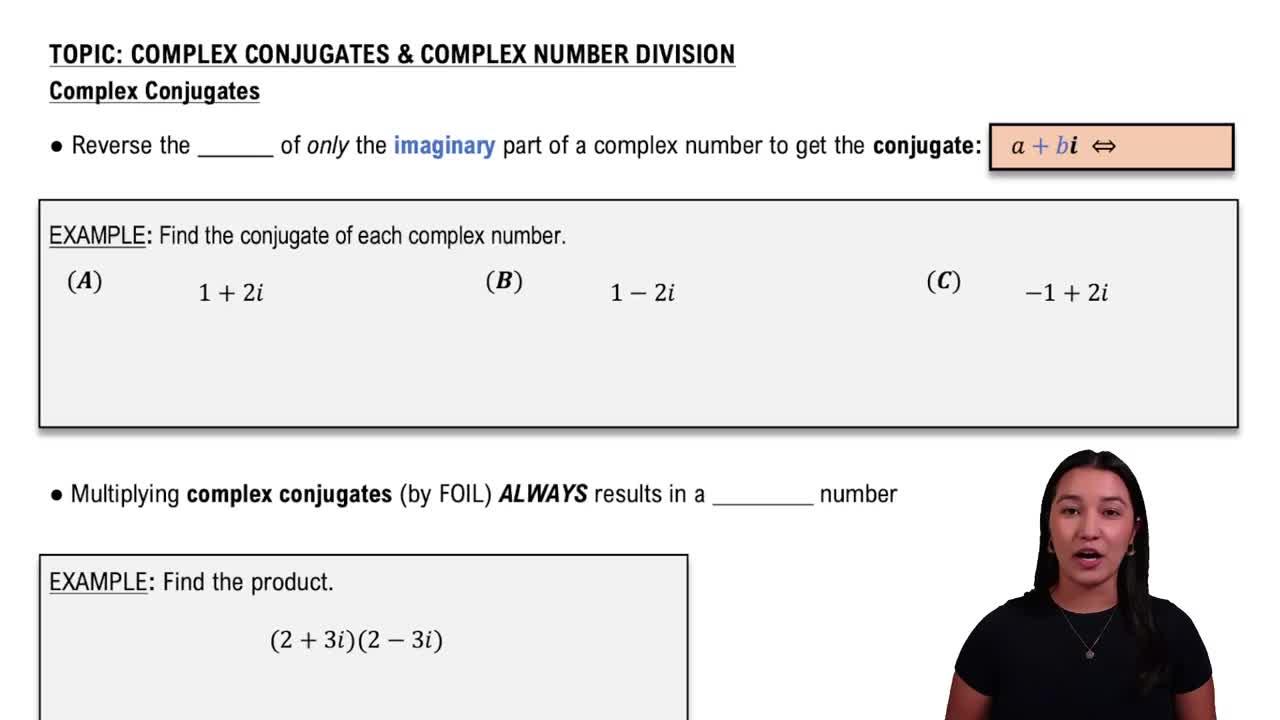
insert step 2> Recall that complex roots of polynomials with real coefficients come in conjugate pairs.
insert step 3> Recognize that if 7+2i is a zero, its complex conjugate 7-2i must also be a zero.
insert step 4> Understand that the conjugate of a complex number a+bi is a-bi.
insert step 5> Conclude that 7-2i is the other zero of the polynomial function.
Verified video answer for a similar problem:
This video solution was recommended by our tutors as helpful for the problem above
Video duration:
1m
Play a video:
Was this helpful?
Key Concepts
Here are the essential concepts you must grasp in order to answer the question correctly.
Complex Conjugate Root Theorem
The Complex Conjugate Root Theorem states that if a polynomial has real coefficients, then any non-real complex roots must occur in conjugate pairs. This means that if a complex number 'a + bi' is a root, its conjugate 'a - bi' must also be a root of the polynomial.
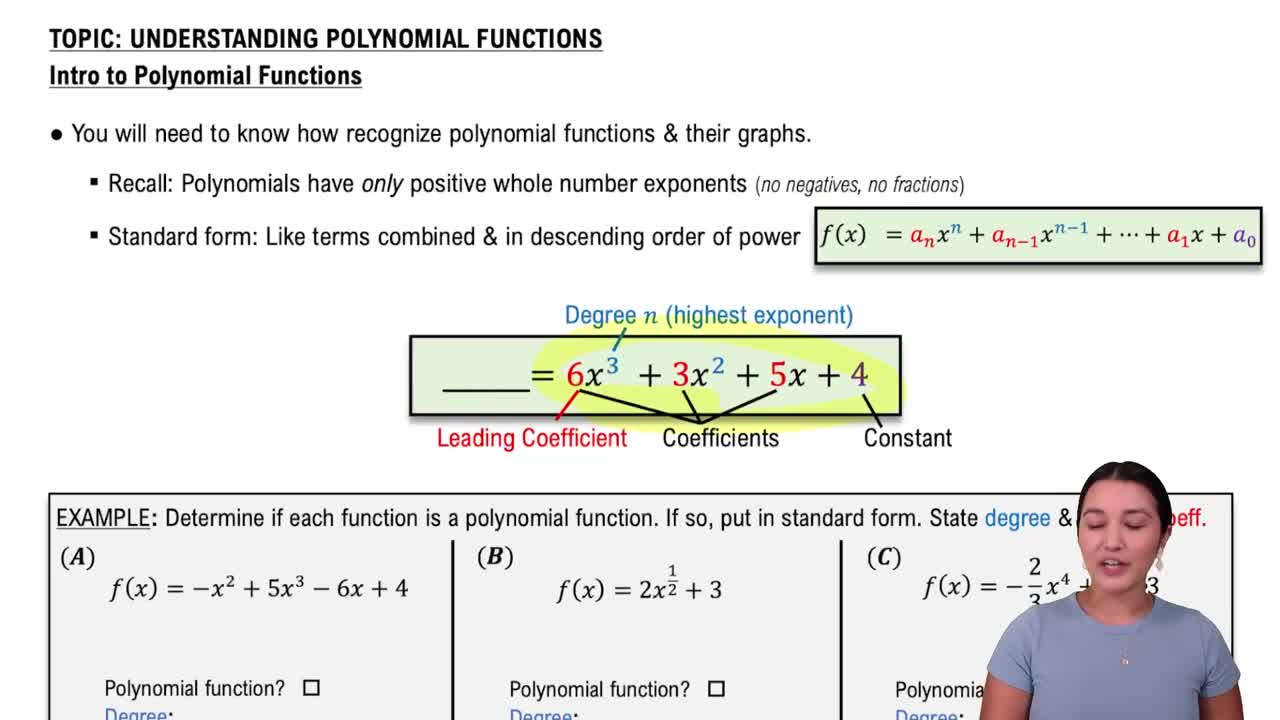
A polynomial function is a mathematical expression involving a sum of powers in one or more variables multiplied by coefficients. The degree of the polynomial is determined by the highest power of the variable. Understanding the nature of polynomial functions is essential for analyzing their roots and behavior.
The zeros of a function, also known as roots, are the values of the variable that make the function equal to zero. For polynomial functions, finding the zeros is crucial for understanding the function's graph, as they indicate where the graph intersects the x-axis.