In Exercises 59–72, simplify each expression using the products-to-powers rule.
(4x)³
Verified step by step guidance
1
Identify the expression to simplify: \((4x)^3\).
Apply the products-to-powers rule, which states \((ab)^n = a^n \cdot b^n\).
Separate the base \(4x\) into its components: \(4\) and \(x\).
Raise each component to the power of 3: \(4^3\) and \(x^3\).
Combine the results: \(4^3 \cdot x^3\).
Verified video answer for a similar problem:
This video solution was recommended by our tutors as helpful for the problem above.
Video duration:
2m
Play a video:
0 Comments
Key Concepts
Here are the essential concepts you must grasp in order to answer the question correctly.
Exponents
Exponents are a mathematical notation indicating the number of times a number, known as the base, is multiplied by itself. For example, in the expression (4x)³, both 4 and x are raised to the power of 3, meaning (4x) is multiplied by itself three times. Understanding how to manipulate exponents is crucial for simplifying expressions.
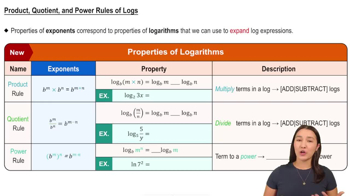
The products-to-powers rule states that when raising a product to a power, you can distribute the exponent to each factor in the product. For instance, (ab)ⁿ = aⁿbⁿ. This rule simplifies calculations by allowing you to handle each component of the product separately, which is essential for simplifying expressions like (4x)³.
Simplifying expressions involves reducing them to their simplest form, making them easier to work with. This process often includes combining like terms, applying exponent rules, and performing arithmetic operations. In the case of (4x)³, simplification will yield a clearer expression that can be used in further calculations or problem-solving.

 2:35 minutes
 Verified step by step guidance
 04:06
04:06