Use the rules for radicals to perform the indicated operations. Assume all variable expressions represent positive real numbers. √9/25
Verified step by step guidance
1
Recognize that the expression \( \sqrt{\frac{9}{25}} \) is a square root of a fraction.
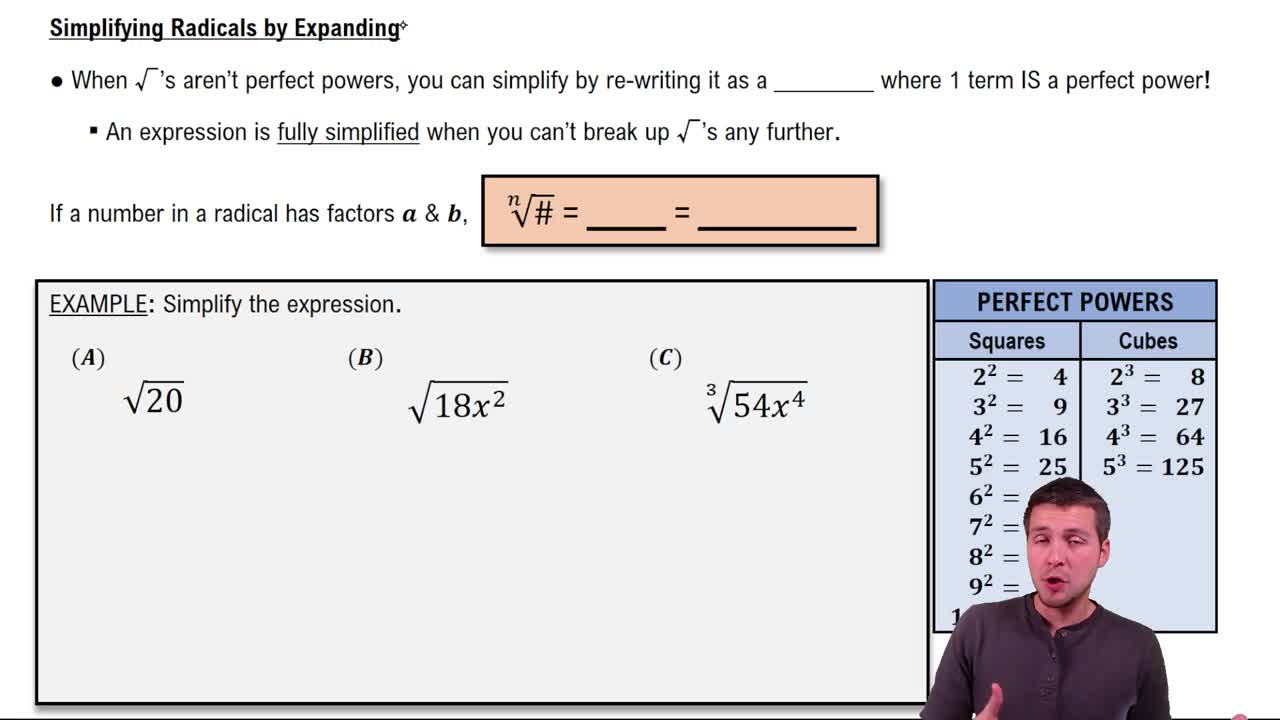
Use the property of radicals that states \( \sqrt{\frac{a}{b}} = \frac{\sqrt{a}}{\sqrt{b}} \) to rewrite the expression as \( \frac{\sqrt{9}}{\sqrt{25}} \).
Calculate the square root of the numerator: \( \sqrt{9} \). Since 9 is a perfect square, this simplifies to 3.
Calculate the square root of the denominator: \( \sqrt{25} \). Since 25 is a perfect square, this simplifies to 5.
Write the simplified expression as \( \frac{3}{5} \), which is the simplified form of the original radical expression.
Verified video answer for a similar problem:
This video solution was recommended by our tutors as helpful for the problem above
Video duration:
52s
Play a video:
Was this helpful?
Key Concepts
Here are the essential concepts you must grasp in order to answer the question correctly.
Properties of Radicals
Radicals represent roots, such as square roots, and follow specific properties like √(a/b) = √a / √b. Understanding these properties allows simplification of expressions involving roots by separating numerators and denominators.
Simplifying square roots involves finding perfect squares within the radicand and extracting them. For example, √9 = 3 and √25 = 5, which helps reduce the expression to a simpler form.
Assuming variables represent positive real numbers ensures that the principal (non-negative) root is considered. This avoids ambiguity in root values and allows direct application of radical rules without considering negative roots.