Solve each inequality. Give the solution set in interval notation. See Example 4. 1≤(4x-5)/2<9
Verified step by step guidance
1
Start by breaking the compound inequality into two separate inequalities: \(1 \leq \frac{4x - 5}{2}\) and \(\frac{4x - 5}{2} < 9\).
For the first inequality \(1 \leq \frac{4x - 5}{2}\), multiply both sides by 2 to eliminate the fraction: \(2 \leq 4x - 5\).
Add 5 to both sides of the inequality \(2 \leq 4x - 5\) to isolate the term with \(x\): \(7 \leq 4x\).
Divide both sides by 4 to solve for \(x\): \(\frac{7}{4} \leq x\).
For the second inequality \(\frac{4x - 5}{2} < 9\), multiply both sides by 2 to eliminate the fraction: \(4x - 5 < 18\).
Verified video answer for a similar problem:
This video solution was recommended by our tutors as helpful for the problem above
Video duration:
1m
Play a video:
Was this helpful?
Key Concepts
Here are the essential concepts you must grasp in order to answer the question correctly.
Inequalities
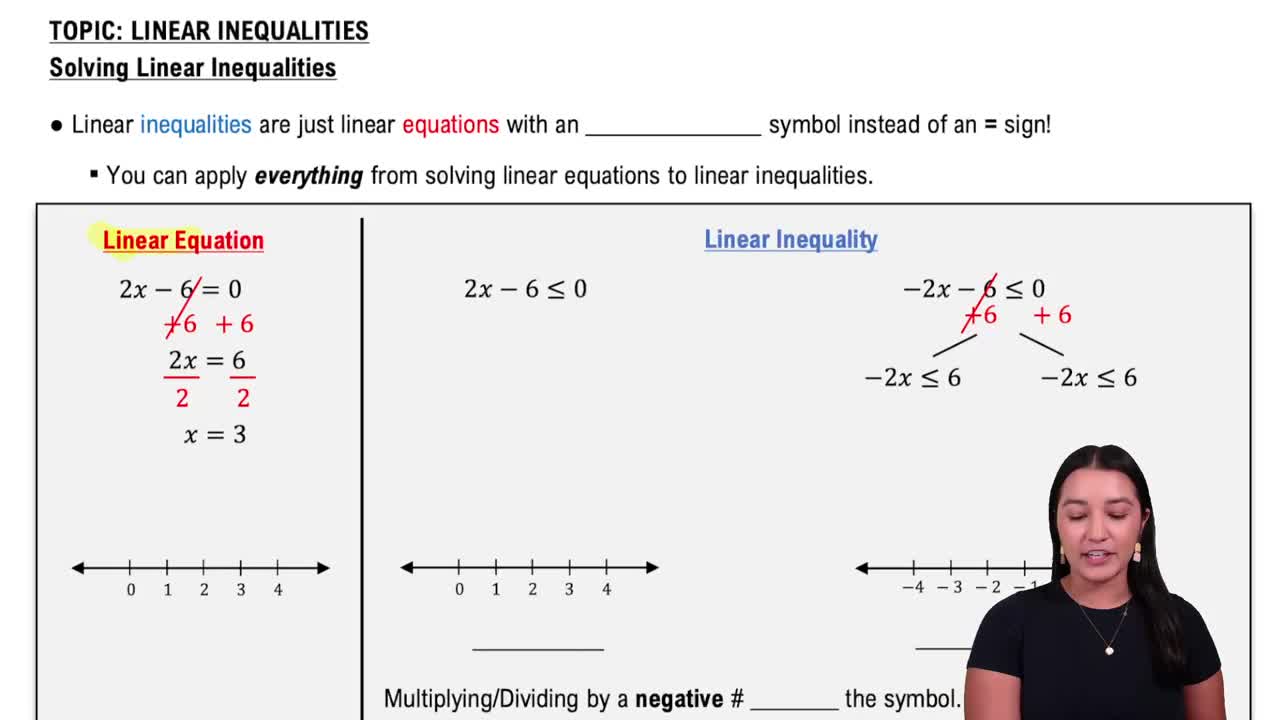
Inequalities are mathematical statements that express the relationship between two expressions that are not necessarily equal. They can be represented using symbols such as <, >, ≤, and ≥. Solving inequalities involves finding the values of the variable that make the inequality true, which often requires manipulating the inequality similarly to equations, while being mindful of the direction of the inequality when multiplying or dividing by negative numbers.
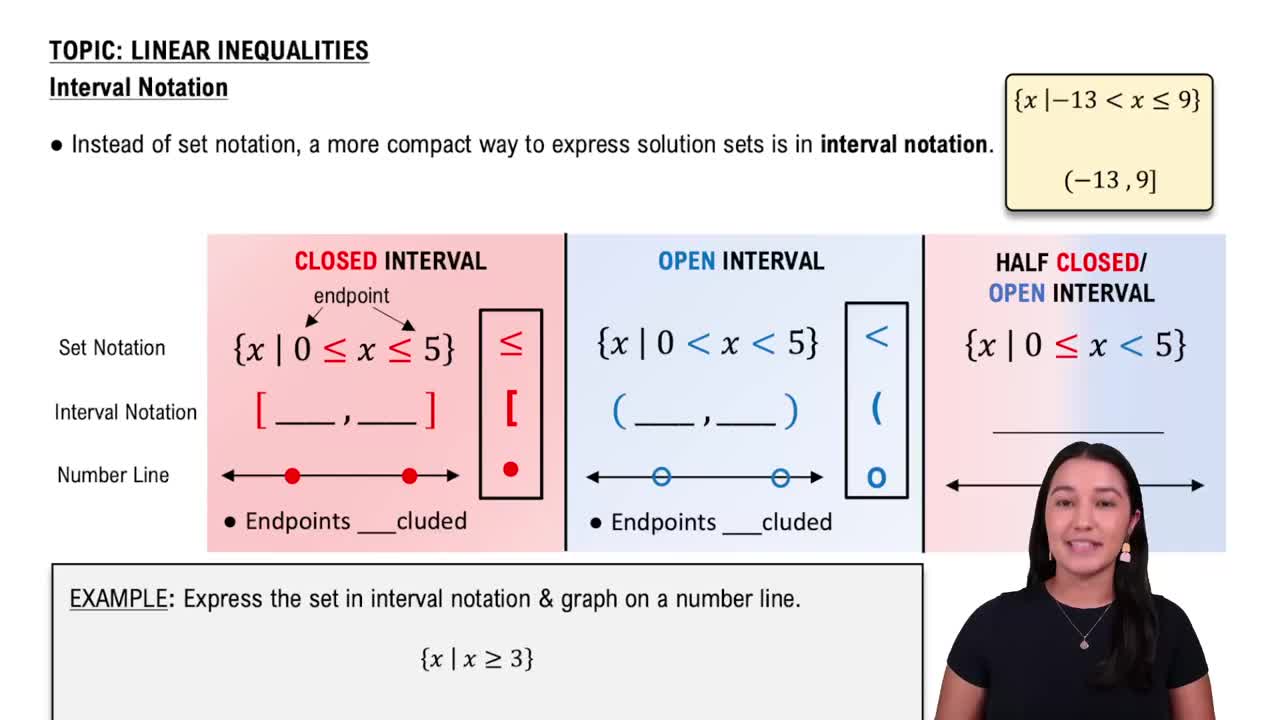
Interval notation is a way of representing a set of numbers between two endpoints. It uses parentheses and brackets to indicate whether the endpoints are included in the set. For example, (a, b) means all numbers between a and b, excluding a and b, while [a, b] includes both endpoints. This notation is particularly useful for expressing the solution sets of inequalities succinctly.
Compound inequalities involve two or more inequalities that are combined into one statement, often using the word 'and' or 'or'. In the given question, the compound inequality 1 ≤ (4x - 5)/2 < 9 requires solving both parts simultaneously. Understanding how to break down and solve each part is crucial for finding the overall solution set, which can then be expressed in interval notation.