In Exercises 29–44, simplify using the quotient rule.
_____
³√11/64
Verified step by step guidance
1
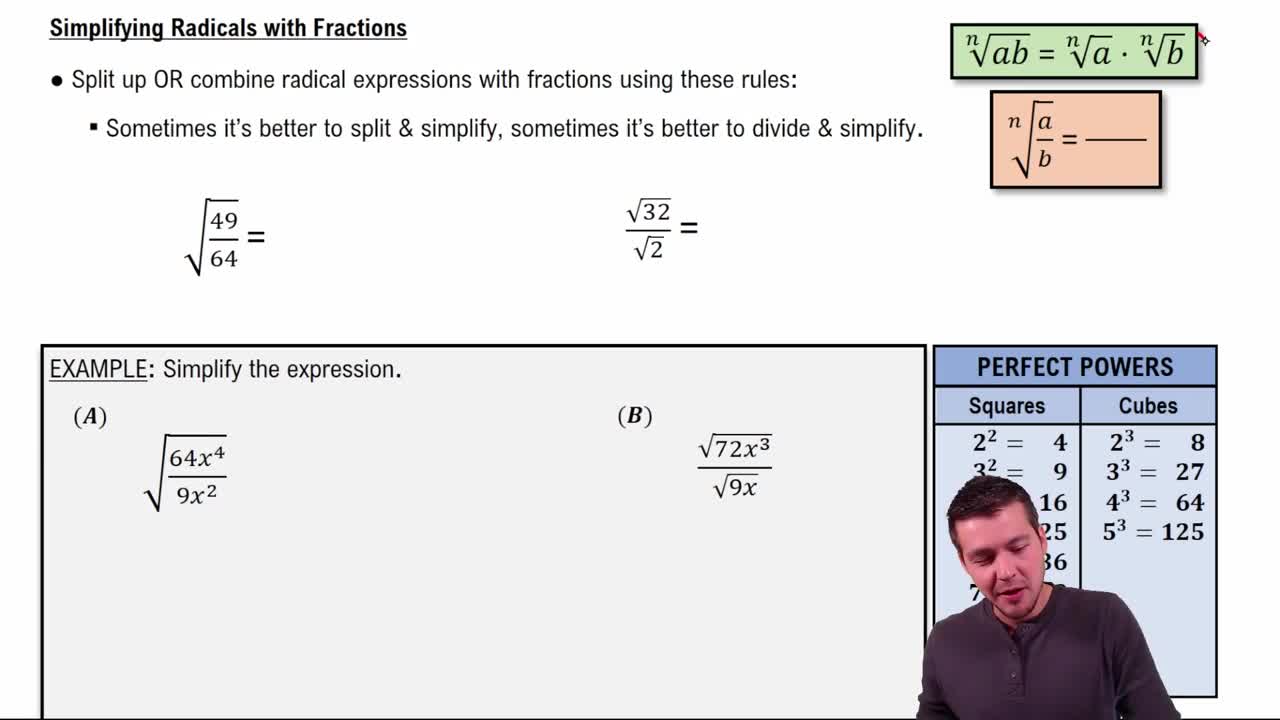
Identify the expression as a cube root of a fraction: \( \sqrt[3]{\frac{11}{64}} \).
Apply the quotient rule for radicals, which states that \( \sqrt[n]{\frac{a}{b}} = \frac{\sqrt[n]{a}}{\sqrt[n]{b}} \).
Separate the cube root of the fraction into the cube root of the numerator and the cube root of the denominator: \( \frac{\sqrt[3]{11}}{\sqrt[3]{64}} \).
Recognize that \( 64 \) is a perfect cube, specifically \( 4^3 \), so \( \sqrt[3]{64} = 4 \).
Express the simplified form as \( \frac{\sqrt[3]{11}}{4} \).
Verified video answer for a similar problem:
This video solution was recommended by our tutors as helpful for the problem above.
Video duration:
3m
Play a video:
0 Comments
Key Concepts
Here are the essential concepts you must grasp in order to answer the question correctly.
Quotient Rule
The quotient rule is a fundamental principle in algebra used to simplify expressions that involve division. It states that when dividing two powers with the same base, you subtract the exponents. This rule is essential for simplifying expressions like fractions, especially when dealing with roots or exponents.
Radical expressions involve roots, such as square roots or cube roots. In this context, the cube root (³√) indicates the number that, when multiplied by itself three times, gives the original number. Understanding how to manipulate and simplify radical expressions is crucial for solving problems involving roots.
Simplifying fractions involves reducing them to their lowest terms, which makes calculations easier and clearer. This process often includes factoring the numerator and denominator and canceling out common factors. Mastery of this concept is vital for effectively simplifying expressions like ³√(11/64).

 3:13 minutes
 Verified step by step guidance
 3:49
3:49