Table of contents
- 0. Review of Algebra4h 18m
- 1. Equations & Inequalities3h 18m
- 2. Graphs of Equations1h 43m
- 3. Functions2h 17m
- 4. Polynomial Functions1h 44m
- 5. Rational Functions1h 23m
- 6. Exponential & Logarithmic Functions2h 28m
- 7. Systems of Equations & Matrices4h 5m
- 8. Conic Sections2h 23m
- 9. Sequences, Series, & Induction1h 22m
- 10. Combinatorics & Probability1h 45m
4. Polynomial Functions
Zeros of Polynomial Functions
Problem 49
Textbook Question
For each polynomial function, find all zeros and their multiplicities. ƒ(x)=3x(x-2)(x+3)(x^2-1)
Verified step by step guidance1
Identify the factors of the polynomial function \( f(x) = 3x(x-2)(x+3)(x^2-1) \).
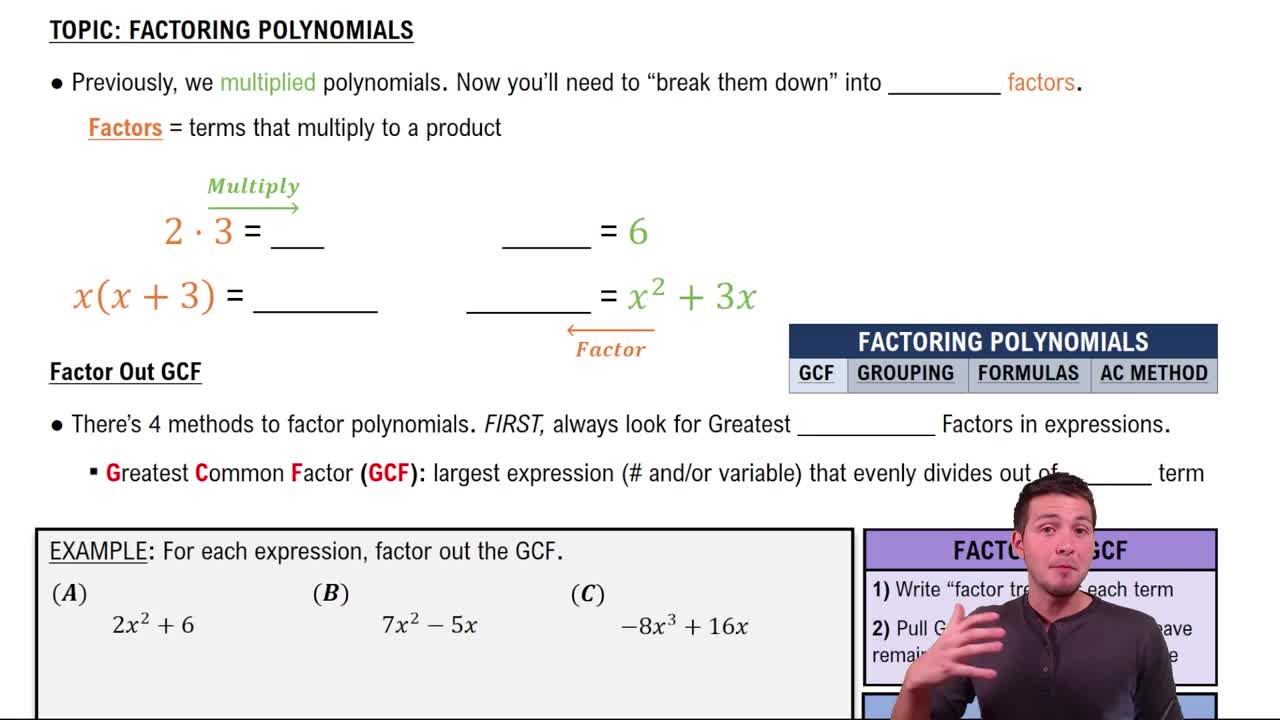
Recognize that \( x^2 - 1 \) is a difference of squares, which can be factored further as \( (x-1)(x+1) \).
Rewrite the polynomial as \( f(x) = 3x(x-2)(x+3)(x-1)(x+1) \).
Set each factor equal to zero to find the zeros: \( x = 0, x = 2, x = -3, x = 1, x = -1 \).
Determine the multiplicity of each zero by examining the exponents of the factors. Since each factor appears only once, each zero has a multiplicity of 1.
Verified video answer for a similar problem:This video solution was recommended by our tutors as helpful for the problem above
Video duration:
5mPlay a video:
Was this helpful?
Key Concepts
Here are the essential concepts you must grasp in order to answer the question correctly.
Polynomial Functions
A polynomial function is a mathematical expression involving a sum of powers in one or more variables multiplied by coefficients. The general form of a polynomial in one variable is f(x) = a_n*x^n + a_(n-1)*x^(n-1) + ... + a_1*x + a_0, where 'n' is a non-negative integer and 'a_n' is not zero. Understanding polynomial functions is crucial for analyzing their behavior, including finding zeros.
Recommended video:
Introduction to Polynomial Functions
Zeros of a Polynomial
The zeros of a polynomial function are the values of 'x' for which the function equals zero, i.e., f(x) = 0. These points are also known as roots and can be found by factoring the polynomial or using the quadratic formula for second-degree polynomials. Identifying zeros is essential for understanding the function's graph and its intersections with the x-axis.
Recommended video:
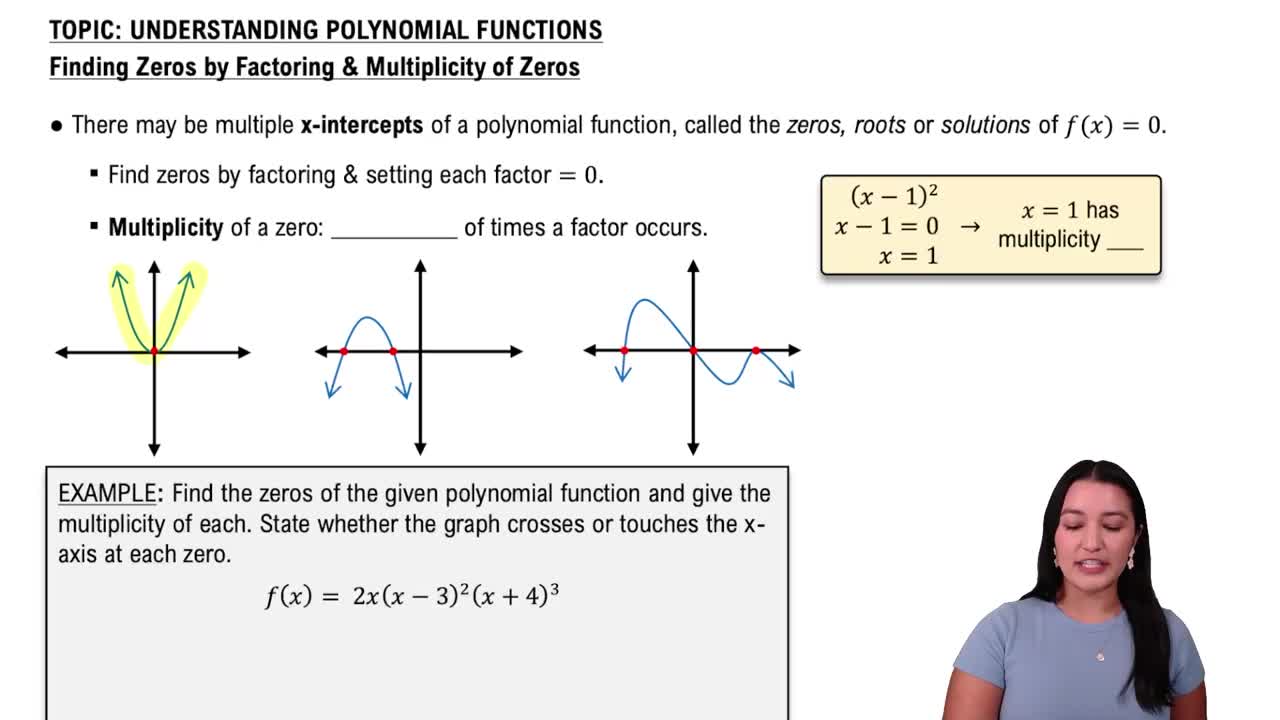
Finding Zeros & Their Multiplicity
Multiplicity of Zeros
The multiplicity of a zero refers to the number of times a particular root appears in the factorization of a polynomial. If a polynomial can be expressed as (x - r)^m, where 'r' is a root and 'm' is the multiplicity, then 'm' indicates how many times 'r' is a solution. The multiplicity affects the graph's behavior at the zero, such as whether the graph crosses or touches the x-axis.
Recommended video:
Finding Zeros & Their Multiplicity
Related Videos
Related Practice
Textbook Question
Solve each problem. Use Descartes' rule of signs to determine the different possibilities for the numbers of positive, negative, and nonreal complex zeros of ƒ(x)=x^3+3x^2-4x-2.
401
views