In Exercises 39–52, find all zeros of the polynomial function or solve the given polynomial equation. Use the Rational Zero Theorem, Descartes's Rule of Signs, and possibly the graph of the polynomial function shown by a graphing utility as an aid in obtaining the first zero or the first root. f(x)=3x4−11x3−x2+19x+6
Table of contents
- 0. Review of Algebra4h 18m
- 1. Equations & Inequalities3h 18m
- 2. Graphs of Equations1h 43m
- 3. Functions2h 17m
- 4. Polynomial Functions1h 44m
- 5. Rational Functions1h 23m
- 6. Exponential & Logarithmic Functions2h 28m
- 7. Systems of Equations & Matrices4h 5m
- 8. Conic Sections2h 23m
- 9. Sequences, Series, & Induction1h 22m
- 10. Combinatorics & Probability1h 45m
4. Polynomial Functions
Zeros of Polynomial Functions
Problem 61
Textbook Question
Find a polynomial function ƒ(x) of least degree having only real coefficients and zeros as given. Assume multiplicity 1 unless otherwise stated. See Examples 4–6. 5+i and 5-i
Verified step by step guidance1
Identify the complex zeros given in the problem, which are 5+i and 5-i.
Recognize that complex zeros occur in conjugate pairs. Since 5+i and 5-i are conjugates, they are both zeros of the polynomial.
Set up factors corresponding to these zeros. For a zero of 5+i, the factor is (x - (5+i)). For a zero of 5-i, the factor is (x - (5-i)).
Multiply these factors to find the polynomial. The multiplication is (x - (5+i))(x - (5-i)).
Expand and simplify the expression obtained in the previous step using the formula (a - b)(a + b) = a^2 - b^2, where a=x-5 and b=i, to find the polynomial of least degree.
Verified video answer for a similar problem:This video solution was recommended by our tutors as helpful for the problem above
Video duration:
6mPlay a video:
Was this helpful?
Key Concepts
Here are the essential concepts you must grasp in order to answer the question correctly.
Polynomial Functions
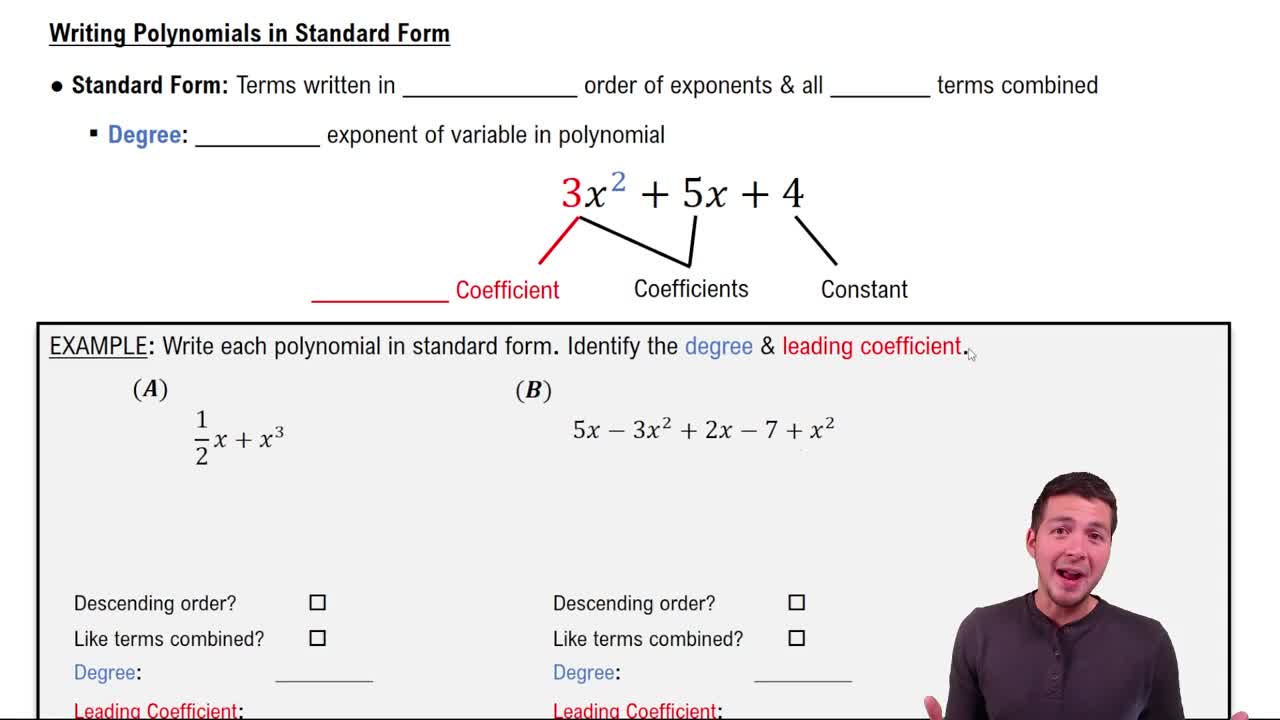
A polynomial function is a mathematical expression involving a sum of powers in one or more variables multiplied by coefficients. The general form of a polynomial in one variable x is given by f(x) = a_n*x^n + a_(n-1)*x^(n-1) + ... + a_1*x + a_0, where a_n, a_(n-1), ..., a_0 are constants and n is a non-negative integer. Understanding polynomial functions is essential for constructing and analyzing their properties, including their degree and zeros.
Recommended video:
Introduction to Polynomial Functions
Complex Conjugate Root Theorem
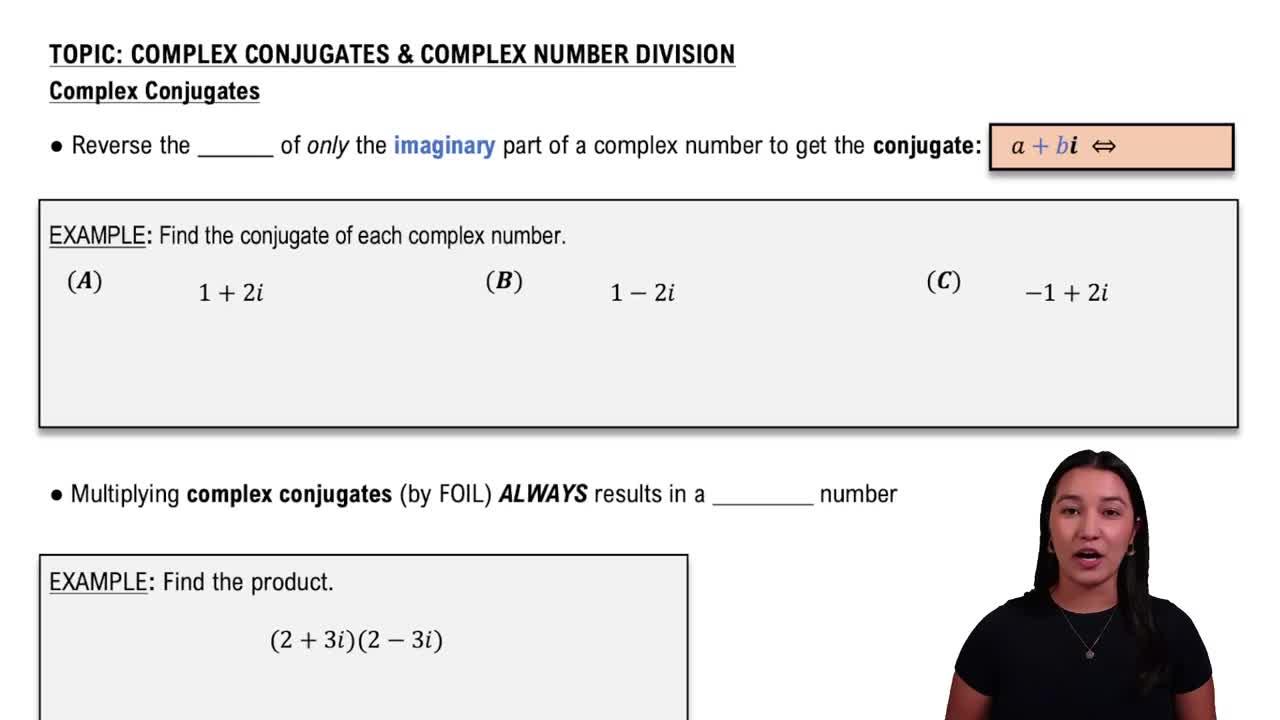
The Complex Conjugate Root Theorem states that if a polynomial has real coefficients, then any non-real complex roots must occur in conjugate pairs. For example, if 5+i is a root, then its conjugate 5-i must also be a root. This theorem is crucial for determining all the roots of a polynomial when given complex roots, ensuring that the polynomial remains a function with real coefficients.
Recommended video:
Complex Conjugates
Degree of a Polynomial
The degree of a polynomial is the highest power of the variable in the polynomial expression. It determines the polynomial's behavior, including the number of roots it can have and its end behavior as x approaches positive or negative infinity. In this context, finding a polynomial of least degree means constructing the simplest polynomial that satisfies the given roots, which directly relates to the number of roots and their multiplicities.
Recommended video:
Guided course
Standard Form of Polynomials
Related Videos
Related Practice
Textbook Question
861
views