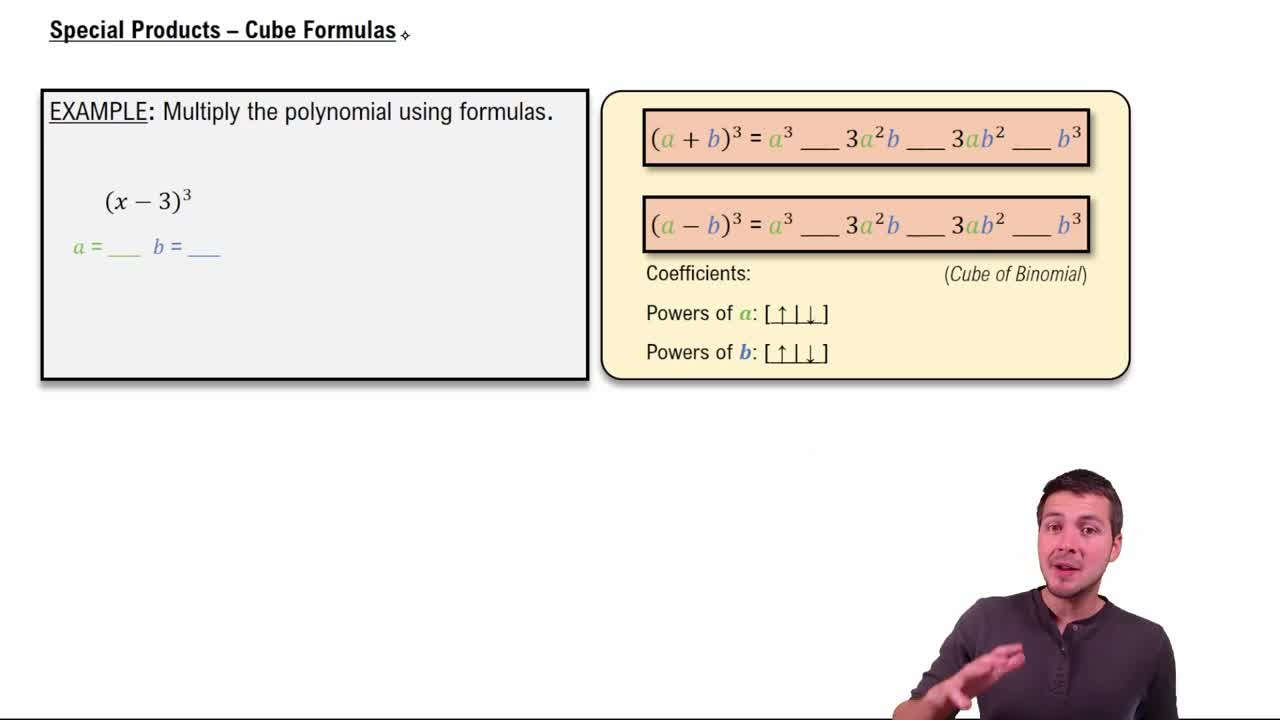
Substitute the coefficients and simplify each term: \(1 \cdot z^3 \cdot 1 + 3 \cdot z^2 \cdot (-3) + 3 \cdot z \cdot 9 + 1 \cdot 1 \cdot (-27)\).
Verified video answer for a similar problem:
This video solution was recommended by our tutors as helpful for the problem above
Video duration:
4m
Play a video:
Was this helpful?
Key Concepts
Here are the essential concepts you must grasp in order to answer the question correctly.
Binomial Expansion
Binomial expansion is a method used to expand expressions that are raised to a power, particularly those in the form of (a + b)^n. The expansion is achieved using the Binomial Theorem, which states that (a + b)^n = Σ (n choose k) * a^(n-k) * b^k, where k ranges from 0 to n. This theorem allows for systematic calculation of each term in the expansion.
A cubic function is a polynomial function of degree three, typically expressed in the form f(x) = ax^3 + bx^2 + cx + d. The graph of a cubic function can have one or two turning points and can exhibit various shapes, including inflection points. Understanding cubic functions is essential for analyzing their behavior and roots.
Factoring involves breaking down a polynomial into simpler components, which can help in finding its roots or solutions. For a cubic expression like (z - 3)^3, recognizing that it represents a repeated root is crucial. The roots of the polynomial indicate where the function intersects the x-axis, providing insight into its behavior and solutions.