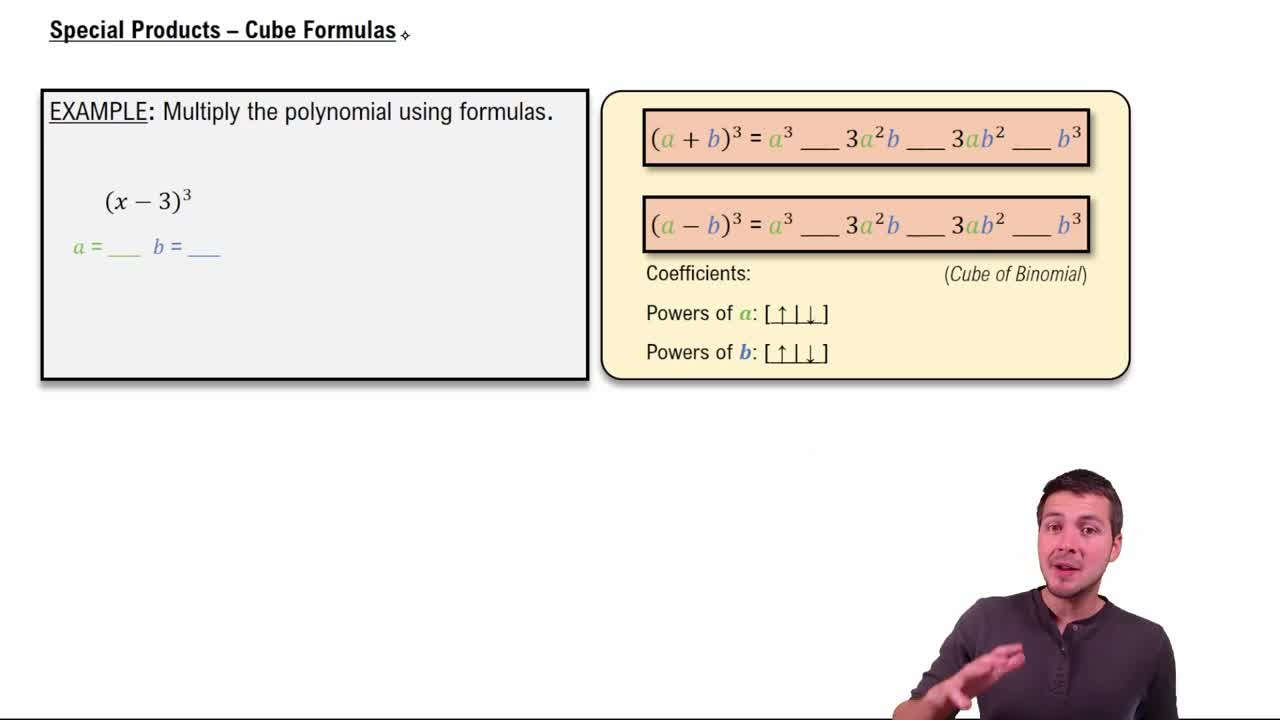
Recognize that the expression \((2x - 3)^3\) represents a binomial raised to the third power. To expand this, we can use the Binomial Theorem, which states \((a + b)^n = \sum_{k=0}^{n} \binom{n}{k} a^{n-k} b^k\).
Identify the components of the binomial: \(a = 2x\), \(b = -3\), and \(n = 3\).
Apply the Binomial Theorem to expand \((2x - 3)^3\): \((2x - 3)^3 = \binom{3}{0}(2x)^3(-3)^0 + \binom{3}{1}(2x)^2(-3)^1 + \binom{3}{2}(2x)^1(-3)^2 + \binom{3}{3}(2x)^0(-3)^3\).
Simplify each term in the expansion: \(\binom{3}{0}(2x)^3(-3)^0\), \(\binom{3}{1}(2x)^2(-3)^1\), \(\binom{3}{2}(2x)^1(-3)^2\), and \(\binom{3}{3}(2x)^0(-3)^3\). Use the binomial coefficients \(\binom{3}{k}\) and simplify powers of \(2x\) and \(-3\).
Combine all the simplified terms to write the expanded form of \((2x - 3)^3\).
Verified video answer for a similar problem:
This video solution was recommended by our tutors as helpful for the problem above
Video duration:
3m
Play a video:
Was this helpful?
Key Concepts
Here are the essential concepts you must grasp in order to answer the question correctly.
Binomial Expansion
Binomial expansion refers to the process of expanding expressions that are raised to a power, particularly those in the form of (a + b)^n. The expansion can be systematically achieved using the Binomial Theorem, which states that (a + b)^n = Σ (n choose k) * a^(n-k) * b^k, where k ranges from 0 to n. This theorem allows for the calculation of each term in the expansion without needing to multiply the binomial repeatedly.
Cubic expansion specifically deals with the expansion of a binomial raised to the third power, such as (a + b)^3. The result can be expressed as a^3 + 3a^2b + 3ab^2 + b^3. Understanding this pattern is crucial for efficiently calculating the product of a binomial raised to the third power, as it simplifies the process and avoids lengthy multiplication.
Polynomial Multiplication
Polynomial multiplication involves multiplying two or more polynomials to produce a new polynomial. This process requires distributing each term in one polynomial to every term in the other, often using the distributive property or the FOIL method for binomials. Mastery of polynomial multiplication is essential for solving problems like (2x - 3)^3, as it forms the basis for combining like terms and simplifying the resulting expression.