Understand the inequality \( |1.5x - 14| < 0 \). The absolute value \( |A| \) represents the distance of \( A \) from zero, which is always \( \geq 0 \).
Recall that the absolute value of any real number is never negative, so \( |1.5x - 14| < 0 \) means we are looking for values of \( x \) where the absolute value is less than zero.
Since absolute values cannot be negative, there are no real numbers \( x \) that satisfy \( |1.5x - 14| < 0 \).
Therefore, the solution set is empty, meaning no solution exists for this inequality.
In summary, inequalities of the form \( |expression| < 0 \) have no solutions because absolute values are always \( \geq 0 \).
Verified video answer for a similar problem:
This video solution was recommended by our tutors as helpful for the problem above
Video duration:
39s
Play a video:
Was this helpful?
Key Concepts
Here are the essential concepts you must grasp in order to answer the question correctly.
Absolute Value Inequalities
Absolute value inequalities involve expressions within absolute value bars, representing distance from zero. For inequalities like |A| < B, the solution requires B to be positive, and the expression A must lie between -B and B. Understanding how to interpret and manipulate these inequalities is essential for solving them.
The absolute value of a number is always non-negative, meaning |x| ≥ 0 for any real x. This property implies that an absolute value expression cannot be less than zero, which is crucial when determining if an inequality has solutions or not.
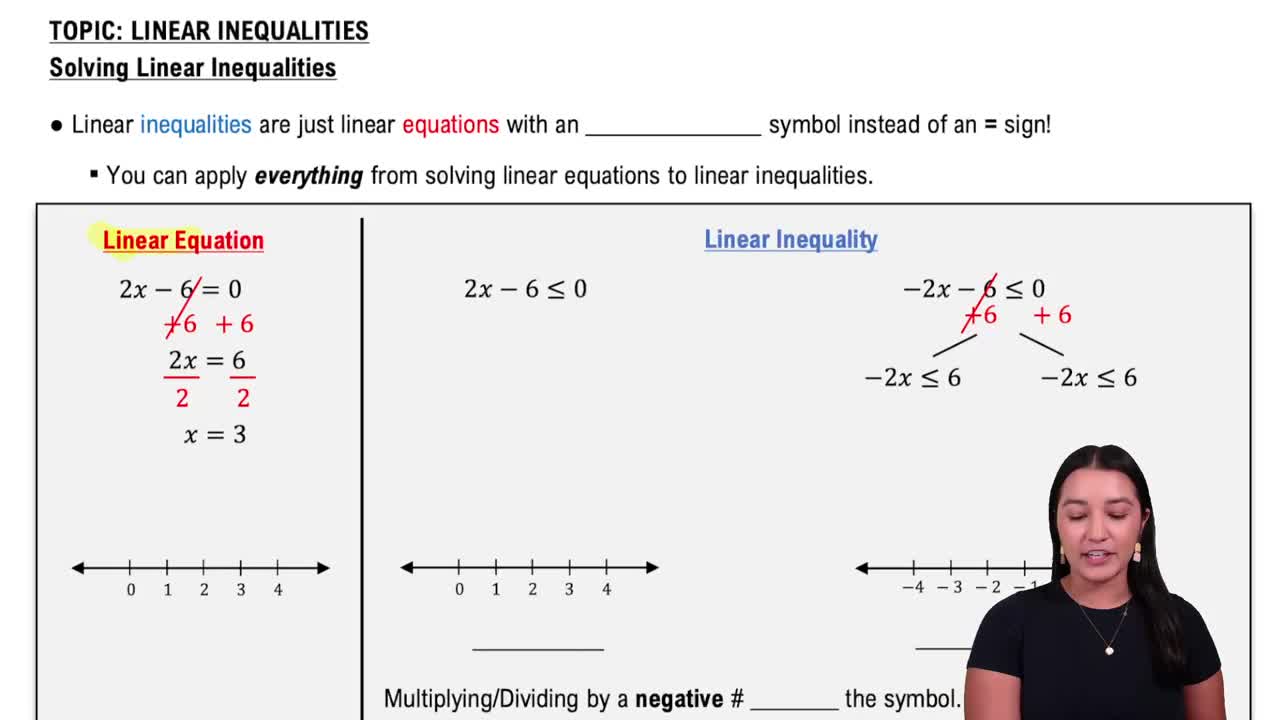
Solving linear inequalities involves isolating the variable on one side using algebraic operations while maintaining inequality direction. When combined with absolute value expressions, it requires careful consideration of the inequality's conditions to find valid solution sets or conclude no solution exists.