In Exercises 59–94, solve each absolute value inequality. |x - 1| ≤ 2
Verified step by step guidance
1
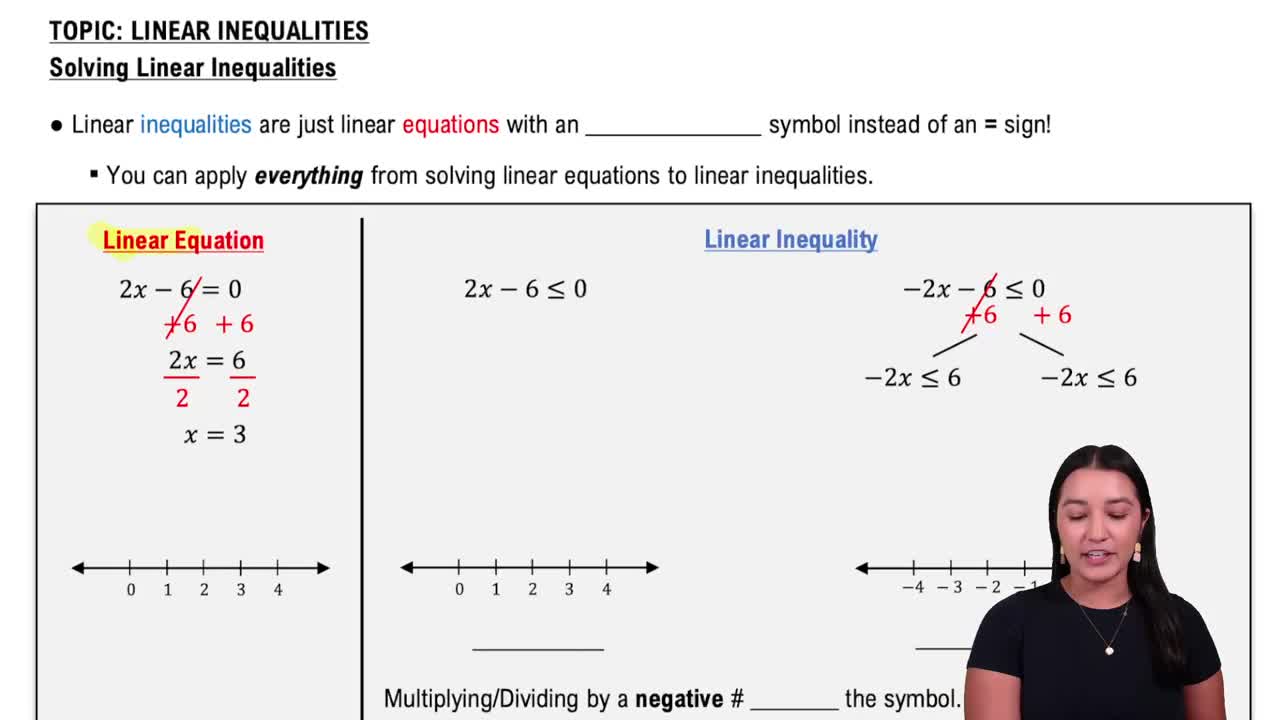
Recall that an absolute value inequality of the form \(|A| \leq B\) means that the expression inside the absolute value, \(A\), lies between \(-B\) and \(B\). So, rewrite the inequality \(|x - 1| \leq 2\) as a compound inequality: \(-2 \leq x - 1 \leq 2\).
Next, solve the compound inequality by isolating \(x\) in the middle. Add 1 to all three parts of the inequality: \(-2 + 1 \leq x - 1 + 1 \leq 2 + 1\), which simplifies to \(-1 \leq x \leq 3\).
Interpret the solution: \(x\) can be any value between \(-1\) and \$3$, inclusive, because the original inequality uses the 'less than or equal to' symbol.
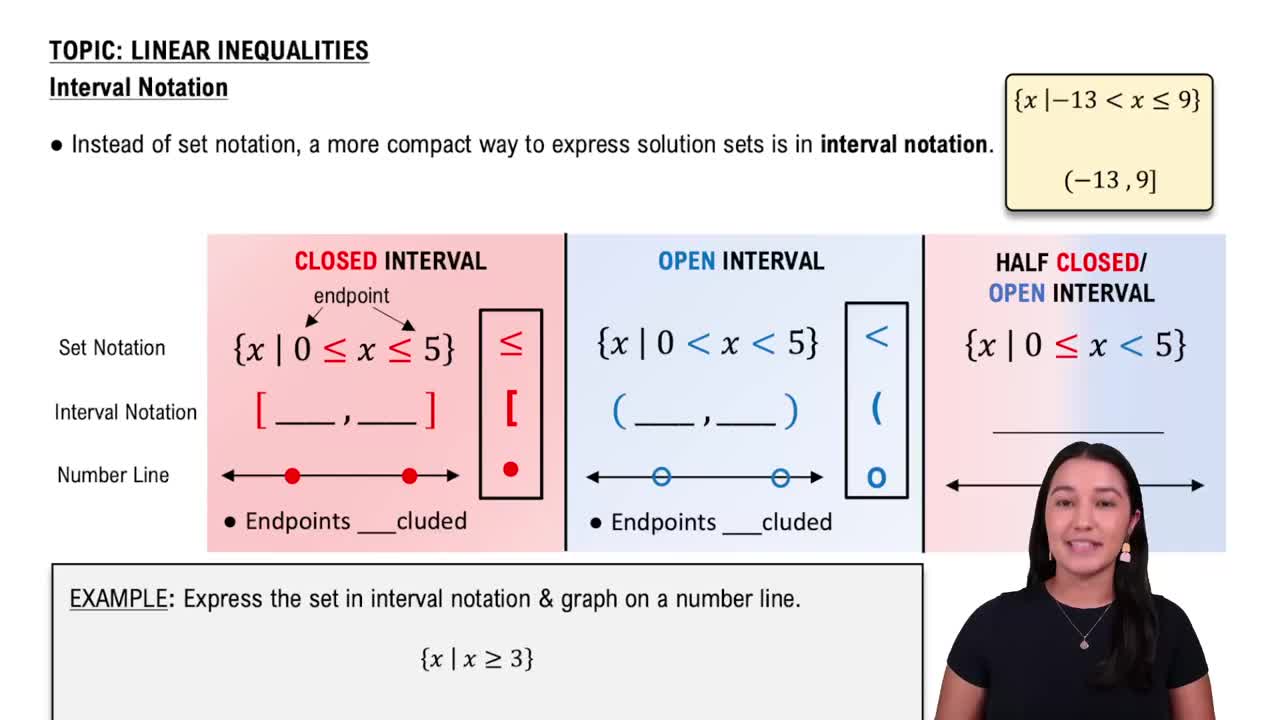
Express the solution in interval notation as \([-1, 3]\), which represents all real numbers \(x\) such that \(-1 \leq x \leq 3\).
Optionally, you can graph the solution on a number line by shading the region between \(-1\) and \$3$, including the endpoints.
Verified video answer for a similar problem:
This video solution was recommended by our tutors as helpful for the problem above
Video duration:
3m
Play a video:
Was this helpful?
Key Concepts
Here are the essential concepts you must grasp in order to answer the question correctly.
Absolute Value Definition
The absolute value of a number represents its distance from zero on the number line, always as a non-negative value. For any real number x, |x| equals x if x is positive or zero, and -x if x is negative. Understanding this helps interpret expressions like |x - 1| as the distance between x and 1.
An inequality involving absolute value, such as |A| ≤ B, can be rewritten as a compound inequality: -B ≤ A ≤ B, provided B is non-negative. This allows the absolute value inequality to be solved by considering the range of values A can take within these bounds.
After rewriting the absolute value inequality as a compound inequality, solving it involves isolating the variable and expressing the solution as an interval. Interval notation concisely represents all values satisfying the inequality, for example, x ∈ [a, b], indicating x lies between a and b inclusive.