Simplify each expression. Write answers without negative exponents. Assume all vari-ables represent positive real numbers. See Examples 8 and 9. (27/64)-4/3
Table of contents
- 0. Review of Algebra4h 18m
- 1. Equations & Inequalities3h 18m
- 2. Graphs of Equations1h 43m
- 3. Functions2h 17m
- 4. Polynomial Functions1h 44m
- 5. Rational Functions1h 23m
- 6. Exponential & Logarithmic Functions2h 28m
- 7. Systems of Equations & Matrices4h 5m
- 8. Conic Sections2h 23m
- 9. Sequences, Series, & Induction1h 22m
- 10. Combinatorics & Probability1h 45m
0. Review of Algebra
Rational Exponents
Problem 114
Textbook Question
Calculate each value mentally. (0.13/2)(903/2)
Verified step by step guidance1
Recognize that the expression is a product of two terms raised to fractional exponents: \((0.1^{3/2})(90^{3/2})\).
Recall the property of exponents that allows you to combine terms with the same exponent: \(a^{m} \times b^{m} = (ab)^{m}\). Apply this to rewrite the expression as \((0.1 \times 90)^{3/2}\).
Calculate the product inside the parentheses: \$0.1 \times 90$.
Rewrite the expression as a single term raised to the power \(\frac{3}{2}\): \((9)^{3/2}\).
Understand that the fractional exponent \(\frac{3}{2}\) means you take the square root (denominator 2) and then cube the result (numerator 3), or vice versa. So, calculate \(\sqrt{9}\) first, then raise that result to the power of 3.
Verified video answer for a similar problem:This video solution was recommended by our tutors as helpful for the problem above
Video duration:
4mPlay a video:
Was this helpful?
Key Concepts
Here are the essential concepts you must grasp in order to answer the question correctly.
Exponents and Powers
Exponents indicate how many times a base number is multiplied by itself. For example, a^b means multiplying 'a' by itself 'b' times. Understanding how to work with fractional exponents, such as 3/2, is essential for simplifying expressions.
Recommended video:
Powers of i
Fractional Exponents
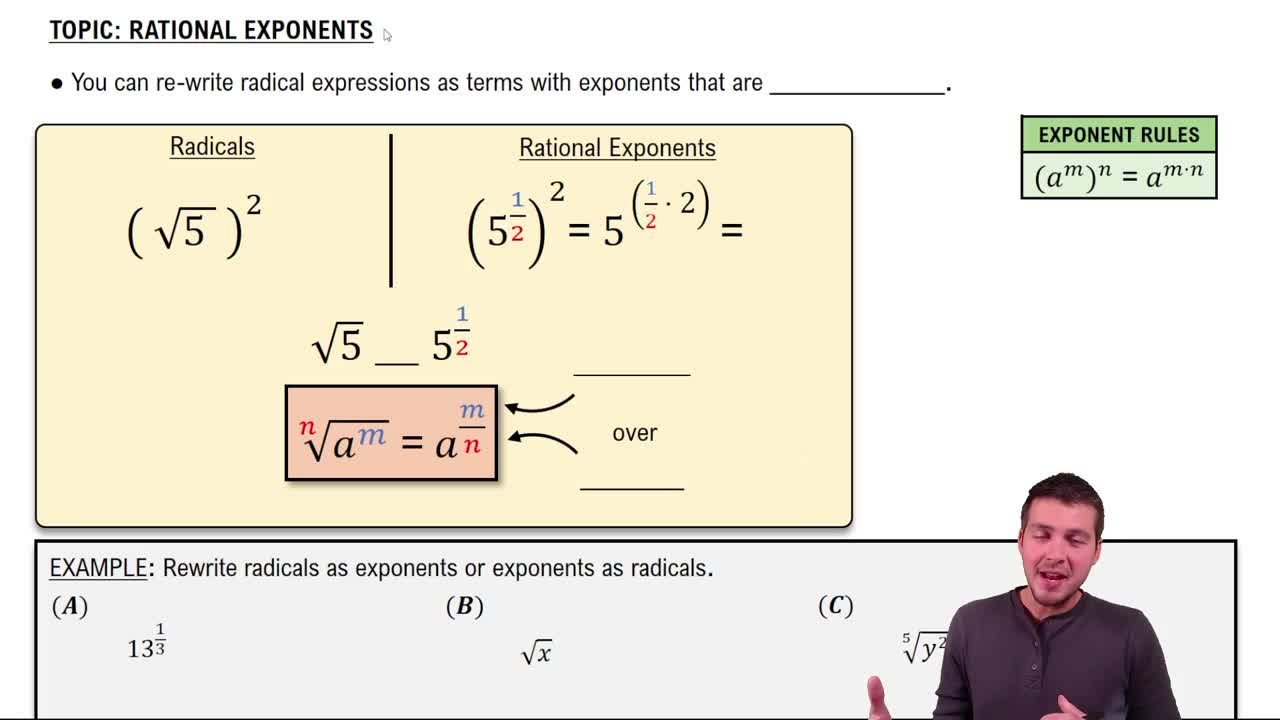
A fractional exponent like 3/2 represents both a power and a root: a^(3/2) equals the square root of a cubed, or (√a)^3. This concept helps in rewriting and simplifying expressions involving roots and powers.
Recommended video:
Guided course
Rational Exponents
Properties of Exponents in Multiplication
When multiplying expressions with the same exponent, such as (a^m)(b^m), the result can be written as (ab)^m. This property allows combining terms efficiently, which is useful for mental calculation and simplification.
Recommended video:
Guided course
Introduction to Exponent Rules
Related Videos
Related Practice
Textbook Question
511
views