Solve each inequality. Give the solution set in interval notation. See Examples 1 and 2. 3(x+5)+1≥5+3x
Verified step by step guidance
1
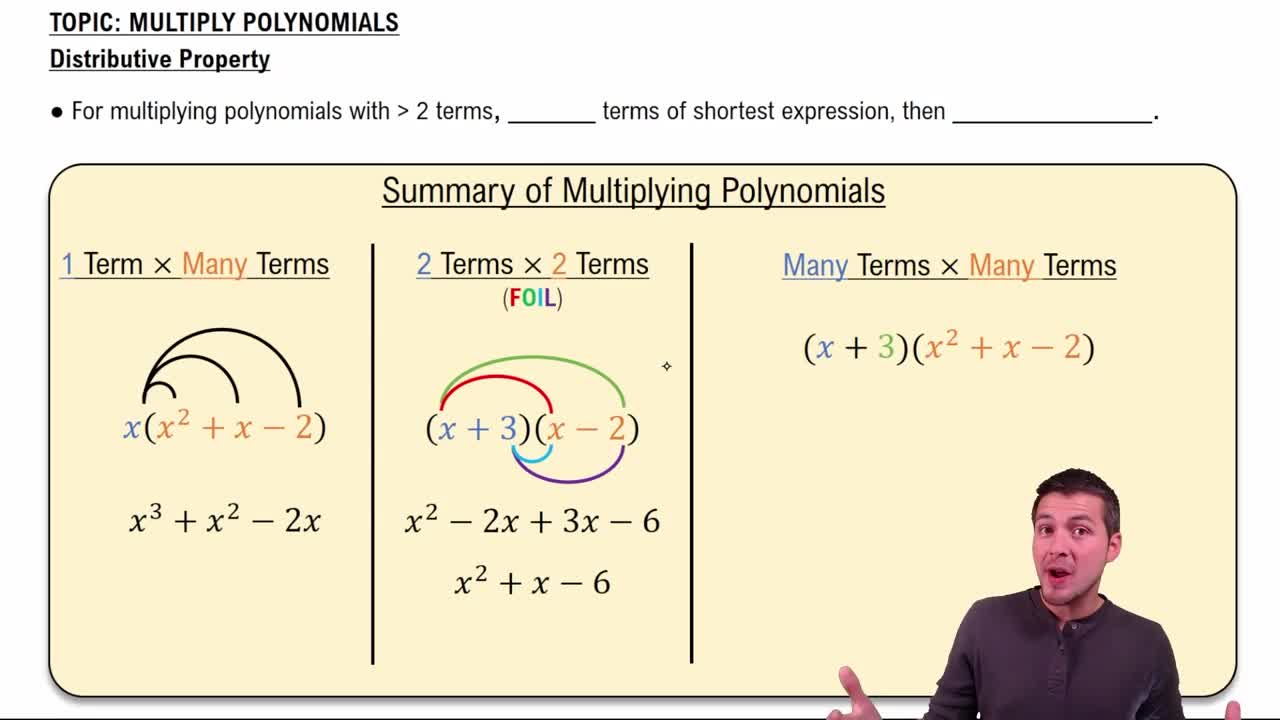
Start by distributing the 3 on the left side: 3(x+5) becomes 3x + 15.
Add 1 to the result from the distribution: 3x + 15 + 1 becomes 3x + 16.
Set up the inequality: 3x + 16 \geq 5 + 3x.
Subtract 3x from both sides to simplify: 3x + 16 - 3x \geq 5 + 3x - 3x.
Simplify the inequality to find the solution set.
Verified video answer for a similar problem:
This video solution was recommended by our tutors as helpful for the problem above
Video duration:
2m
Play a video:
Was this helpful?
Key Concepts
Here are the essential concepts you must grasp in order to answer the question correctly.
Inequalities
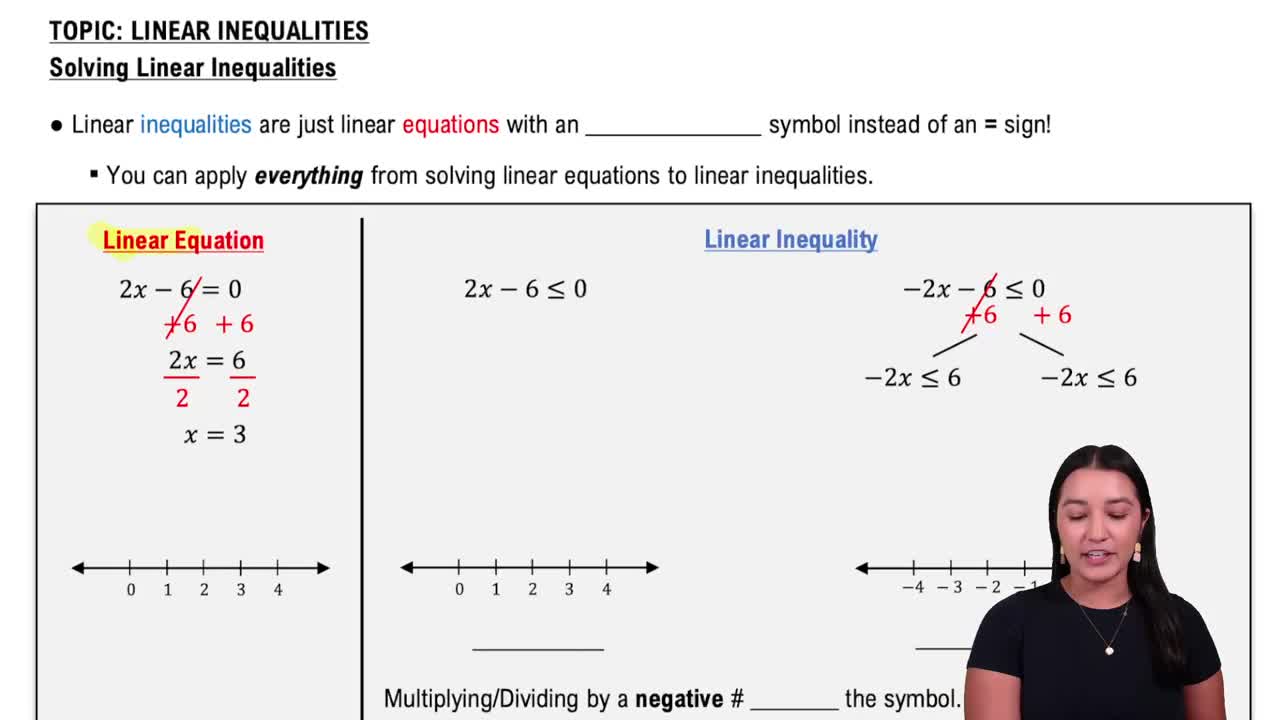
Inequalities are mathematical statements that express the relationship between two expressions that are not necessarily equal. They use symbols such as '≥' (greater than or equal to), '≤' (less than or equal to), '>' (greater than), and '<' (less than). Solving inequalities involves finding the values of the variable that make the inequality true.
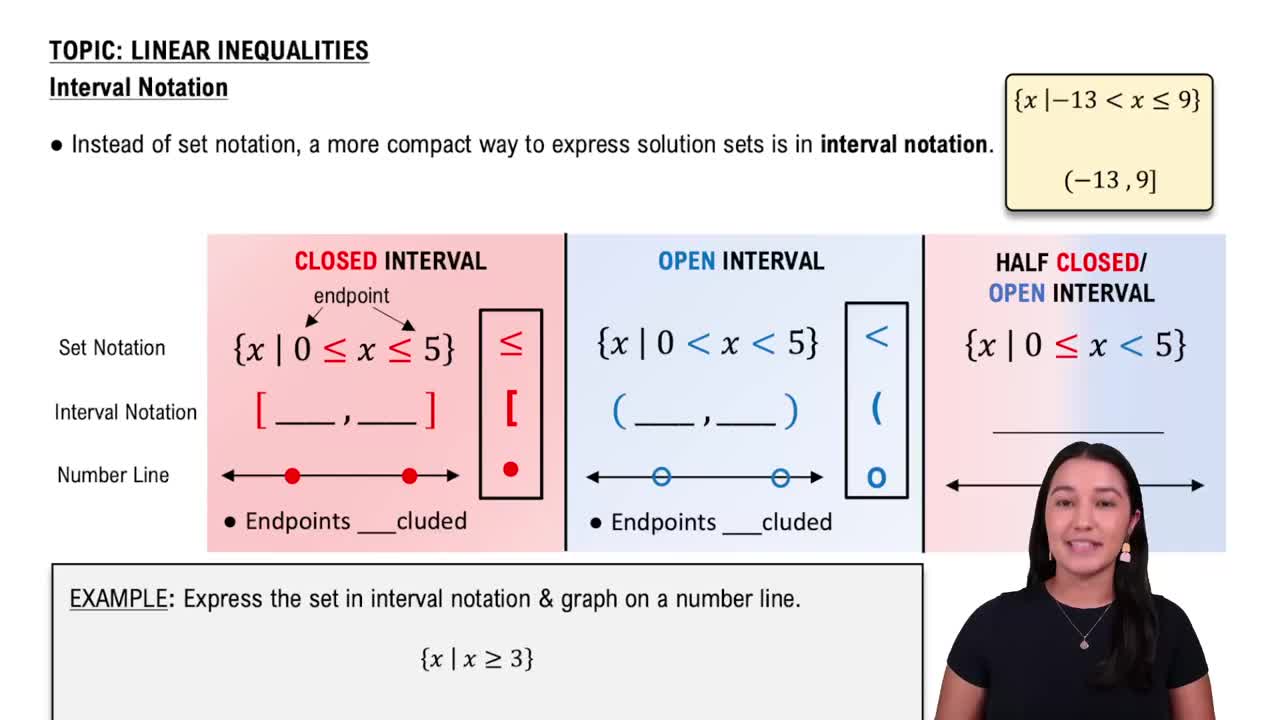
Interval notation is a way of representing a set of numbers between two endpoints. It uses brackets [ ] to include endpoints and parentheses ( ) to exclude them. For example, the interval [2, 5) includes 2 and all numbers up to but not including 5. This notation is particularly useful for expressing the solution sets of inequalities.
Algebraic manipulation involves applying various algebraic techniques to simplify or solve equations and inequalities. This includes operations such as distributing, combining like terms, and isolating the variable. Mastery of these techniques is essential for effectively solving inequalities and understanding their solutions.