In Exercises 15–26, use graphs to find each set. (- ∞, 5) ∩ [1, 8)
Verified step by step guidance
1
Understand the problem: You are asked to find the intersection of two intervals, \((-\infty, 5)\) and \([1, 8)\), which means finding all the numbers that belong to both intervals simultaneously.
Recall the meaning of each interval: \((-\infty, 5)\) includes all real numbers less than 5, but not 5 itself; \([1, 8)\) includes all real numbers from 1 up to but not including 8.
Visualize the intervals on a number line: Draw \((-\infty, 5)\) as a ray extending left from 5 (not including 5), and \([1, 8)\) as a segment starting at 1 (including 1) and extending to just before 8.
Identify the overlap (intersection) of these intervals: The intersection consists of all numbers that are both less than 5 and greater than or equal to 1.
Write the intersection interval using interval notation: Combine the conditions to express the intersection as \([1, 5)\), which includes 1 but excludes 5.
Verified video answer for a similar problem:
This video solution was recommended by our tutors as helpful for the problem above
Video duration:
3m
Play a video:
Was this helpful?
Key Concepts
Here are the essential concepts you must grasp in order to answer the question correctly.
Interval Notation
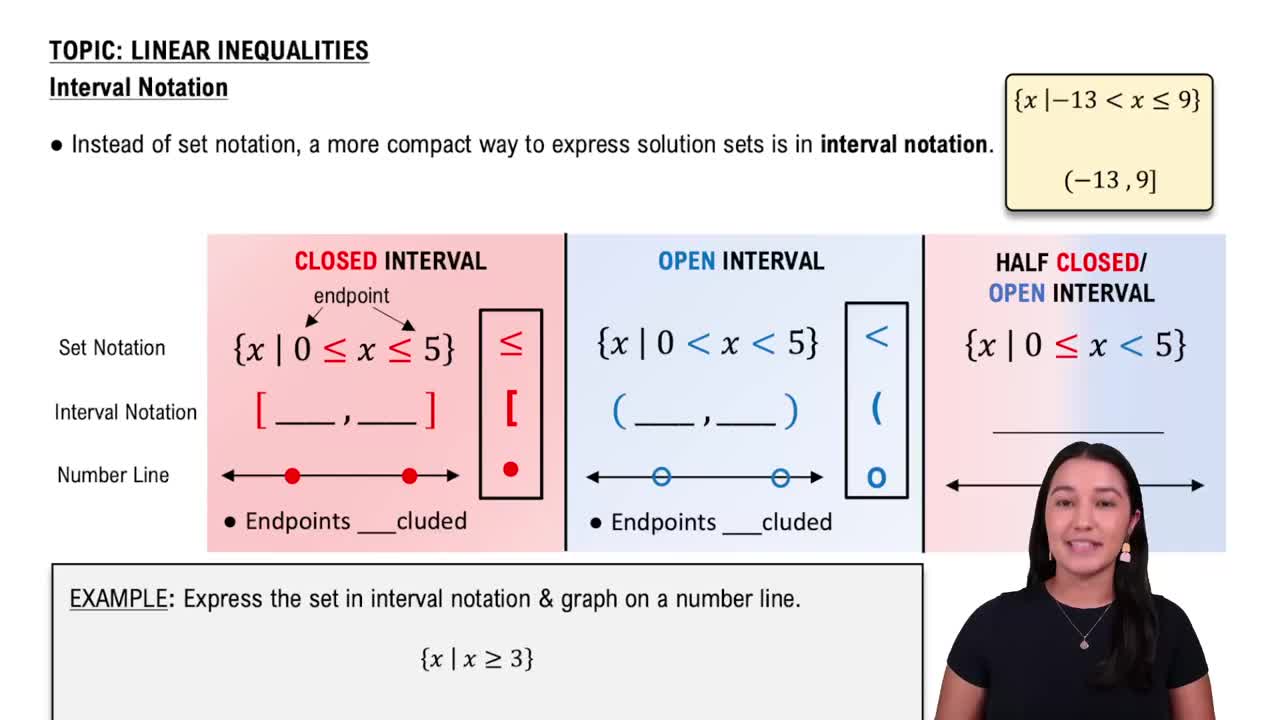
Interval notation is a way to represent sets of real numbers using parentheses and brackets. Parentheses, like ( or ), indicate that an endpoint is not included (open interval), while brackets, like [ or ], indicate inclusion (closed interval). For example, (-∞, 5) includes all numbers less than 5 but not 5 itself.
The intersection of two sets includes all elements that are common to both sets. In interval notation, the intersection of intervals is the overlapping region where both intervals share values. For example, the intersection of (-∞, 5) and [1, 8) includes all numbers greater than or equal to 1 and less than 5.
Graphing intervals involves shading the portion of the number line that represents the set. Open endpoints are shown with open circles, and closed endpoints with filled circles. Visualizing intervals helps identify overlaps and intersections, making it easier to find the common set between intervals.