Solve each inequality. Give the solution set in interval notation. See Examples 1 and 2. 2-4x+5(x-1)<-6(x-2)
Verified step by step guidance
1
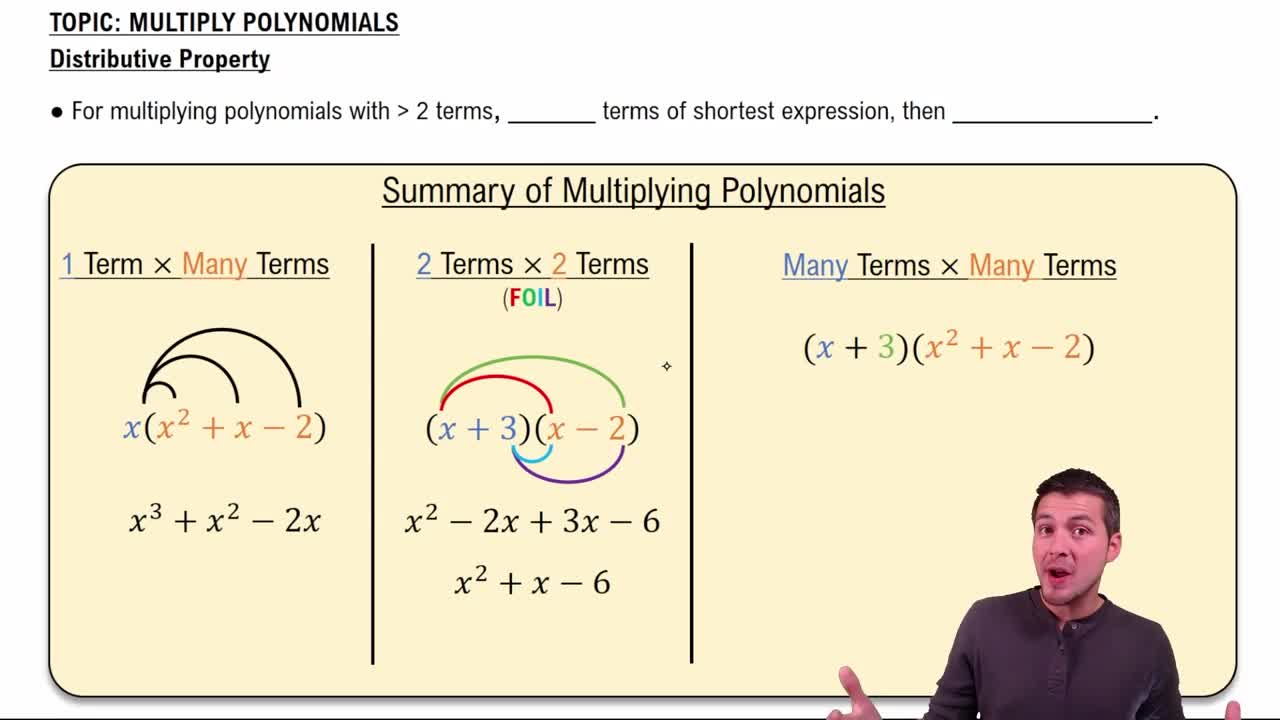
Distribute the terms on both sides of the inequality: \(2 - 4x + 5(x - 1) < -6(x - 2)\).
Simplify each side by distributing: \(2 - 4x + 5x - 5 < -6x + 12\).
Combine like terms on the left side: \(2 + x - 5 < -6x + 12\).
Combine constants on the left side: \(x - 3 < -6x + 12\).
Add \(6x\) to both sides to isolate \(x\): \(x + 6x - 3 < 12\).
Verified video answer for a similar problem:
This video solution was recommended by our tutors as helpful for the problem above
Video duration:
3m
Play a video:
Was this helpful?
Key Concepts
Here are the essential concepts you must grasp in order to answer the question correctly.
Inequalities
Inequalities are mathematical statements that express the relationship between two expressions that are not necessarily equal. They use symbols such as <, >, ≤, and ≥ to indicate whether one side is less than, greater than, or equal to the other. Understanding how to manipulate and solve inequalities is crucial for finding solution sets.
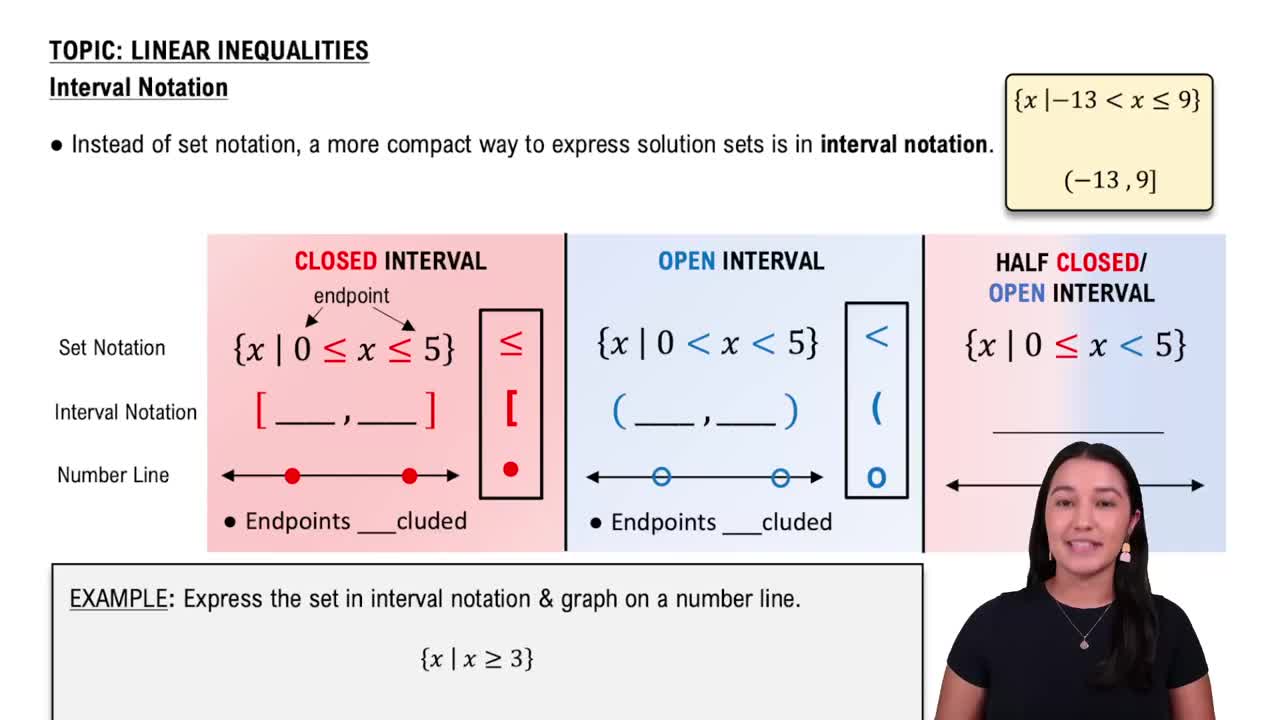
Interval notation is a way of representing a set of numbers between two endpoints. It uses parentheses and brackets to indicate whether the endpoints are included (closed interval) or excluded (open interval). For example, (a, b) means all numbers between a and b, not including a and b, while [a, b] includes both endpoints.
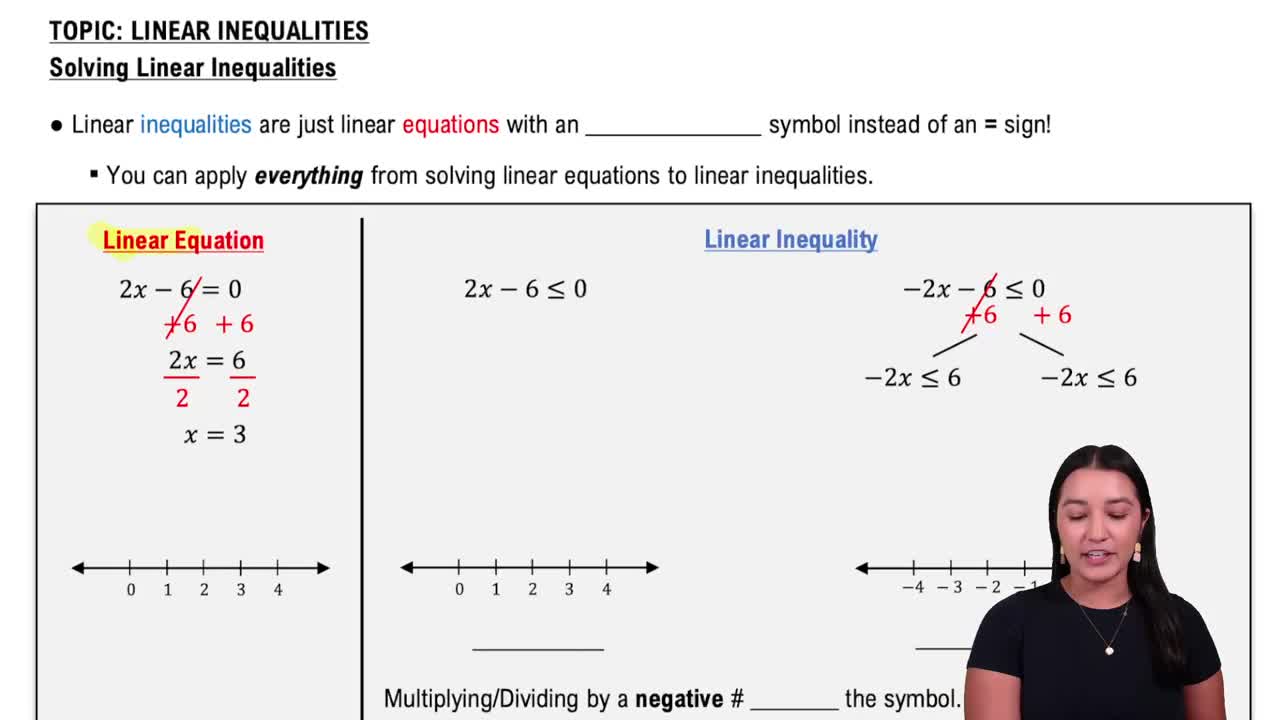
Solving linear inequalities involves isolating the variable on one side of the inequality sign, similar to solving linear equations. However, one must be cautious when multiplying or dividing by a negative number, as it reverses the inequality sign. This process often leads to determining the range of values that satisfy the inequality.