Use the graph to solve each equation or inequality. Use interval notation where appropriate. 7x(x - 1)(x - 2) ≥ 0
Table of contents
- 0. Review of Algebra4h 18m
- 1. Equations & Inequalities3h 18m
- 2. Graphs of Equations1h 43m
- 3. Functions2h 17m
- 4. Polynomial Functions1h 44m
- 5. Rational Functions1h 23m
- 6. Exponential & Logarithmic Functions2h 28m
- 7. Systems of Equations & Matrices4h 5m
- 8. Conic Sections2h 23m
- 9. Sequences, Series, & Induction1h 22m
- 10. Combinatorics & Probability1h 45m
1. Equations & Inequalities
Linear Inequalities
Problem 10
Textbook Question
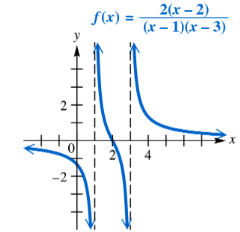
Use the graph to solve each equation or inequality. Use interval notation where appropriate. 2(X-2) / {(X-1)(X-3)} ≤ 0

Verified step by step guidance1
Identify the critical points of the function from the expression \(\frac{2(X-2)}{(X-1)(X-3)}\). These points are where the numerator or denominator equals zero: \(X=2\) (numerator zero), \(X=1\) and \(X=3\) (denominator zero, vertical asymptotes).
Use the graph to determine the sign of the function \(\frac{2(X-2)}{(X-1)(X-3)}\) in the intervals determined by the critical points: \((-\infty, 1)\), \((1, 2)\), \((2, 3)\), and \((3, \infty)\).
Check where the function is less than or equal to zero (\(\leq 0\)). This includes intervals where the graph is below or on the x-axis. Note that the function is undefined at \(X=1\) and \(X=3\) due to vertical asymptotes, so these points are excluded from the solution.
Include the point \(X=2\) in the solution since the numerator is zero there, making the function equal to zero, which satisfies the inequality.
Write the solution in interval notation by combining the intervals where the function is negative or zero, excluding points where the function is undefined.
Verified video answer for a similar problem:This video solution was recommended by our tutors as helpful for the problem above
Video duration:
6mPlay a video:
Was this helpful?
Key Concepts
Here are the essential concepts you must grasp in order to answer the question correctly.
Rational Functions and Their Graphs
A rational function is a ratio of two polynomials, and its graph can have vertical asymptotes where the denominator is zero. Understanding how to identify these asymptotes and the behavior of the function near them is crucial for analyzing the graph and solving inequalities involving rational expressions.
Recommended video:
How to Graph Rational Functions
Solving Inequalities Using Graphs
To solve inequalities like f(x) ≤ 0 using a graph, identify where the function is below or on the x-axis. The x-values corresponding to these regions form the solution set, which can be expressed in interval notation. This visual approach helps in understanding the solution without algebraic manipulation.
Recommended video:
Guided course
Linear Inequalities
Interval Notation and Domain Restrictions
Interval notation is a concise way to represent sets of real numbers, especially solutions to inequalities. When dealing with rational functions, domain restrictions occur at values that make the denominator zero, which must be excluded from the solution set. Recognizing these restrictions ensures the solution is mathematically valid.
Recommended video:
Interval Notation
Related Videos
Related Practice
Textbook Question
390
views