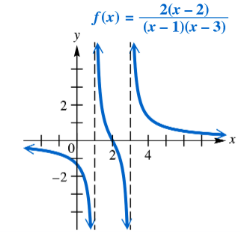
Use the graph to solve each equation or inequality. Use interval notation where appropriate. 7x(x - 1)(x - 2) > 0
Table of contents
- 0. Review of Algebra4h 18m
- 1. Equations & Inequalities3h 18m
- 2. Graphs of Equations1h 43m
- 3. Functions2h 17m
- 4. Polynomial Functions1h 44m
- 5. Rational Functions1h 23m
- 6. Exponential & Logarithmic Functions2h 28m
- 7. Systems of Equations & Matrices4h 5m
- 8. Conic Sections2h 23m
- 9. Sequences, Series, & Induction1h 22m
- 10. Combinatorics & Probability1h 45m
1. Equations & Inequalities
Linear Inequalities
Problem 9
Textbook Question
Use the graph to solve each equation or inequality. Use interval notation where appropriate. 2(X-2) / {(X-1)(X-3)} > 0

Verified step by step guidance1
Identify the critical points of the function \( f(x) = \frac{2(x-2)}{(x-1)(x-3)} \). These occur where the numerator or denominator is zero: set \( 2(x-2) = 0 \) and \( (x-1)(x-3) = 0 \). This gives critical points at \( x = 2 \), \( x = 1 \), and \( x = 3 \).
Divide the number line into intervals based on these critical points: \( (-\infty, 1) \), \( (1, 2) \), \( (2, 3) \), and \( (3, \infty) \).
Determine the sign of the function \( f(x) \) on each interval by choosing a test point from each interval and substituting it into the function \( f(x) = \frac{2(x-2)}{(x-1)(x-3)} \).
Use the graph to verify the sign of the function on each interval. The graph shows where the function is above the x-axis (positive) and below the x-axis (negative).
Write the solution to the inequality \( \frac{2(x-2)}{(x-1)(x-3)} > 0 \) by including the intervals where the function is positive, excluding points where the function is undefined (vertical asymptotes at \( x=1 \) and \( x=3 \)). Express the solution in interval notation.
Verified video answer for a similar problem:This video solution was recommended by our tutors as helpful for the problem above
Video duration:
4mPlay a video:
Was this helpful?
Key Concepts
Here are the essential concepts you must grasp in order to answer the question correctly.
Rational Inequalities
Rational inequalities involve expressions where one polynomial is divided by another, and the inequality compares this ratio to zero or another value. Solving them requires finding where the rational expression is positive, negative, or zero by analyzing the signs of numerator and denominator.
Recommended video:
Guided course
Nonlinear Inequalities
Critical Points and Domain Restrictions
Critical points occur where the numerator or denominator equals zero, causing the rational expression to be zero or undefined. These points divide the number line into intervals to test the inequality. Domain restrictions exclude values making the denominator zero, as the function is undefined there.
Recommended video:
Domain Restrictions of Composed Functions
Graph Interpretation for Inequalities
Graphs of rational functions help visualize where the function is positive or negative by showing the curve's position relative to the x-axis. Intervals where the graph lies above the x-axis correspond to positive values, aiding in solving inequalities by identifying solution intervals.
Recommended video:
Guided course
Linear Inequalities
Related Videos
Related Practice
Textbook Question
380
views