
Textbook Question
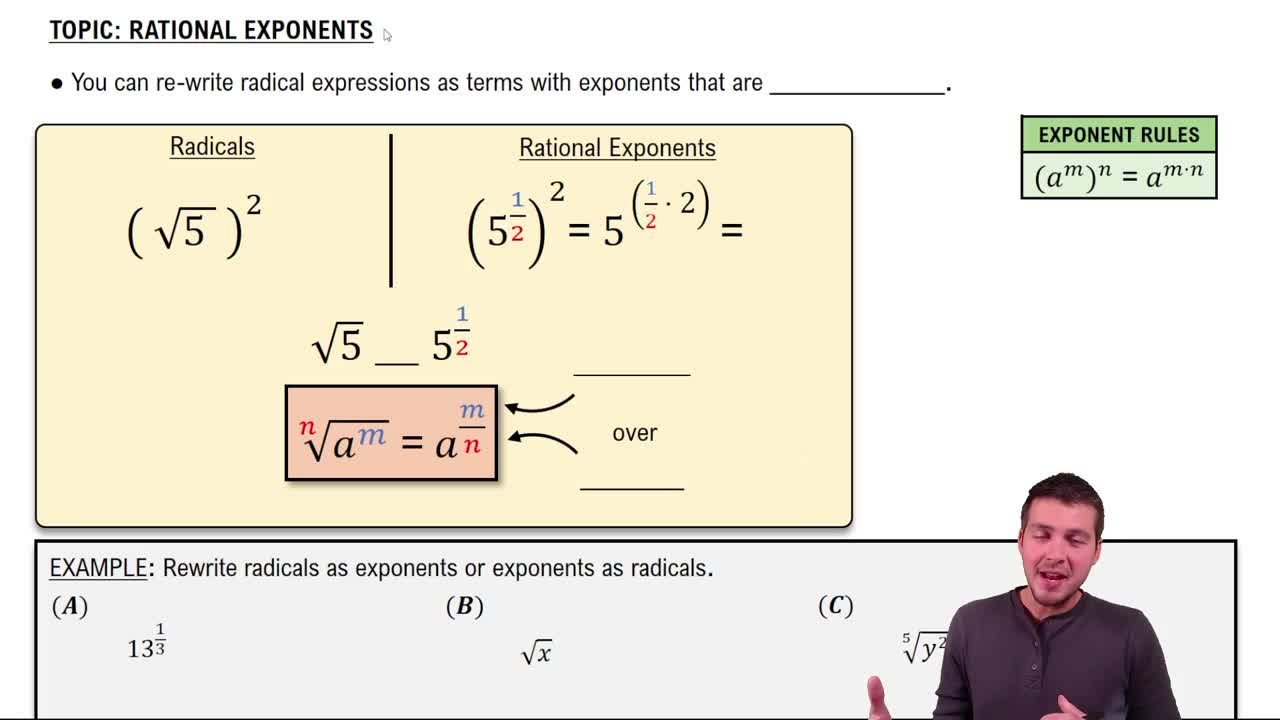
Match the rational exponent expression in Column I with the equivalent radical expression in Column II. Assume that x is not 0. (d) ( 3x )-1/3
1134
views

 Verified step by step guidance
 04:06
04:06
 05:20 05:20
Match the rational exponent expression in Column I with the equivalent radical expression in Column II. Assume that x is not 0. (d) ( 3x )-1/3
Match the rational exponent expression in Column I with the equivalent radical expression in Column II. Assume that x is not 0. ( -3x )-1/3
The mixed number equivalent of the improper fraction is .
In the fraction 5/8, 5 is the numerator and 8 is the denominator.
Determine whether each statement is true or false. If false, correct the right side of the equation. (y2)(y5) = y7
Match the rational exponent expression in Column I with the equivalent radical expression in Column II. Assume that x is not 0. ( -3x )1/3