In this Exercise Set, assume that all variables represent positive real numbers.
In Exercises 1–10, add or subtract as indicated.
_ _
7√3 + 2√3
Verified step by step guidance
1
Identify the like terms in the expression: \(7\sqrt{3}\) and \(2\sqrt{3}\).
Since both terms have the same radical part (\(\sqrt{3}\)), they can be combined by adding their coefficients.
Add the coefficients of the like terms: \(7 + 2\).
Combine the result with the common radical part: \((7 + 2)\sqrt{3}\).
Simplify the expression by performing the addition of the coefficients.
Verified video answer for a similar problem:
This video solution was recommended by our tutors as helpful for the problem above.
Video duration:
1m
Play a video:
0 Comments
Key Concepts
Here are the essential concepts you must grasp in order to answer the question correctly.
Radical Expressions
Radical expressions involve roots, such as square roots or cube roots, and are often represented with the radical symbol (√). Understanding how to manipulate these expressions, including addition and subtraction, is crucial. When combining radical expressions, it is important to ensure that the radicands (the numbers under the radical) are the same, allowing for simplification.
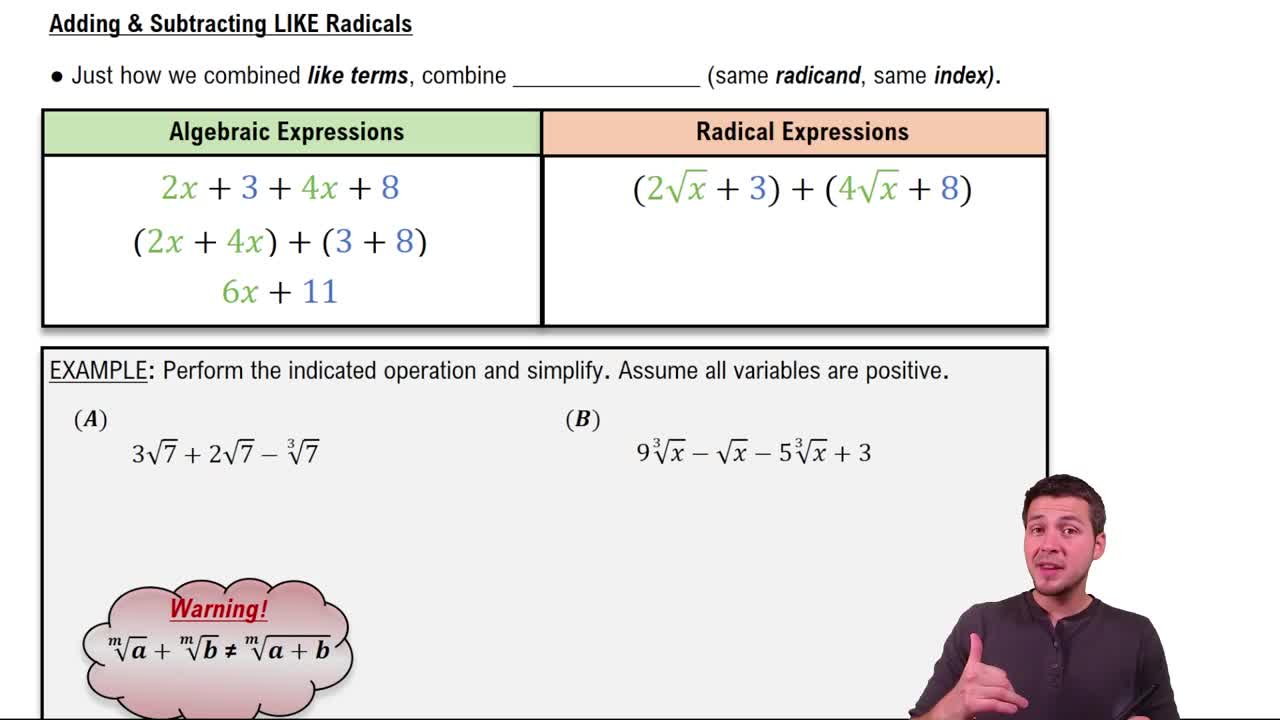
Like terms are terms that contain the same variable raised to the same power, or in the case of radicals, have the same radicand. For example, 7√3 and 2√3 are like terms because they both contain the radical √3. When adding or subtracting like terms, you combine their coefficients while keeping the radical part unchanged, which is essential for simplifying expressions correctly.
Combining radicals involves adding or subtracting radical expressions that are like terms. To do this, you simply add or subtract the coefficients of the radicals while keeping the radical itself intact. For instance, in the expression 7√3 + 2√3, you would add the coefficients 7 and 2 to get 9√3, demonstrating the process of combining radicals effectively.

 1:33 minutes
 Verified step by step guidance
 05:45
05:45