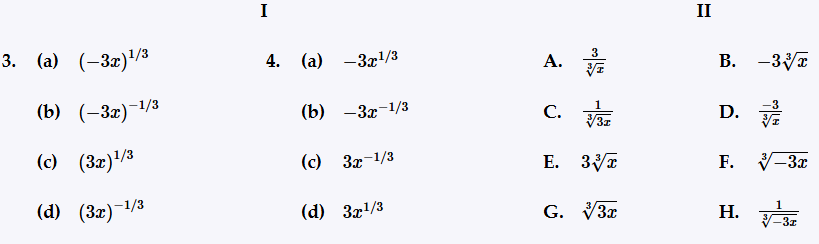
Match the rational exponent expression in Column I with the equivalent radical expression in Column II. Assume that x is not 0. (c) ( 3x )1/3
Verified step by step guidance
1
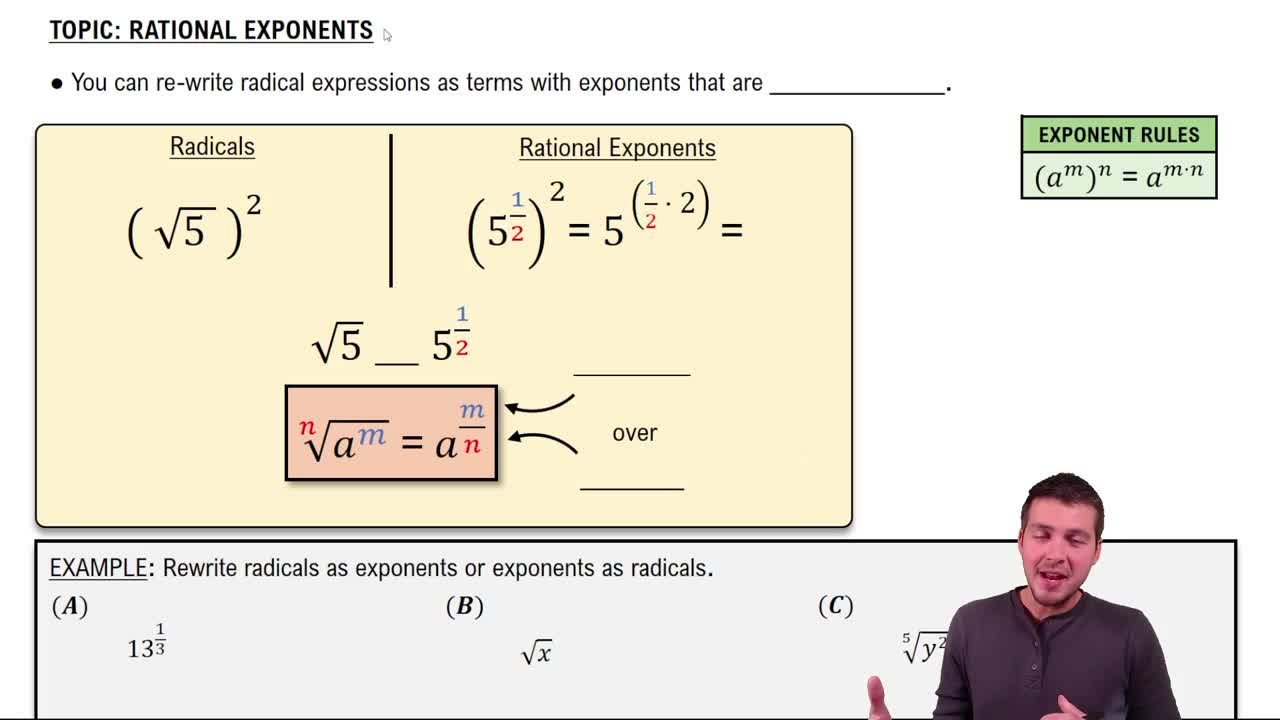
Recall that a rational exponent of the form \(a^{\frac{m}{n}}\) can be rewritten as a radical expression: \(a^{\frac{m}{n}} = \sqrt[n]{a^m}\).
Identify the base and the exponent in the expression \((3x)^{\frac{1}{3}}\). Here, the base is \$3x\( and the exponent is \)\frac{1}{3}$.
Apply the rule for rational exponents: \((3x)^{\frac{1}{3}} = \sqrt[3]{3x}\), which means the cube root of \$3x$.
Understand that the denominator of the exponent (3) indicates the root, and the numerator (1) indicates the power to which the base is raised inside the radical.
Therefore, the equivalent radical expression for \((3x)^{\frac{1}{3}}\) is the cube root of \$3x\(, written as \)\sqrt[3]{3x}$.
Verified video answer for a similar problem:
This video solution was recommended by our tutors as helpful for the problem above
Video duration:
2m
Play a video:
Was this helpful?
Key Concepts
Here are the essential concepts you must grasp in order to answer the question correctly.
Rational Exponents
Rational exponents express roots and powers simultaneously. An exponent in the form of a fraction a/b means raising the base to the power a and then taking the b-th root. For example, x^(1/3) represents the cube root of x.
Radical expressions use root symbols to denote roots of numbers or variables. The n-th root of a number x is written as √[n]{x}, which is equivalent to x raised to the power 1/n. For instance, the cube root of 3x is written as √[3]{3x}.
Properties of exponents allow simplification and manipulation of expressions with powers. For example, (ab)^m = a^m * b^m, which means the exponent applies to each factor inside the parentheses. This helps convert expressions like (3x)^(1/3) into radical form.