Use the table to evaluate each expression, if possible.
Verified step by step guidance
1
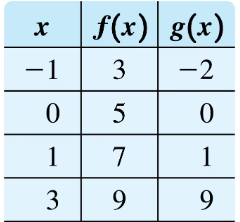
Identify the functions \( f(x) \) and \( g(x) \) from the given table. Locate the values of \( f(3) \) and \( g(3) \) by finding the row where \( x = 3 \).
Recall the definition of the operation \( (f - g)(x) \), which means subtracting the value of \( g(x) \) from \( f(x) \). Mathematically, this is written as \( (f - g)(x) = f(x) - g(x) \).
Substitute \( x = 3 \) into the expression to get \( (f - g)(3) = f(3) - g(3) \).
Using the values found in step 1, plug in \( f(3) \) and \( g(3) \) into the expression \( f(3) - g(3) \).
Perform the subtraction to find the value of \( (f - g)(3) \), if both \( f(3) \) and \( g(3) \) are defined in the table.
Verified video answer for a similar problem:
This video solution was recommended by our tutors as helpful for the problem above
Video duration:
1m
Play a video:
Was this helpful?
Key Concepts
Here are the essential concepts you must grasp in order to answer the question correctly.
Function Operations
Function operations involve combining two functions using addition, subtraction, multiplication, or division. In this case, (f - g)(x) means subtracting the value of g(x) from f(x) for a given input x. Understanding how to perform these operations is essential to evaluate expressions like (f - g)(3).
When functions are given in a table, you find the function's value at a specific input by locating the input in the table and reading the corresponding output. This skill is necessary to find f(3) and g(3) before performing any operations on them.
The domain of a function is the set of input values for which the function is defined. Before evaluating (f - g)(3), it is important to verify that both f and g are defined at x = 3. If either function is undefined at this point, the expression cannot be evaluated.