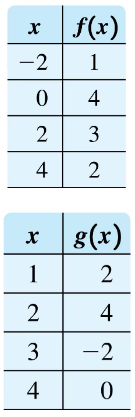
Use the tables for ƒ and g to evaluate each expression.
Verified step by step guidance
1
Understand that the expression \( (g \circ f)(-2) \) means \( g(f(-2)) \), which is the composition of functions \( g \) and \( f \) evaluated at \( -2 \).
First, find the value of \( f(-2) \) by looking up \( -2 \) in the table for \( f \) and noting the corresponding output.
Next, take the value you found for \( f(-2) \) and use it as the input for the function \( g \).
Look up this input value in the table for \( g \) to find \( g(f(-2)) \).
The result you get from the table for \( g \) is the value of \( (g \circ f)(-2) \).
Verified video answer for a similar problem:
This video solution was recommended by our tutors as helpful for the problem above
Video duration:
1m
Play a video:
Was this helpful?
Key Concepts
Here are the essential concepts you must grasp in order to answer the question correctly.
Function Composition
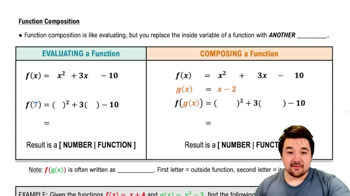
Function composition involves applying one function to the result of another, denoted as (g∘ƒ)(x) = g(ƒ(x)). To evaluate (g∘ƒ)(-2), first find ƒ(-2), then use that output as the input for g.
Function tables list input-output pairs for functions. To evaluate a function at a specific input, locate the input value in the table and read off the corresponding output value.
When evaluating (g∘ƒ)(x), the order matters: compute ƒ(x) first, then apply g to that result. This ensures correct evaluation and avoids confusion between g(ƒ(x)) and ƒ(g(x)).