Find the quotient. Express your answer in standard form.
Table of contents
- 0. Review of Algebra4h 18m
- 1. Equations & Inequalities3h 18m
- 2. Graphs of Equations1h 43m
- 3. Functions2h 17m
- 4. Polynomial Functions1h 44m
- 5. Rational Functions1h 23m
- 6. Exponential & Logarithmic Functions2h 28m
- 7. Systems of Equations & Matrices4h 5m
- 8. Conic Sections2h 23m
- 9. Sequences, Series, & Induction1h 22m
- 10. Combinatorics & Probability1h 45m
1. Equations & Inequalities
Complex Numbers
Problem 18a
Textbook Question
Identify each number as real, complex, pure imaginary, or nonreal com-plex. (More than one of these descriptions will apply.) √24
Verified step by step guidance1
First, recognize that the number given is \( \sqrt{24} \). Since 24 is a positive real number, its square root is also a real number.
Simplify \( \sqrt{24} \) by factoring 24 into its prime factors: \( 24 = 4 \times 6 \). Then, \( \sqrt{24} = \sqrt{4 \times 6} = \sqrt{4} \times \sqrt{6} \).
Calculate \( \sqrt{4} \), which is 2, so \( \sqrt{24} = 2\sqrt{6} \). This is a real number because it is a product of real numbers.
Since \( \sqrt{24} \) is a real number and does not involve the imaginary unit \( i \), it is not complex in the sense of having an imaginary part, nor is it pure imaginary or nonreal complex.
Therefore, \( \sqrt{24} \) is classified as a real number (and also a complex number because all real numbers are a subset of complex numbers), but it is not pure imaginary or nonreal complex.
Verified video answer for a similar problem:This video solution was recommended by our tutors as helpful for the problem above
Video duration:
49sPlay a video:
Was this helpful?
Key Concepts
Here are the essential concepts you must grasp in order to answer the question correctly.
Real Numbers
Real numbers include all rational and irrational numbers that can be found on the number line. They encompass integers, fractions, and roots of positive numbers, such as √24, which is a positive real number because it represents a non-negative value.
Recommended video:
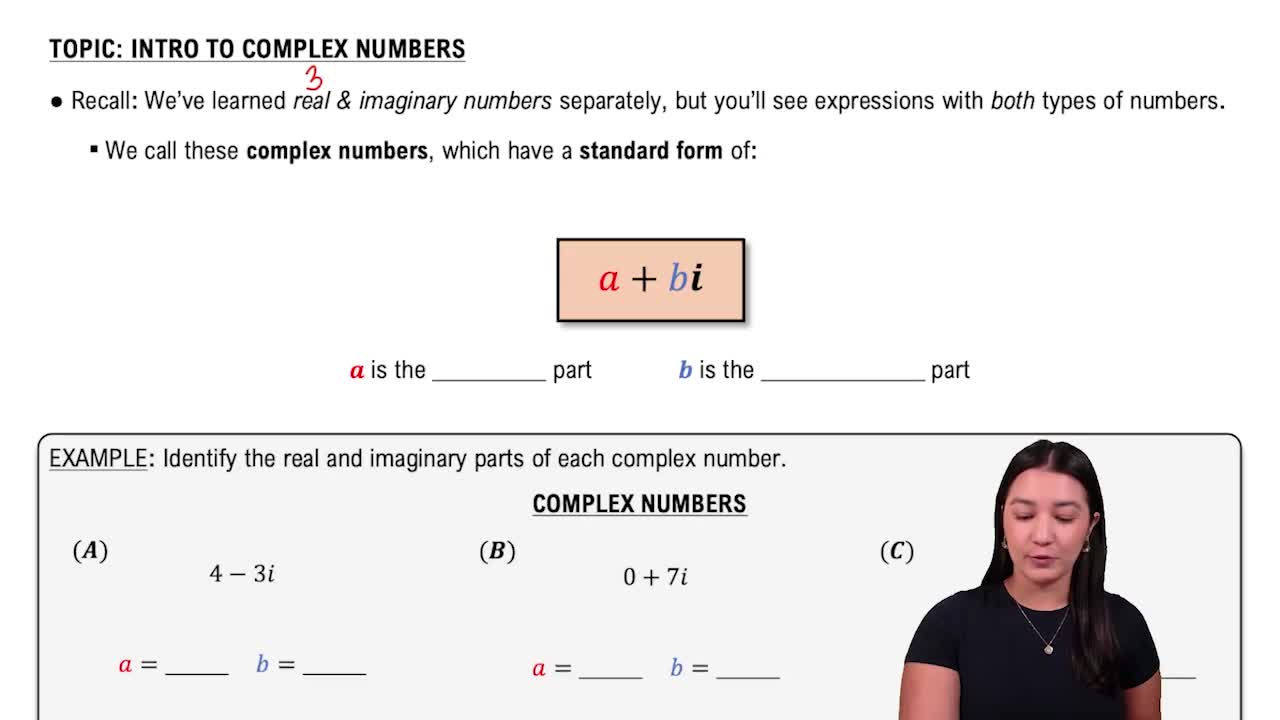
Introduction to Complex Numbers
Complex Numbers
Complex numbers are numbers in the form a + bi, where a and b are real numbers and i is the imaginary unit with i² = -1. Every real number is also a complex number with b = 0, so √24 can be considered a complex number with zero imaginary part.
Recommended video:
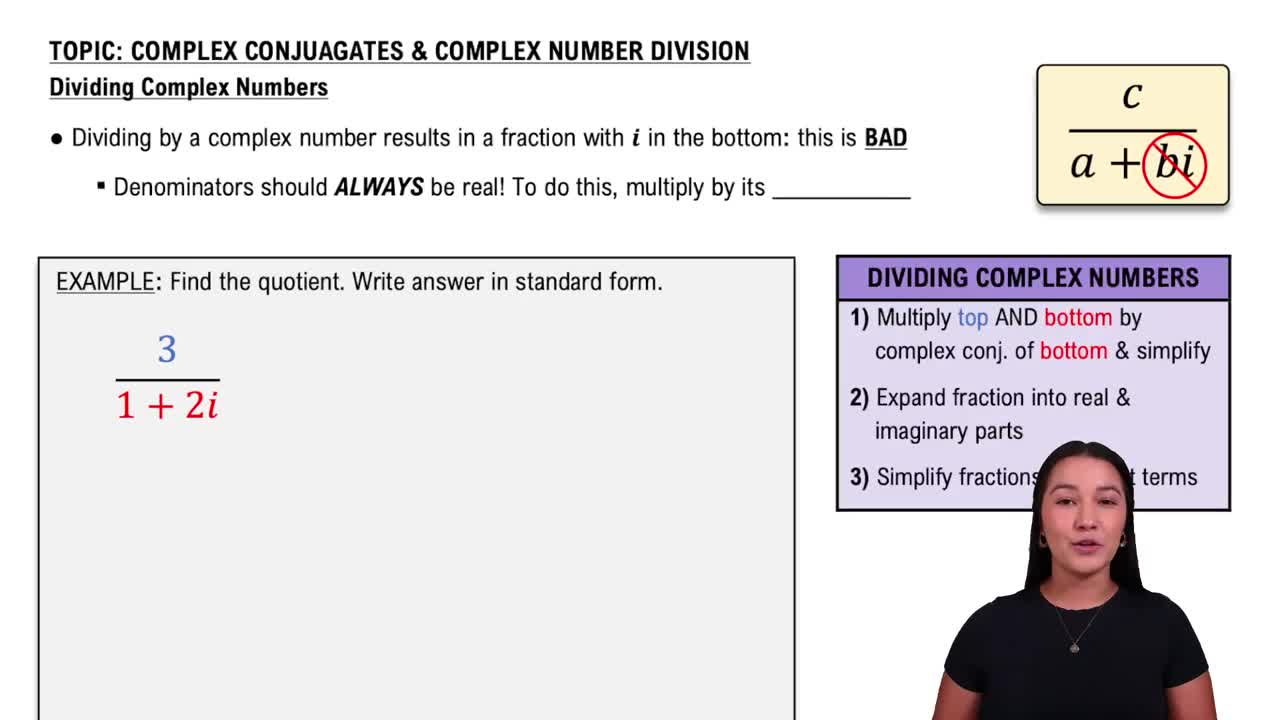
Dividing Complex Numbers
Pure Imaginary and Nonreal Complex Numbers
Pure imaginary numbers have the form 0 + bi where b ≠ 0, meaning they lie entirely on the imaginary axis. Nonreal complex numbers have a nonzero imaginary part. Since √24 has no imaginary part, it is neither pure imaginary nor nonreal complex.
Recommended video:
Introduction to Complex Numbers
Watch next
Master Introduction to Complex Numbers with a bite sized video explanation from Patrick
Start learningRelated Videos
Related Practice
Multiple Choice
581
views
7
rank