Begin by graphing the cube root function, f(x) = ∛x. Then use transformations of this graph to graph the given function. -∛(x+2)
Table of contents
- 0. Review of Algebra4h 18m
- 1. Equations & Inequalities3h 18m
- 2. Graphs of Equations1h 43m
- 3. Functions2h 17m
- 4. Polynomial Functions1h 44m
- 5. Rational Functions1h 23m
- 6. Exponential & Logarithmic Functions2h 28m
- 7. Systems of Equations & Matrices4h 5m
- 8. Conic Sections2h 23m
- 9. Sequences, Series, & Induction1h 22m
- 10. Combinatorics & Probability1h 45m
3. Functions
Common Functions
Problem 66
Textbook Question
In Exercises 64–66, begin by graphing the square root function, f(x) = √x. Then use transformations of this graph to graph the given function. r(x) = 2√(x + 2)
Verified step by step guidance1
Start with the basic square root function \(f(x) = \sqrt{x}\), which is graphed starting at the point \((0,0)\) and increases slowly as \(x\) increases.
Identify the transformation inside the square root: \(r(x) = 2\sqrt{x + 2}\). The expression \(x + 2\) inside the square root indicates a horizontal shift to the left by 2 units.
Apply the horizontal shift by moving every point on the graph of \(f(x) = \sqrt{x}\) two units to the left. For example, the point \((0,0)\) on \(f(x)\) moves to \((-2,0)\) on \(r(x)\).
Next, observe the coefficient 2 outside the square root, which means a vertical stretch by a factor of 2. Multiply all the \(y\)-values of the shifted graph by 2.
Combine these transformations: first shift the graph of \(f(x)\) left by 2 units, then stretch it vertically by a factor of 2 to get the graph of \(r(x) = 2\sqrt{x + 2}\).
Verified video answer for a similar problem:This video solution was recommended by our tutors as helpful for the problem above
Video duration:
6mPlay a video:
Was this helpful?
Key Concepts
Here are the essential concepts you must grasp in order to answer the question correctly.
Square Root Function
The square root function, f(x) = √x, is defined for x ≥ 0 and produces non-negative outputs. Its graph starts at the origin (0,0) and increases slowly, forming a curve that rises to the right. Understanding this base graph is essential before applying any transformations.
Recommended video:
Imaginary Roots with the Square Root Property
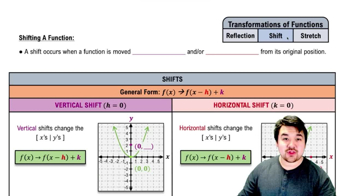
Horizontal Shifts of Functions
A horizontal shift occurs when a constant is added or subtracted inside the function's argument, such as in f(x + c). For f(x + 2), the graph shifts 2 units to the left. This transformation changes the starting point of the graph along the x-axis without altering its shape.
Recommended video:
Shifts of Functions
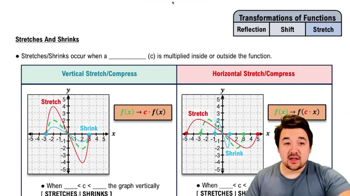
Vertical Stretching of Functions
Multiplying a function by a constant greater than 1, like 2√(x + 2), stretches the graph vertically. This means all y-values are multiplied by 2, making the graph steeper. Vertical stretching affects the output values but does not shift the graph horizontally.
Recommended video:
Stretches & Shrinks of Functions
Watch next
Master Graphs of Common Functions with a bite sized video explanation from Patrick
Start learningRelated Videos
Related Practice
Textbook Question
1002
views