Begin by graphing the square root function, f(x) = √x. Then use transformations of this graph to graph the given function. g(x) = 2√(x+1)
Table of contents
- 0. Review of Algebra4h 18m
- 1. Equations & Inequalities3h 18m
- 2. Graphs of Equations1h 43m
- 3. Functions2h 17m
- 4. Polynomial Functions1h 44m
- 5. Rational Functions1h 23m
- 6. Exponential & Logarithmic Functions2h 28m
- 7. Systems of Equations & Matrices4h 5m
- 8. Conic Sections2h 23m
- 9. Sequences, Series, & Induction1h 22m
- 10. Combinatorics & Probability1h 45m
3. Functions
Common Functions
Problem 115
Textbook Question
Begin by graphing the cube root function, f(x) = ∛x. Then use transformations of this graph to graph the given function. -∛(x+2)
Verified step by step guidance1
Step 1: Begin by understanding the parent function f(x) = ∛x. The cube root function is symmetric about the origin and passes through points such as (0, 0), (1, 1), (-1, -1), (8, 2), and (-8, -2). Graph this parent function as the base graph.
Step 2: Analyze the transformation inside the cube root function. The term (x + 2) indicates a horizontal shift. Since it is (x + 2), the graph of the parent function will shift 2 units to the left.
Step 3: Next, consider the negative sign in front of the cube root function, -∛(x + 2). This negative sign reflects the graph across the x-axis. Every y-value of the graph will be multiplied by -1, flipping the graph vertically.
Step 4: Combine the transformations. First, shift the graph of f(x) = ∛x two units to the left, and then reflect the resulting graph across the x-axis.
Step 5: Plot the transformed graph by applying the transformations to key points of the parent function. For example, the point (0, 0) remains unchanged, (1, 1) becomes (-1, -1), and (-1, -1) becomes (-3, 1). Continue this process for other key points to complete the graph.
Verified video answer for a similar problem:This video solution was recommended by our tutors as helpful for the problem above
Video duration:
3mPlay a video:
Was this helpful?
Key Concepts
Here are the essential concepts you must grasp in order to answer the question correctly.
Cube Root Function
The cube root function, denoted as f(x) = ∛x, is a type of radical function that returns the number whose cube is x. It is defined for all real numbers and has a characteristic S-shaped curve that passes through the origin (0,0). Understanding its basic shape and properties is essential for applying transformations.
Recommended video:
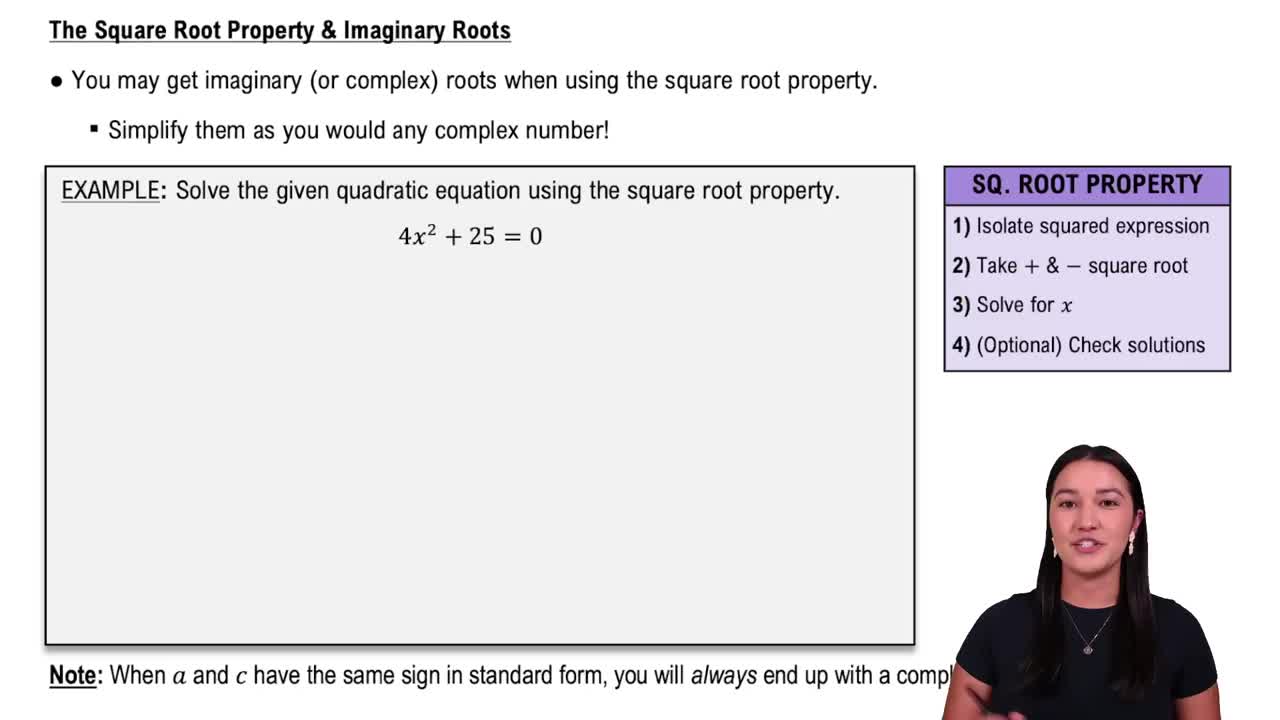
Imaginary Roots with the Square Root Property
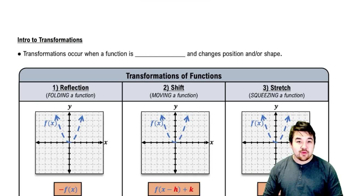
Graph Transformations
Graph transformations involve shifting, reflecting, stretching, or compressing the graph of a function. For the function -∛(x+2), the graph of f(x) = ∛x is first shifted left by 2 units due to the (x+2) term, and then reflected across the x-axis because of the negative sign. Mastery of these transformations allows for accurate graphing of modified functions.
Recommended video:
Intro to Transformations
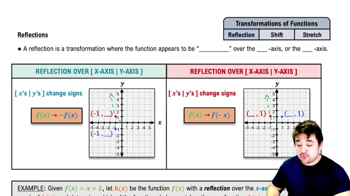
Reflection Across the X-Axis
Reflection across the x-axis is a transformation that flips the graph of a function over the x-axis. This means that for every point (x, y) on the original graph, the reflected point will be (x, -y). In the context of the function -∛(x+2), this reflection changes the sign of the output values, resulting in a graph that is inverted compared to the original cube root function.
Recommended video:
Reflections of Functions
Watch next
Master Graphs of Common Functions with a bite sized video explanation from Patrick
Start learningRelated Videos
Related Practice
Textbook Question
569
views