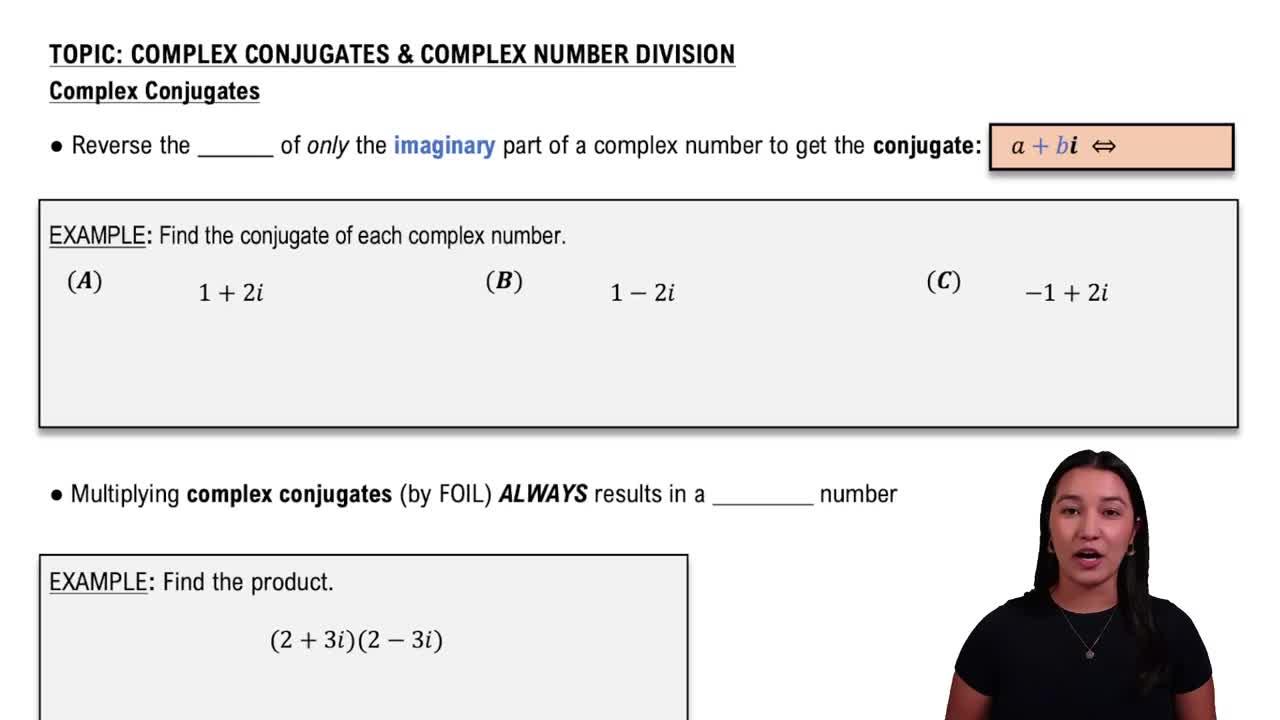
In Exercises 39–64, rationalize each denominator.
7
-----
³√x
Verified step by step guidance
1
Identify the expression: \( \frac{7}{\sqrt[3]{x}} \). The goal is to rationalize the denominator.
To rationalize a cube root in the denominator, multiply both the numerator and the denominator by the square of the cube root: \( \frac{\sqrt[3]{x^2}}{\sqrt[3]{x^2}} \).
This multiplication will give: \( \frac{7 \cdot \sqrt[3]{x^2}}{\sqrt[3]{x} \cdot \sqrt[3]{x^2}} \).
Simplify the denominator using the property \( \sqrt[3]{x} \cdot \sqrt[3]{x^2} = \sqrt[3]{x^3} = x \).
The expression becomes: \( \frac{7 \cdot \sqrt[3]{x^2}}{x} \).
Verified video answer for a similar problem:
This video solution was recommended by our tutors as helpful for the problem above.
Video duration:
2m
Play a video:
0 Comments
Key Concepts
Here are the essential concepts you must grasp in order to answer the question correctly.
Rationalizing the Denominator
Rationalizing the denominator involves rewriting a fraction so that the denominator is a rational number. This is often necessary when the denominator contains roots or irrational numbers, as it simplifies calculations and makes the expression easier to work with. The process typically involves multiplying both the numerator and denominator by a suitable expression that eliminates the root in the denominator.
A cube root of a number x is a value that, when multiplied by itself three times, gives x. In mathematical notation, the cube root of x is expressed as ³√x. Understanding cube roots is essential when dealing with expressions that involve them, especially in rationalization, as it helps in identifying the appropriate factors needed to eliminate the root from the denominator.
Multiplying by conjugates is a technique used to rationalize denominators that contain binomials or roots. The conjugate of a binomial expression is formed by changing the sign between its two terms. This method is particularly useful for eliminating square roots, but can also be adapted for cube roots by using specific algebraic identities, ensuring that the product results in a rational number.

 2:59 minutes
 Verified step by step guidance
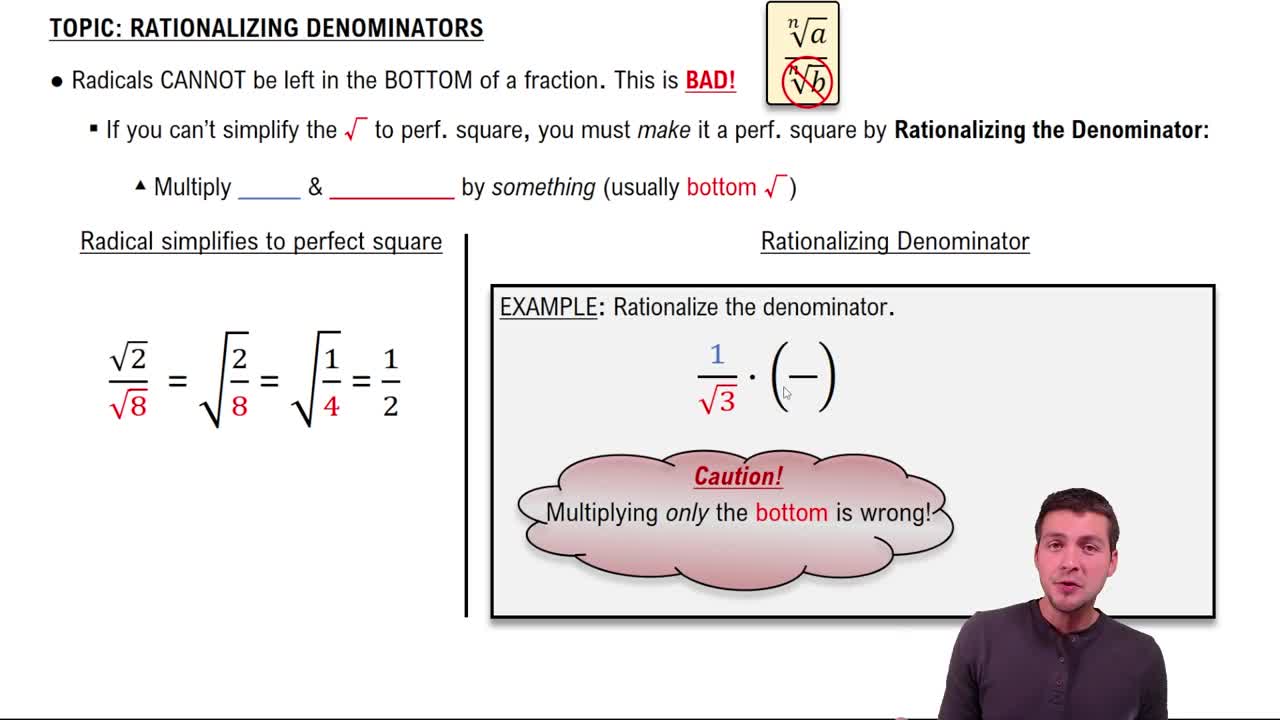
 02:58
02:58