In Exercises 53–58, simplify each expression using the power rule.
(x⁶)¹⁰
Verified step by step guidance
1
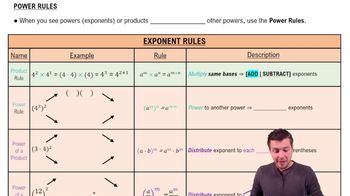
Identify the power rule for exponents, which states that \((a^m)^n = a^{m \cdot n}\).
Apply the power rule to the expression \((x^6)^{10}\).
Multiply the exponents: \(6 \cdot 10\).
Rewrite the expression as \(x^{6 \cdot 10}\).
Simplify the exponent to express the final simplified form.
Verified video answer for a similar problem:
This video solution was recommended by our tutors as helpful for the problem above.
Video duration:
2m
Play a video:
0 Comments
Key Concepts
Here are the essential concepts you must grasp in order to answer the question correctly.
Power Rule
The power rule is a fundamental property of exponents that states when raising a power to another power, you multiply the exponents. Mathematically, this is expressed as (a^m)^n = a^(m*n), where 'a' is the base, 'm' is the exponent of the first power, and 'n' is the exponent of the second power. This rule simplifies expressions involving exponents significantly.
Exponential notation is a way to represent repeated multiplication of a number by itself. For example, x^n means x is multiplied by itself n times. Understanding this notation is crucial for manipulating expressions with exponents, as it allows for concise representation and simplification of large products.
Simplification of expressions involves reducing an expression to its simplest form, making it easier to work with. This often includes combining like terms, applying the power rule, and reducing fractions. Mastering simplification techniques is essential for solving algebraic problems efficiently and accurately.

 2:16 minutes
 Verified step by step guidance
 5:50
5:50