Let and . Solve each matrix equation for X. 4A + 3B = - 2X
Table of contents
- 0. Review of Algebra4h 18m
- 1. Equations & Inequalities3h 18m
- 2. Graphs of Equations1h 43m
- 3. Functions2h 17m
- 4. Polynomial Functions1h 44m
- 5. Rational Functions1h 23m
- 6. Exponential & Logarithmic Functions2h 28m
- 7. Systems of Equations & Matrices4h 5m
- 8. Conic Sections2h 23m
- 9. Sequences, Series, & Induction1h 22m
- 10. Combinatorics & Probability1h 45m
7. Systems of Equations & Matrices
Introduction to Matrices
Problem 37
Textbook Question
Perform the indicated matrix operations given that A, B and C are defined as follows. If an operation is not defined, state the reason.
4B - 3C
Verified step by step guidance1
Step 1: Identify the matrices and the operation to be performed. We are asked to compute the expression \$4B - 3C\(, where matrices \)B\( and \)C\( are given as:
\)B = \begin{bmatrix} 5 & 1 \\ -2 & -2 \end{bmatrix}\( and \)C = \begin{bmatrix} 1 & -1 \\ -1 & 1 \end{bmatrix}$.
Step 2: Multiply matrix \(B\) by the scalar 4. This means multiplying each element of \(B\) by 4:
\$4B = 4 \times \begin{bmatrix} 5 & 1 \\ -2 & -2 \end{bmatrix} = \begin{bmatrix} 4 \times 5 & 4 \times 1 \\ 4 \times (-2) & 4 \times (-2) \end{bmatrix}$.
Step 3: Multiply matrix \(C\) by the scalar 3. This means multiplying each element of \(C\) by 3:
\$3C = 3 \times \begin{bmatrix} 1 & -1 \\ -1 & 1 \end{bmatrix} = \begin{bmatrix} 3 \times 1 & 3 \times (-1) \\ 3 \times (-1) & 3 \times 1 \end{bmatrix}$.
Step 4: Subtract the matrix \$3C\( from the matrix \)4B\(. This involves subtracting corresponding elements:
\)4B - 3C = \begin{bmatrix} (4B)_{11} - (3C)_{11} & (4B)_{12} - (3C)_{12} \\ (4B)_{21} - (3C)_{21} & (4B)_{22} - (3C)_{22} \end{bmatrix}$.
Step 5: Verify the dimensions of matrices \(B\) and \(C\) are the same before performing the subtraction. Since both are \$2 \times 2$ matrices, the subtraction is defined and can be performed element-wise.
Verified video answer for a similar problem:This video solution was recommended by our tutors as helpful for the problem above
Video duration:
2mPlay a video:
Was this helpful?
Key Concepts
Here are the essential concepts you must grasp in order to answer the question correctly.
Matrix Multiplication
Matrix multiplication involves multiplying rows of the first matrix by columns of the second matrix and summing the products. It is only defined when the number of columns in the first matrix equals the number of rows in the second. This operation is not commutative, meaning AB does not necessarily equal BA.
Recommended video:
Finding Zeros & Their Multiplicity
Scalar Multiplication of Matrices
Scalar multiplication involves multiplying every element of a matrix by a constant (scalar). This operation changes the magnitude of the matrix elements but not the matrix dimensions. It is distributive over matrix addition and associative with scalar multiplication.
Recommended video:
Guided course
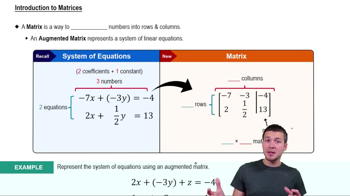
Introduction to Matrices
Matrix Dimensions and Operation Validity
The dimensions of matrices determine which operations are defined. For addition or subtraction, matrices must have the same dimensions. For multiplication, the number of columns in the first matrix must equal the number of rows in the second. Understanding dimensions helps identify if an operation is possible.
Recommended video:
Guided course
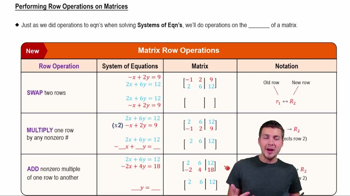
Performing Row Operations on Matrices
Watch next
Master Introduction to Matrices with a bite sized video explanation from Patrick
Start learningRelated Videos
Related Practice
Textbook Question
57
views