Write the partial fraction decomposition of each rational expression. (6x-11)/(x − 1)²
Table of contents
- 0. Review of Algebra4h 18m
- 1. Equations & Inequalities3h 18m
- 2. Graphs of Equations1h 43m
- 3. Functions2h 17m
- 4. Polynomial Functions1h 44m
- 5. Rational Functions1h 23m
- 6. Exponential & Logarithmic Functions2h 28m
- 7. Systems of Equations & Matrices4h 5m
- 8. Conic Sections2h 23m
- 9. Sequences, Series, & Induction1h 22m
- 10. Combinatorics & Probability1h 45m
7. Systems of Equations & Matrices
Introduction to Matrices
Problem 16
Textbook Question
Write the partial fraction decomposition of each rational expression. x/(x2 +2x -3)
Verified step by step guidance1
Start by factoring the denominator of the rational expression. The denominator is \(x^2 + 2x - 3\). To factor it, look for two numbers that multiply to \(-3\) and add to \$2$.
Rewrite the denominator as a product of two binomials: \(x^2 + 2x - 3 = (x + a)(x + b)\), where \(a\) and \(b\) are the numbers found in the previous step.
Set up the partial fraction decomposition. Since the denominator factors into two linear factors, the decomposition will be of the form \(\frac{x}{(x + a)(x + b)} = \frac{A}{x + a} + \frac{B}{x + b}\), where \(A\) and \(B\) are constants to be determined.
Multiply both sides of the equation by the denominator \((x + a)(x + b)\) to clear the fractions, resulting in \(x = A(x + b) + B(x + a)\).
Expand the right side and collect like terms. Then, equate the coefficients of corresponding powers of \(x\) on both sides to form a system of equations. Solve this system to find the values of \(A\) and \(B\).
Verified video answer for a similar problem:This video solution was recommended by our tutors as helpful for the problem above
Video duration:
8mPlay a video:
Was this helpful?
Key Concepts
Here are the essential concepts you must grasp in order to answer the question correctly.
Partial Fraction Decomposition
Partial fraction decomposition is a method used to express a rational function as a sum of simpler fractions, making integration or other operations easier. It involves breaking down a complex rational expression into a sum of fractions with simpler denominators, typically linear or irreducible quadratic factors.
Recommended video:
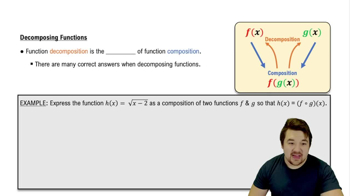
Decomposition of Functions
Factoring Quadratic Expressions
Factoring quadratic expressions involves rewriting a quadratic polynomial as a product of two binomials. For example, x^2 + 2x - 3 factors into (x + 3)(x - 1). This step is essential in partial fraction decomposition to identify the denominators of the simpler fractions.
Recommended video:
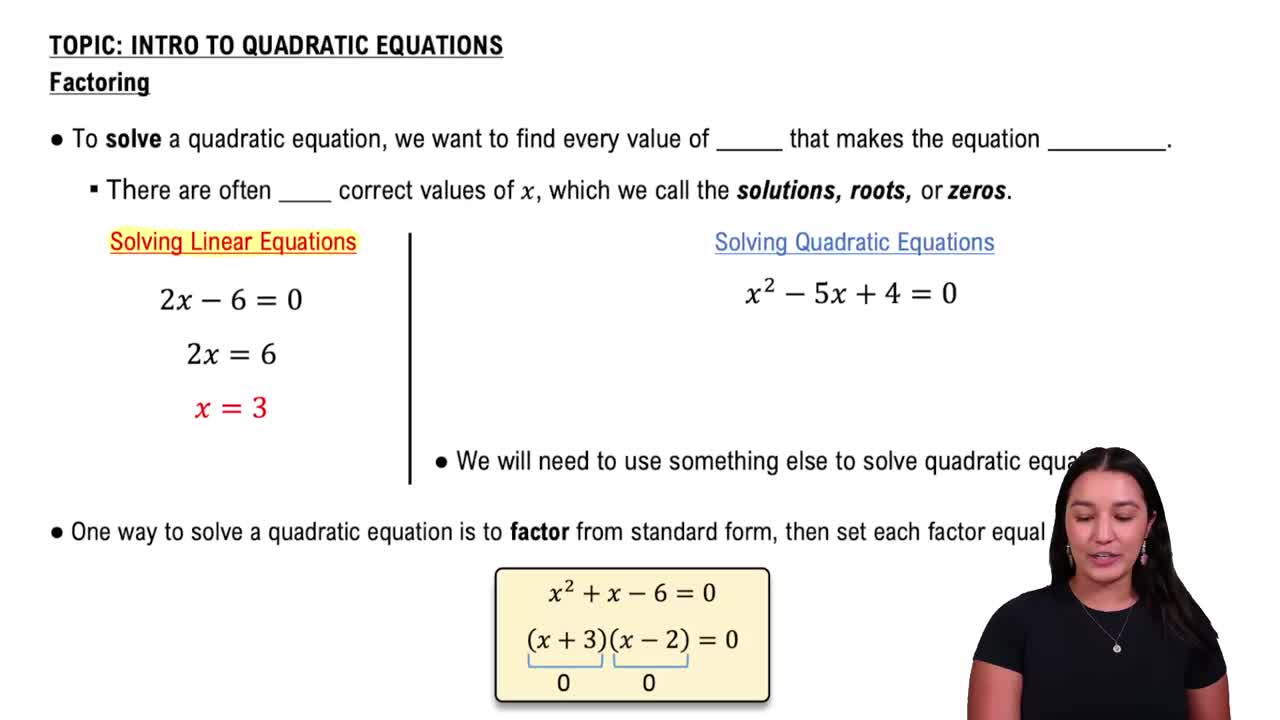
Solving Quadratic Equations by Factoring
Setting Up and Solving Equations for Coefficients
After expressing the rational function as a sum of partial fractions, you set up an equation by equating numerators. Then, by substituting values or comparing coefficients of like terms, you solve for unknown constants. This process determines the exact form of the decomposition.
Recommended video:
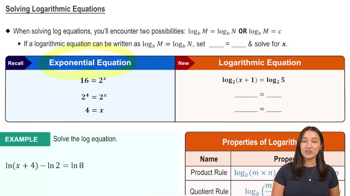
Solving Logarithmic Equations
Watch next
Master Introduction to Matrices with a bite sized video explanation from Patrick
Start learningRelated Videos
Related Practice
Textbook Question
492
views