Convert each equation to standard form by completing the square on x and y. Then graph the ellipse and give the location of its foci. 36x2 +9y2 - 216x = 0
Table of contents
- 0. Review of Algebra4h 18m
- 1. Equations & Inequalities3h 18m
- 2. Graphs of Equations1h 43m
- 3. Functions2h 17m
- 4. Polynomial Functions1h 44m
- 5. Rational Functions1h 23m
- 6. Exponential & Logarithmic Functions2h 28m
- 7. Systems of Equations & Matrices4h 5m
- 8. Conic Sections2h 23m
- 9. Sequences, Series, & Induction1h 22m
- 10. Combinatorics & Probability1h 45m
8. Conic Sections
Ellipses: Standard Form
Problem 67
Textbook Question
Graph each semiellipse. y = -√16 - 4x²
Verified step by step guidance1
Recognize that the given equation is \(y = \sqrt{16 - 4x^{2}}\), which represents the upper half of an ellipse because \(y\) is defined as the positive square root.
Rewrite the equation by squaring both sides to eliminate the square root: \(y^{2} = 16 - 4x^{2}\).
Rearrange the equation to standard ellipse form by moving all terms to one side: \$4x^{2} + y^{2} = 16$.
Divide the entire equation by 16 to normalize it: \(\frac{4x^{2}}{16} + \frac{y^{2}}{16} = 1\), which simplifies to \(\frac{x^{2}}{4} + \frac{y^{2}}{16} = 1\).
Identify the ellipse parameters: the semi-major axis length \(a = 4\) (along the y-axis) and the semi-minor axis length \(b = 2\) (along the x-axis). Since \(y = \sqrt{16 - 4x^{2}}\) only gives the upper half, graph the ellipse only for \(y \geq 0\).
Verified video answer for a similar problem:This video solution was recommended by our tutors as helpful for the problem above
Video duration:
5mPlay a video:
Was this helpful?
Key Concepts
Here are the essential concepts you must grasp in order to answer the question correctly.
Equation of an Ellipse
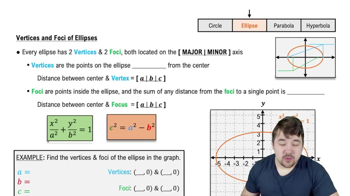
An ellipse is a set of points where the sum of distances to two foci is constant. Its standard form is (x²/a²) + (y²/b²) = 1. The given equation y = √(16 - 4x²) represents the upper half of an ellipse after rearranging to fit this form.
Recommended video:
Foci and Vertices of an Ellipse
Graphing Functions with Square Roots
When graphing y = √(expression), the output y is always non-negative, representing only the upper part of the curve. This means the graph is a semiellipse (half ellipse) above the x-axis, and the domain is restricted to values where the expression inside the root is non-negative.
Recommended video:
Imaginary Roots with the Square Root Property
Domain and Range of the Function
The domain consists of all x-values for which the expression under the square root is ≥ 0. For y = √(16 - 4x²), this means 16 - 4x² ≥ 0, limiting x between -2 and 2. The range is y ≥ 0 since the square root function outputs non-negative values.
Recommended video:
Domain & Range of Transformed Functions
Watch next
Master Graph Ellipses at Origin with a bite sized video explanation from Patrick
Start learningRelated Videos
Related Practice
Textbook Question
605
views