Find the solution set for each system by graphing both of the system's equations in the same rectangular coordinate system and finding points of intersection. Check all solutions in both equations.
Table of contents
- 0. Review of Algebra4h 18m
- 1. Equations & Inequalities3h 18m
- 2. Graphs of Equations1h 43m
- 3. Functions2h 17m
- 4. Polynomial Functions1h 44m
- 5. Rational Functions1h 23m
- 6. Exponential & Logarithmic Functions2h 28m
- 7. Systems of Equations & Matrices4h 5m
- 8. Conic Sections2h 23m
- 9. Sequences, Series, & Induction1h 22m
- 10. Combinatorics & Probability1h 45m
8. Conic Sections
Ellipses: Standard Form
Problem 87
Textbook Question
Find the standard form of the equation of an ellipse with vertices at (0, -6) and (0, 6), passing through (2, 4).
Verified step by step guidance1
Identify the center of the ellipse by finding the midpoint of the vertices. Since the vertices are at (0, -6) and (0, 6), the center is at (0, 0).
Determine the orientation of the ellipse. The vertices lie on the y-axis, so the major axis is vertical. This means the standard form of the ellipse equation is \( \frac{x^2}{b^2} + \frac{y^2}{a^2} = 1 \), where \(a\) is the distance from the center to a vertex along the y-axis.
Calculate \(a\), the distance from the center to a vertex. Since the vertices are at (0, ±6), \(a = 6\). So, \(a^2 = 36\).
Use the point (2, 4) that lies on the ellipse to find \(b^2\). Substitute \(x = 2\), \(y = 4\), and \(a^2 = 36\) into the ellipse equation: \( \frac{2^2}{b^2} + \frac{4^2}{36} = 1 \).
Solve the equation from step 4 for \(b^2\) by isolating \( \frac{4}{b^2} \), then multiply both sides by \(b^2\) and solve for \(b^2\). This will give you the value needed to write the standard form of the ellipse.
Verified video answer for a similar problem:This video solution was recommended by our tutors as helpful for the problem above
Video duration:
12mPlay a video:
Was this helpful?
Key Concepts
Here are the essential concepts you must grasp in order to answer the question correctly.
Standard Form of an Ellipse
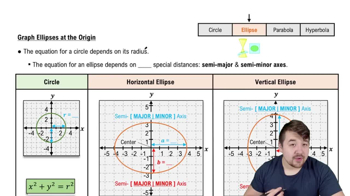
The standard form of an ellipse equation depends on the orientation of its major axis. For a vertical major axis centered at the origin, the equation is (x^2 / b^2) + (y^2 / a^2) = 1, where 'a' is the distance from the center to a vertex along the y-axis, and 'b' is the distance along the x-axis. Understanding this form helps in identifying the ellipse's shape and size.
Recommended video:
Graph Ellipses at Origin
Vertices of an Ellipse
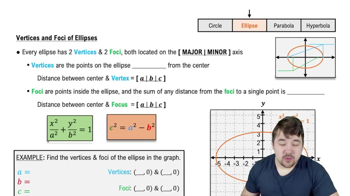
Vertices are the points on the ellipse farthest from the center along the major axis. Given vertices at (0, -6) and (0, 6), the center is at the origin (0,0), and the length of the major axis is 12, so a = 6. Knowing the vertices allows determination of 'a' in the ellipse equation.
Recommended video:
Foci and Vertices of an Ellipse
Using a Point to Find the Ellipse Parameters
Substituting a known point on the ellipse into the standard form equation allows solving for the unknown parameter 'b'. Here, the point (2, 4) lies on the ellipse, so plugging in x=2 and y=4 helps find 'b', completing the equation. This step is essential to fully define the ellipse.
Recommended video:
Guided course
Finding Equations of Lines Given Two Points
Watch next
Master Graph Ellipses at Origin with a bite sized video explanation from Patrick
Start learningRelated Videos
Related Practice
Textbook Question
606
views