Use the Leading Coefficient Test to determine the end behavior of the graph of the polynomial function.
Table of contents
- 0. Review of Algebra4h 18m
- 1. Equations & Inequalities3h 18m
- 2. Graphs of Equations1h 43m
- 3. Functions2h 17m
- 4. Polynomial Functions1h 44m
- 5. Rational Functions1h 23m
- 6. Exponential & Logarithmic Functions2h 28m
- 7. Systems of Equations & Matrices4h 5m
- 8. Conic Sections2h 23m
- 9. Sequences, Series, & Induction1h 22m
- 10. Combinatorics & Probability1h 45m
4. Polynomial Functions
Understanding Polynomial Functions
Problem 22
Textbook Question
Use an end behavior diagram, as shown below, to describe the end behavior of the graph of each polynomial function. ƒ(x)=-x3-4x2+2x-1


Verified step by step guidance1
Identify the leading term of the polynomial function. For the function \(f(x) = -x^3 - 4x^2 + 2x - 1\), the leading term is \(-x^3\) because it has the highest power of \(x\).
Determine the degree of the polynomial and the sign of the leading coefficient. Here, the degree is 3 (an odd number), and the leading coefficient is \(-1\) (negative).
Recall the general end behavior for polynomials based on degree and leading coefficient: For an odd degree with a negative leading coefficient, as \(x \to \infty\), \(f(x) \to -\infty\), and as \(x \to -\infty\), \(f(x) \to \infty\).
Use this information to describe the end behavior diagram: The graph falls to the right (because \(f(x) \to -\infty\) as \(x \to \infty\)) and rises to the left (because \(f(x) \to \infty\) as \(x \to -\infty\)).
Summarize the end behavior using symbols or words, such as: As \(x \to \infty\), \(f(x) \to -\infty\); as \(x \to -\infty\), \(f(x) \to \infty\).
Verified video answer for a similar problem:This video solution was recommended by our tutors as helpful for the problem above
Video duration:
1mPlay a video:
Was this helpful?
Key Concepts
Here are the essential concepts you must grasp in order to answer the question correctly.
Polynomial Functions
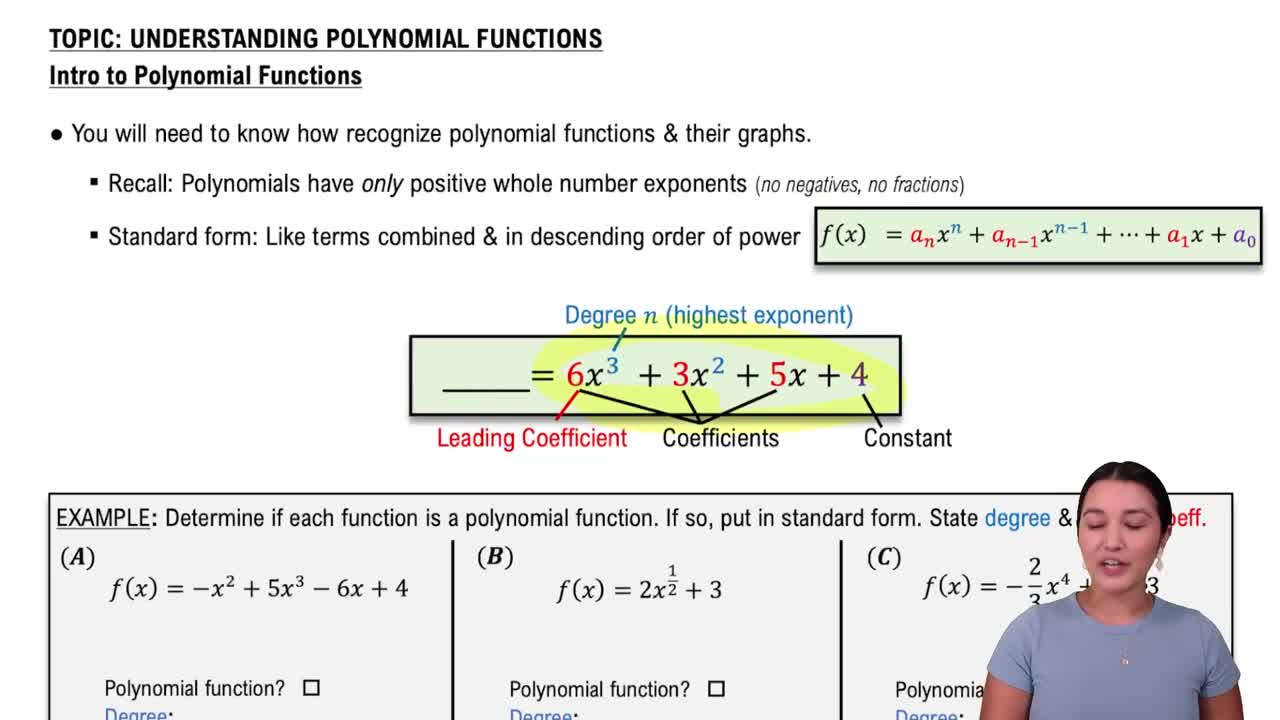
Polynomial functions are expressions consisting of variables raised to whole-number exponents combined using addition, subtraction, and multiplication. Understanding the degree and leading coefficient of a polynomial is essential to analyze its graph and behavior.
Recommended video:
Introduction to Polynomial Functions
End Behavior of Polynomial Functions
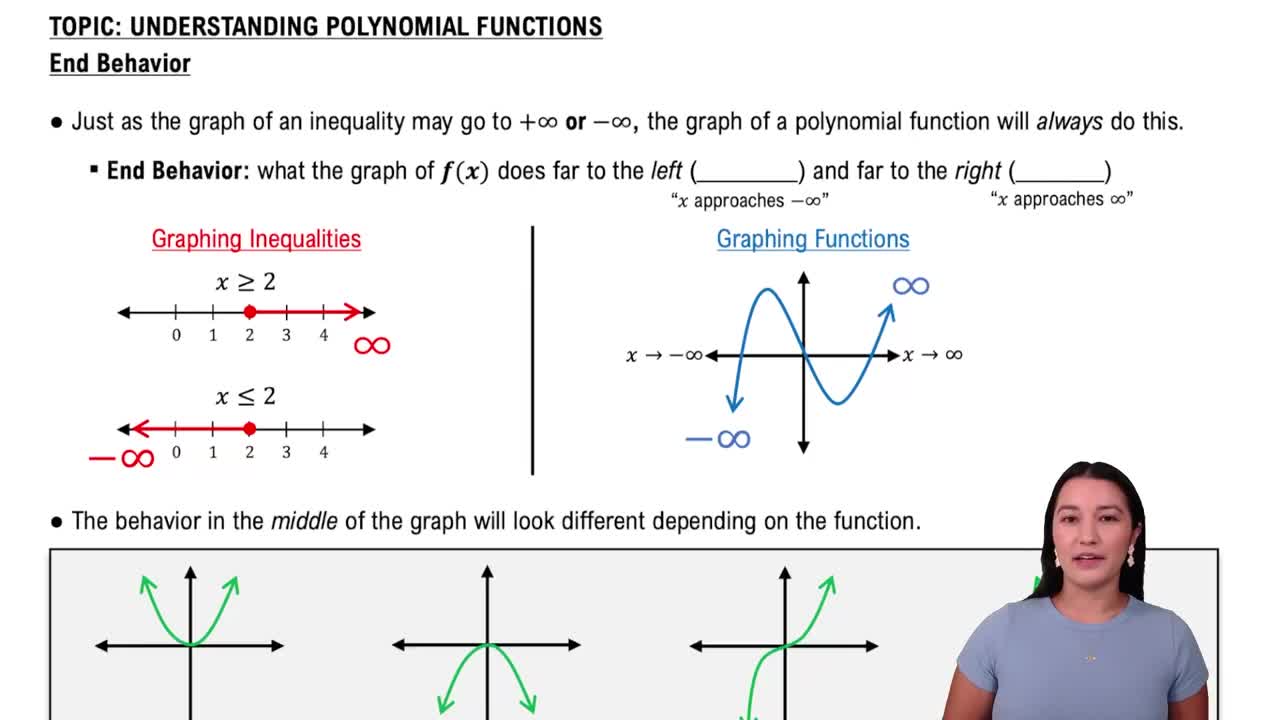
End behavior describes how the values of a polynomial function behave as the input (x) approaches positive or negative infinity. It is primarily determined by the degree and leading coefficient of the polynomial, indicating whether the graph rises or falls at the ends.
Recommended video:
End Behavior of Polynomial Functions
Leading Coefficient Test
The leading coefficient test uses the sign and degree of the leading term to predict the end behavior of a polynomial graph. For example, an odd-degree polynomial with a negative leading coefficient falls to the right and rises to the left, guiding the sketch of the graph.
Recommended video:
End Behavior of Polynomial Functions
Watch next
Master Introduction to Polynomial Functions with a bite sized video explanation from Patrick
Start learningRelated Videos
Related Practice
Textbook Question
876
views