Simplify each radical. Assume all variables represent positive real numbers. 9473
Verified step by step guidance
1
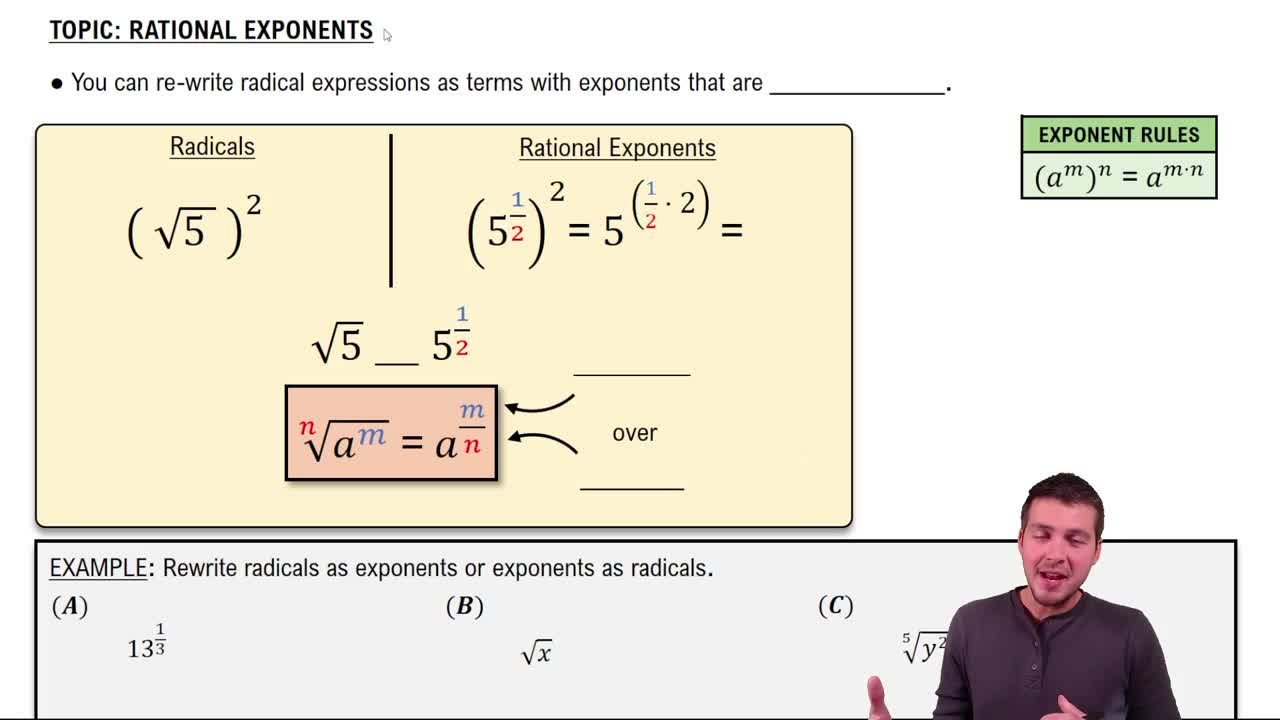
Rewrite the expression using rational exponents. Recall that the nth root of a number can be written as that number raised to the power of 1/n. So, the ninth root of the fourth root of 7 cubed can be written as \(\left(\left(7^{3}\right)^{\frac{1}{4}}\right)^{\frac{1}{9}}\).
Apply the power of a power property of exponents, which states that \((a^{m})^{n} = a^{m \times n}\). Multiply the exponents \(\frac{3}{4}\) and \(\frac{1}{9}\) to simplify the expression inside the parentheses raised to the ninth root.
Calculate the combined exponent: \(\frac{3}{4} \times \frac{1}{9} = \frac{3}{36} = \frac{1}{12}\). So the expression simplifies to \$7^{\frac{1}{12}}$.
Rewrite the expression back into radical form if desired. Since \$7^{\frac{1}{12}}\( is the twelfth root of 7, the simplified radical form is \)\sqrt[12]{7}$.
Confirm that all variables and numbers are positive, so the simplification is valid without considering absolute values.
Verified video answer for a similar problem:
This video solution was recommended by our tutors as helpful for the problem above
Video duration:
2m
Play a video:
Was this helpful?
Key Concepts
Here are the essential concepts you must grasp in order to answer the question correctly.
Radical Expressions and Their Properties
Radical expressions involve roots such as square roots, cube roots, and higher-order roots. Understanding how to manipulate and simplify these expressions requires knowledge of how radicals represent fractional exponents and how to combine or separate roots.
Radicals can be rewritten using fractional exponents, where the root corresponds to the denominator and the power corresponds to the numerator. For example, the nth root of a number raised to the mth power is expressed as the number raised to the m/n power, facilitating simplification.
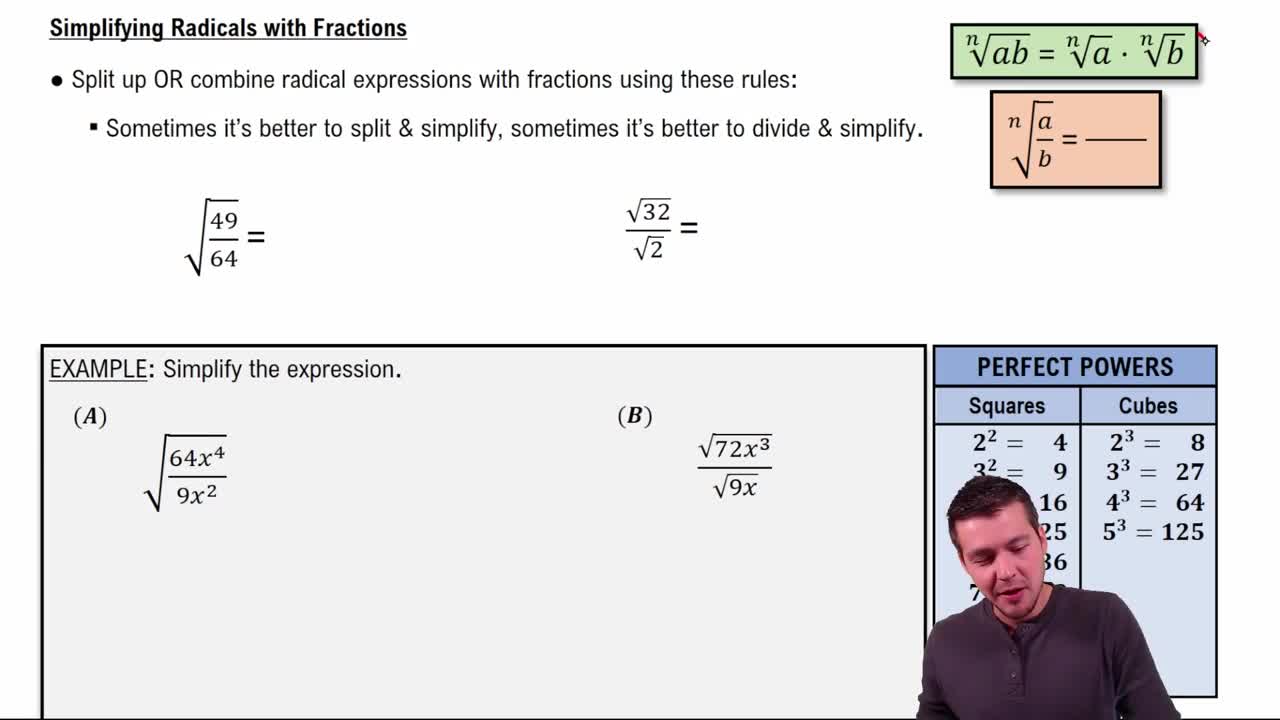
When radicals are nested, such as a root inside another root, they can be combined by multiplying the indices of the roots. This process simplifies the expression by converting nested radicals into a single radical with a product of the indices as its root.