In Exercises 59–94, solve each absolute value inequality. 5 > |4 - x|
Verified step by step guidance
1
Recall that the absolute value inequality \$5 > |4 - x|\( means the distance between \)4 - x\( and \)0$ is less than 5.
Rewrite the inequality without the absolute value as a compound inequality: \(-5 < 4 - x < 5\).
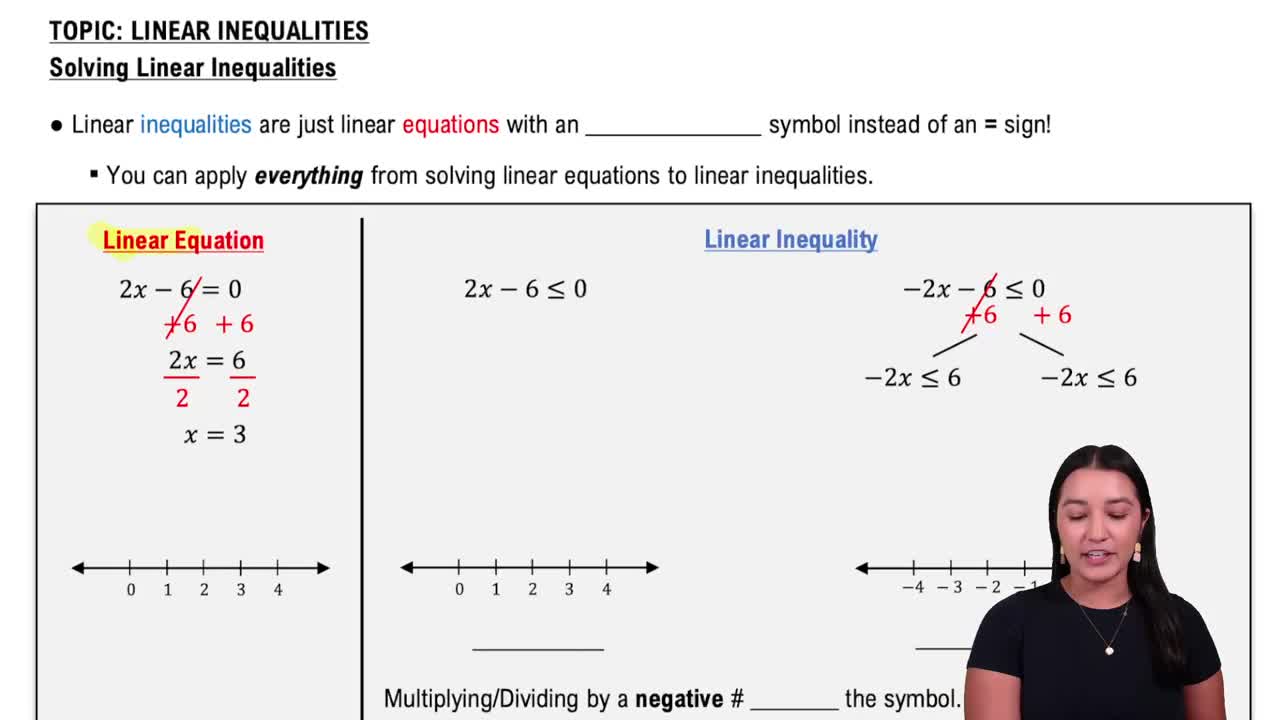
Solve the left part of the compound inequality: \(-5 < 4 - x\). Subtract 4 from both sides to get \(-9 < -x\), then multiply both sides by \(-1\) (remember to reverse the inequality) to get \(x < 9\).
Solve the right part of the compound inequality: \$4 - x < 5\(. Subtract 4 from both sides to get \)-x < 1\(, then multiply both sides by \)-1\( (reverse the inequality) to get \)x > -1$.
Combine the two inequalities to write the solution as \(-1 < x < 9\).
Verified video answer for a similar problem:
This video solution was recommended by our tutors as helpful for the problem above
Video duration:
4m
Play a video:
Was this helpful?
Key Concepts
Here are the essential concepts you must grasp in order to answer the question correctly.
Absolute Value Definition
The absolute value of a number represents its distance from zero on the number line, always as a non-negative value. For any expression |A|, it equals A if A is non-negative, and -A if A is negative. Understanding this helps in rewriting absolute value inequalities into equivalent compound inequalities.
An inequality involving absolute value, such as |A| < b (where b > 0), can be rewritten as a compound inequality: -b < A < b. This allows solving for the variable by isolating it within these bounds. Recognizing this form is essential to find the solution set for the inequality.
Compound inequalities involve two inequalities joined by 'and' or 'or'. For absolute value inequalities like |4 - x| < 5, the solution is found by solving the compound inequality -5 < 4 - x < 5. Understanding how to manipulate and solve these inequalities is key to determining the correct solution range.