Solve each inequality. Give the solution set using interval notation. 5 ≤ 2x -3 ≤ 7
Table of contents
- 0. Review of Algebra4h 18m
- 1. Equations & Inequalities3h 18m
- 2. Graphs of Equations1h 43m
- 3. Functions2h 17m
- 4. Polynomial Functions1h 44m
- 5. Rational Functions1h 23m
- 6. Exponential & Logarithmic Functions2h 28m
- 7. Systems of Equations & Matrices4h 5m
- 8. Conic Sections2h 23m
- 9. Sequences, Series, & Induction1h 22m
- 10. Combinatorics & Probability1h 45m
1. Equations & Inequalities
Linear Inequalities
Problem 91
Textbook Question
In Exercises 59–94, solve each absolute value inequality. 12<−2x+76+73
Verified step by step guidance1
Start by isolating the absolute value expression on one side of the inequality. Subtract \( \frac{3}{7} \) from both sides to get: \[ 12 - \frac{3}{7} < \left| -2x + \frac{6}{7} \right| \]
Simplify the left side by finding a common denominator and performing the subtraction: \[ \text{Calculate } 12 - \frac{3}{7} = \frac{84}{7} - \frac{3}{7} = \frac{81}{7} \]. So the inequality becomes: \[ \frac{81}{7} < \left| -2x + \frac{6}{7} \right| \]
Rewrite the inequality to the standard form for absolute value inequalities: \[ \left| -2x + \frac{6}{7} \right| > \frac{81}{7} \]
Recall that for \( |A| > B \) where \( B > 0 \), the solution splits into two inequalities: \[ A < -B \quad \text{or} \quad A > B \]. Apply this to get: \[ -2x + \frac{6}{7} < -\frac{81}{7} \quad \text{or} \quad -2x + \frac{6}{7} > \frac{81}{7} \]
Solve each inequality separately for \( x \). For each, subtract \( \frac{6}{7} \) from both sides, then divide by \( -2 \), remembering to reverse the inequality sign when dividing by a negative number.
Verified video answer for a similar problem:This video solution was recommended by our tutors as helpful for the problem above
Video duration:
5mPlay a video:
Was this helpful?
Key Concepts
Here are the essential concepts you must grasp in order to answer the question correctly.
Absolute Value Inequalities
An absolute value inequality involves expressions within absolute value bars and requires finding all values of the variable that satisfy the inequality. The absolute value represents the distance from zero, so inequalities often split into two cases to solve.
Recommended video:
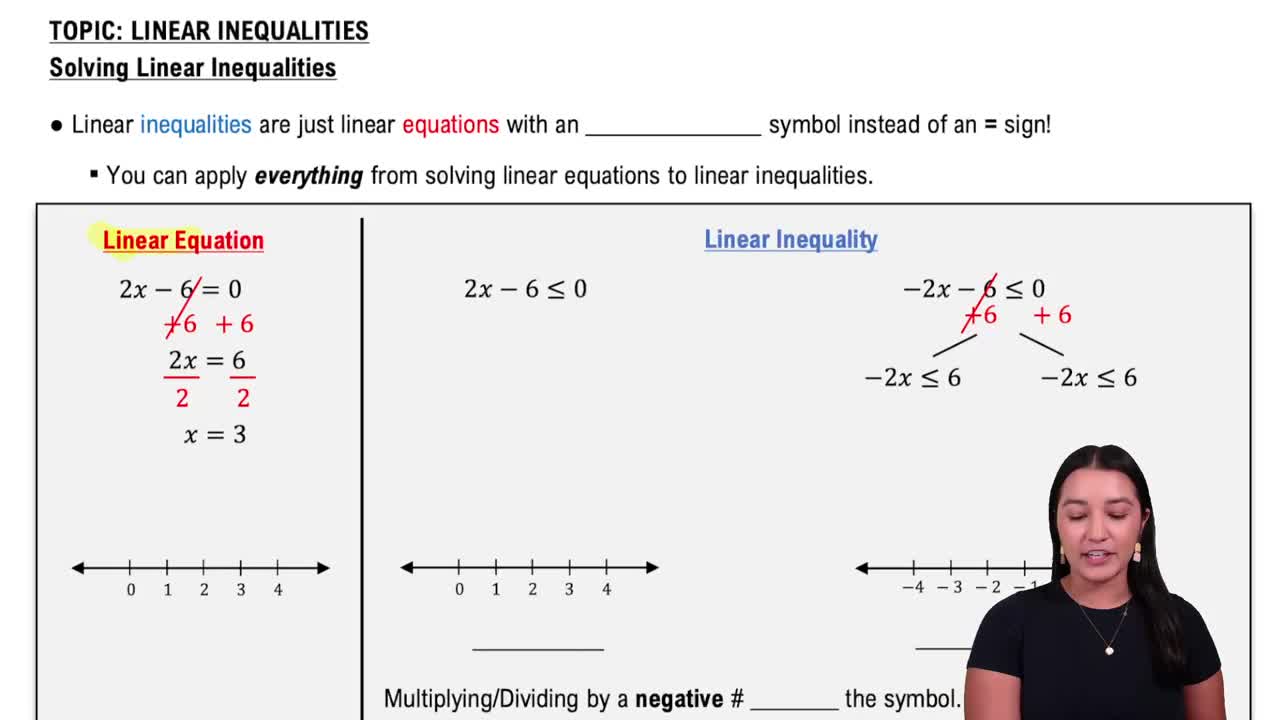
Linear Inequalities
Isolating the Absolute Value Expression
Before solving an absolute value inequality, isolate the absolute value term on one side of the inequality. This often involves subtracting or adding constants and combining like terms to simplify the inequality for further analysis.
Recommended video:
Guided course
Introduction to Algebraic Expressions
Solving Compound Inequalities
Absolute value inequalities can translate into compound inequalities, such as 'less than' or 'greater than' forms. Understanding how to split and solve these compound inequalities is essential to find the solution set for the variable.
Recommended video:
Linear Inequalities
Related Videos
Related Practice
Textbook Question
1216
views