Write the first four terms of each sequence whose general term is given.
Verified step by step guidance
1
Identify the general term of the sequence given by \(a_n = \frac{1}{(n - 1)!}\), where \(n\) is a positive integer starting from 1.
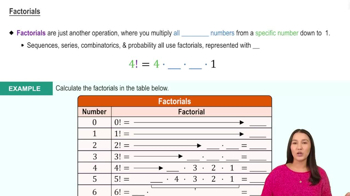
Recall that the factorial function \(k!\) is defined as the product of all positive integers from 1 up to \(k\), with the special case \$0! = 1$.
Calculate the first four terms by substituting \(n = 1, 2, 3, 4\) into the general term formula:
\(a_1 = \frac{1}{(1 - 1)!} = \frac{1}{0!}\),
\(a_2 = \frac{1}{(2 - 1)!} = \frac{1}{1!}\),
\(a_3 = \frac{1}{(3 - 1)!} = \frac{1}{2!}\),
\(a_4 = \frac{1}{(4 - 1)!} = \frac{1}{3!}\).
Verified video answer for a similar problem:
This video solution was recommended by our tutors as helpful for the problem above
Video duration:
3m
Play a video:
Was this helpful?
Key Concepts
Here are the essential concepts you must grasp in order to answer the question correctly.
Sequences and Terms
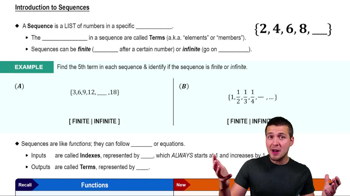
A sequence is an ordered list of numbers defined by a specific rule or formula. Each number in the sequence is called a term, and the position of a term is indicated by its index n. Understanding how to find terms from a general formula is essential for working with sequences.
The factorial of a non-negative integer n, denoted n!, is the product of all positive integers from 1 to n. By definition, 0! = 1. Factorials grow very quickly and are commonly used in sequences, permutations, and combinations.
To find specific terms of a sequence, substitute the term number n into the general term formula. For example, for a_n = 1/(n - 1)!, calculate the factorial of (n - 1) and then find its reciprocal. This process helps generate the sequence's terms explicitly.