Write the first four terms of each sequence whose general term is given.
Table of contents
- 0. Review of Algebra4h 18m
- 1. Equations & Inequalities3h 18m
- 2. Graphs of Equations1h 43m
- 3. Functions2h 17m
- 4. Polynomial Functions1h 44m
- 5. Rational Functions1h 23m
- 6. Exponential & Logarithmic Functions2h 28m
- 7. Systems of Equations & Matrices4h 5m
- 8. Conic Sections2h 23m
- 9. Sequences, Series, & Induction1h 22m
- 10. Combinatorics & Probability1h 45m
9. Sequences, Series, & Induction
Sequences
Problem 8
Textbook Question
In Exercises 8–9, find each indicated sum. This is a summation, refer to the textbook.
Verified step by step guidance1
Step 1: Understand the summation notation. Summation is represented by the Greek letter sigma (∑) and involves adding terms of a sequence. The general form is ∑_(i=a)^(b) f(i), where 'i' is the index of summation, 'a' is the starting value, 'b' is the ending value, and f(i) is the function to be summed.
Step 2: Identify the given summation parameters from the problem. Look for the starting index (a), ending index (b), and the function f(i) that needs to be summed. These details are typically provided in the problem statement or textbook.
Step 3: Substitute the values of the index into the function f(i) for each integer from the starting index (a) to the ending index (b). Write out each term explicitly to ensure clarity.
Step 4: Add the terms together. This involves performing the arithmetic operations to compute the sum of all the terms generated in the previous step.
Step 5: Verify your work by checking each substitution and addition step for accuracy. If the problem involves a formula for summation (e.g., the sum of an arithmetic sequence or geometric sequence), apply the formula as needed to simplify the calculation.
Verified video answer for a similar problem:This video solution was recommended by our tutors as helpful for the problem above
Video duration:
2mPlay a video:
Was this helpful?
Key Concepts
Here are the essential concepts you must grasp in order to answer the question correctly.
Summation Notation
Summation notation, often represented by the Greek letter sigma (Σ), is a concise way to express the sum of a sequence of terms. It includes an index of summation, a lower limit, an upper limit, and the expression to be summed. Understanding how to interpret and manipulate this notation is essential for calculating sums in algebra.
Recommended video:
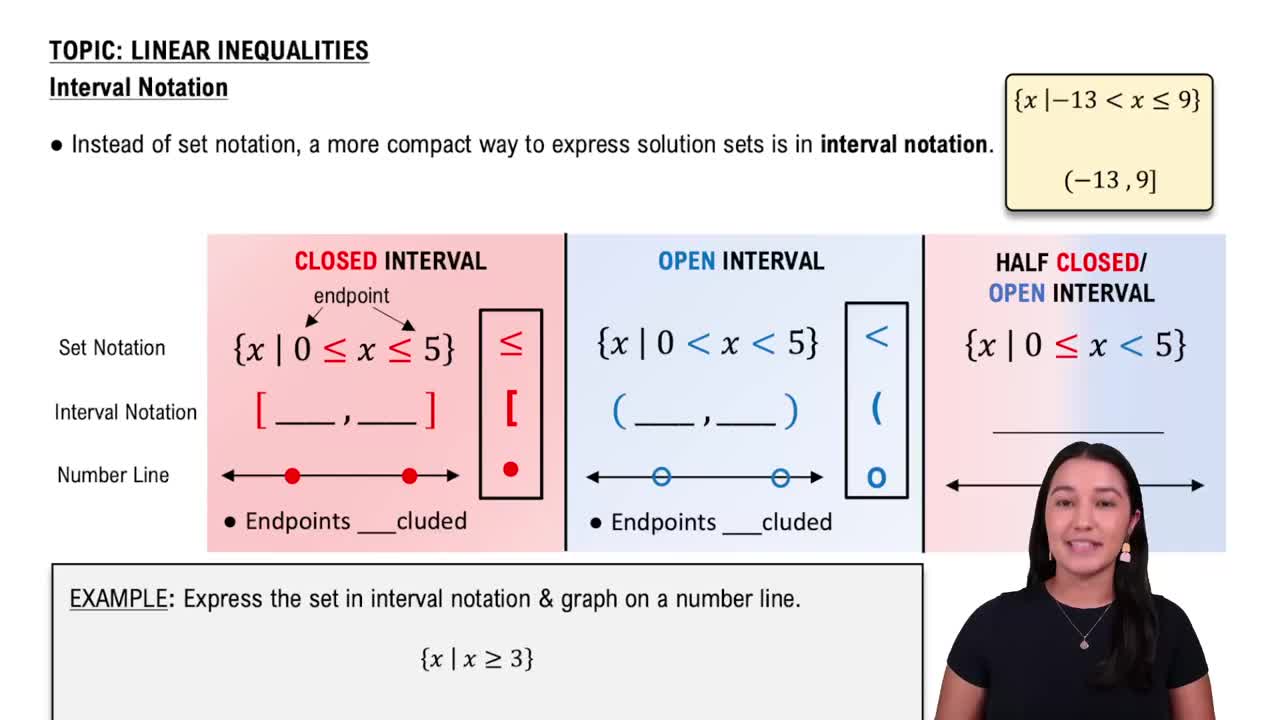
Interval Notation
Arithmetic Series
An arithmetic series is the sum of the terms of an arithmetic sequence, where each term after the first is obtained by adding a constant difference. The formula for the sum of the first n terms of an arithmetic series is S_n = n/2 * (a + l), where a is the first term, l is the last term, and n is the number of terms. Recognizing this structure helps in efficiently calculating sums.
Recommended video:
Guided course
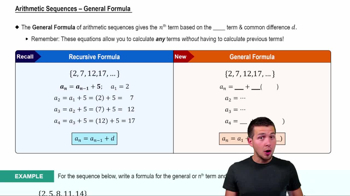
Arithmetic Sequences - General Formula
Geometric Series
A geometric series is the sum of the terms of a geometric sequence, where each term is multiplied by a constant ratio. The sum of the first n terms can be calculated using the formula S_n = a(1 - r^n) / (1 - r) for r ≠ 1, where a is the first term and r is the common ratio. Understanding geometric series is crucial for solving problems involving exponential growth or decay.
Recommended video:
Guided course
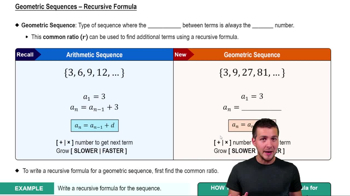
Geometric Sequences - Recursive Formula
Watch next
Master Introduction to Sequences with a bite sized video explanation from Patrick
Start learningRelated Videos
Related Practice
Textbook Question
702
views