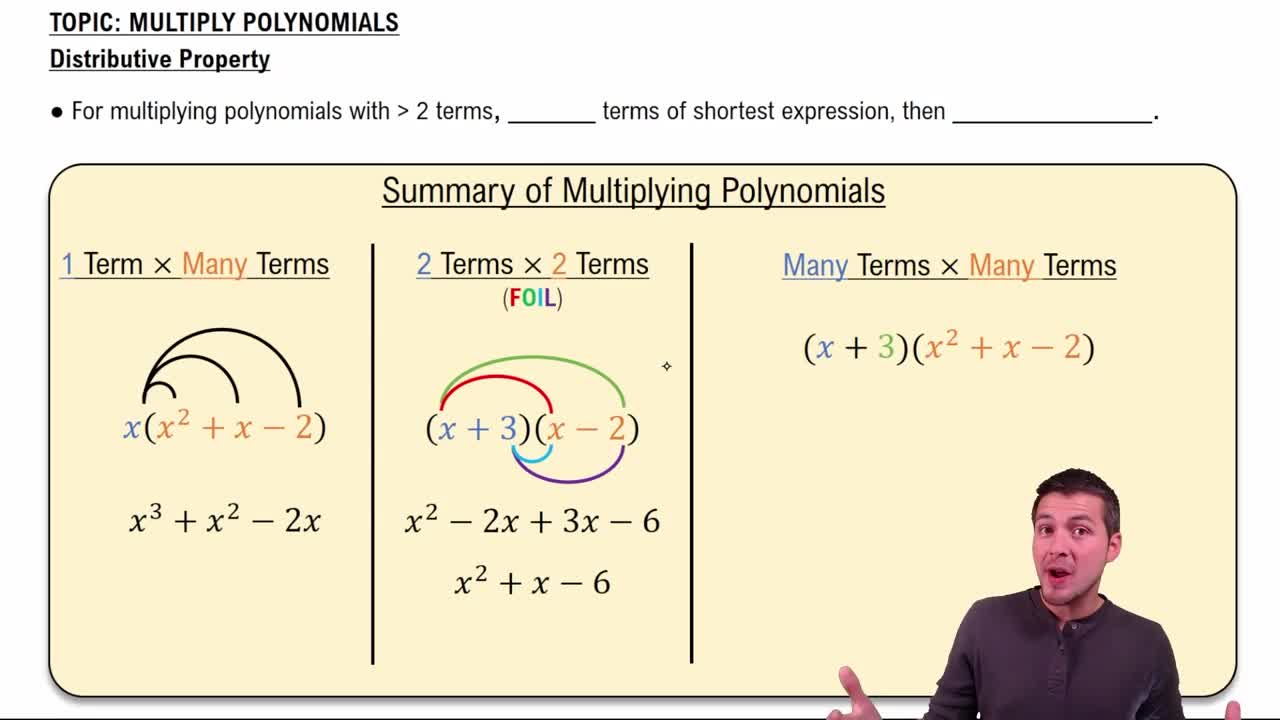
Distribute the first term of the first binomial, \(5m\), to each term in the second binomial, \(3m+4\).
Multiply \(5m\) by \(3m\) to get \(15m^2\).
Multiply \(5m\) by \(4\) to get \(20m\).
Distribute the second term of the first binomial, \(-6\), to each term in the second binomial, \(3m+4\).
Multiply \(-6\) by \(3m\) to get \(-18m\), and \(-6\) by \(4\) to get \(-24\).
Verified video answer for a similar problem:
This video solution was recommended by our tutors as helpful for the problem above
Video duration:
1m
Play a video:
Was this helpful?
Key Concepts
Here are the essential concepts you must grasp in order to answer the question correctly.
Polynomial Multiplication
Polynomial multiplication involves distributing each term in one polynomial to every term in another polynomial. This process is often executed using the distributive property, ensuring that all combinations of terms are accounted for. For example, in the expression (5m - 6)(3m + 4), each term in the first polynomial must be multiplied by each term in the second polynomial.
After multiplying polynomials, the next step is to combine like terms, which are terms that have the same variable raised to the same power. This simplification process helps in reducing the expression to its simplest form. For instance, if the multiplication yields terms like 15m^2, 20m, and -18, the like terms can be combined to produce a more concise polynomial.
The distributive property states that a(b + c) = ab + ac, allowing for the multiplication of a single term by a sum. This property is fundamental in polynomial multiplication, as it facilitates the expansion of expressions. In the given problem, applying the distributive property correctly ensures that each term is multiplied accurately, leading to the correct final polynomial.