In Exercises 31–42, solve by the method of your choice. Identify systems with no solution and systems with infinitely many solutions, using set notation to express their solution sets. x = 9-2y x + 2y = 13
Table of contents
- 0. Review of Algebra4h 18m
- 1. Equations & Inequalities3h 18m
- 2. Graphs of Equations1h 43m
- 3. Functions2h 17m
- 4. Polynomial Functions1h 44m
- 5. Rational Functions1h 23m
- 6. Exponential & Logarithmic Functions2h 28m
- 7. Systems of Equations & Matrices4h 5m
- 8. Conic Sections2h 23m
- 9. Sequences, Series, & Induction1h 22m
- 10. Combinatorics & Probability1h 45m
7. Systems of Equations & Matrices
Two Variable Systems of Linear Equations
Problem 35
Textbook Question
Solve each system of equations. State whether it is an inconsistent system or has infinitely many solutions. If a system has infinitely many solutions, write the solution set with x arbitrary.
5x - 5y - 3 = 0
x - y - 12 = 0
Verified step by step guidance1
Rewrite each equation in the system in the form \(Ax + By = C\) to clearly identify coefficients and constants. For the first equation, add 3 to both sides to get \$5x - 5y = 3\(. For the second equation, add 12 to both sides to get \)x - y = 12$.
Observe the relationship between the two equations. Notice that the first equation has coefficients 5 and -5, and the second has coefficients 1 and -1. Check if the first equation is a multiple of the second by comparing the ratios of the coefficients: \(\frac{5}{1}\) and \(\frac{-5}{-1}\).
If the ratios of the coefficients of \(x\) and \(y\) are equal, check the ratio of the constants on the right side of the equations. Compare \(\frac{3}{12}\). If this ratio is not equal to the coefficient ratios, the system is inconsistent (no solution). If it is equal, the system has infinitely many solutions.
If the system has infinitely many solutions, express one variable in terms of the other using one of the equations. For example, from \(x - y = 12\), solve for \(x\) as \(x = y + 12\) or for \(y\) as \(y = x - 12\).
Write the solution set using a parameter (such as \(t\)) to represent the arbitrary variable. For example, let \(y = t\), then \(x = t + 12\), and express the solution set as \(\{(x, y) | x = t + 12, y = t, t \in \mathbb{R} \}\).
Verified video answer for a similar problem:This video solution was recommended by our tutors as helpful for the problem above
Video duration:
2mPlay a video:
Key Concepts
Here are the essential concepts you must grasp in order to answer the question correctly.
Solving Systems of Linear Equations
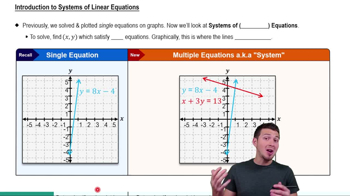
A system of linear equations consists of two or more linear equations with the same variables. Solving the system means finding all variable values that satisfy every equation simultaneously. Methods include substitution, elimination, and graphing, which help determine if solutions exist and what they are.
Recommended video:
Guided course
Introduction to Systems of Linear Equations
Types of Solutions for Systems
Systems of equations can have one unique solution, infinitely many solutions, or no solution (inconsistent). A unique solution occurs when lines intersect at one point, infinitely many when lines coincide, and no solution when lines are parallel and distinct.
Recommended video:
Guided course
Systems of Inequalities
Expressing Solutions with Parameters
When a system has infinitely many solutions, the solution set is expressed using a parameter (often x or t) to represent the free variable. This allows writing dependent variables in terms of the parameter, describing all possible solutions compactly.
Recommended video:
Guided course
Introduction to Algebraic Expressions
Watch next
Master Introduction to Systems of Linear Equations with a bite sized video explanation from Patrick
Start learningRelated Videos
Related Practice
Textbook Question
670
views