Solve each problem. Work each of the following. Sketch the graph of a function that does not intersect its horizontal asymptote y=1, has the line x=3 as a vertical asymptote, and has x-intercepts (2, 0) and (4, 0).
Table of contents
- 0. Review of Algebra4h 18m
- 1. Equations & Inequalities3h 18m
- 2. Graphs of Equations1h 43m
- 3. Functions2h 17m
- 4. Polynomial Functions1h 44m
- 5. Rational Functions1h 23m
- 6. Exponential & Logarithmic Functions2h 28m
- 7. Systems of Equations & Matrices4h 5m
- 8. Conic Sections2h 23m
- 9. Sequences, Series, & Induction1h 22m
- 10. Combinatorics & Probability1h 45m
5. Rational Functions
Graphing Rational Functions
Problem 9
Textbook Question
Use the graph of the rational function in the figure shown to complete each statement in Exercises 9–14.

As , ____
Verified step by step guidance1
Identify the point of interest on the x-axis, which is \(x \to -3^-\), meaning we are approaching \(-3\) from the left side.
Look at the graph near \(x = -3\) on the left side to observe the behavior of the function \(f(x)\) as \(x\) approaches \(-3\) from values less than \(-3\).
Notice the value of \(f(x)\) as \(x\) gets closer to \(-3\) from the left. Check if the function values increase without bound (go to \(+\infty\)), decrease without bound (go to \(-\infty\)), or approach a finite number.
From the graph, observe that as \(x\) approaches \(-3\) from the left, the function \(f(x)\) decreases without bound, meaning \(f(x) \to -\infty\).
Summarize the behavior: As \(x \to -3^-\), \(f(x) \to -\infty\).
Verified video answer for a similar problem:This video solution was recommended by our tutors as helpful for the problem above
Video duration:
1mPlay a video:
Was this helpful?
Key Concepts
Here are the essential concepts you must grasp in order to answer the question correctly.
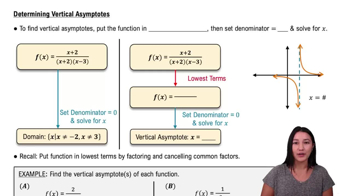
Vertical Asymptotes
Vertical asymptotes occur where the function approaches infinity or negative infinity as the input approaches a specific value. They indicate values of x where the function is undefined, often due to division by zero in rational functions. In the graph, vertical asymptotes are shown at x = 6 and x = 14.
Recommended video:
Determining Vertical Asymptotes
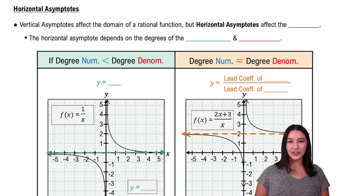
Horizontal Asymptotes
A horizontal asymptote represents the value that the function approaches as x tends to positive or negative infinity. It shows the end behavior of the function. In this graph, the horizontal asymptote is y = 0, meaning the function values get closer to zero as x becomes very large or very small.
Recommended video:
Determining Horizontal Asymptotes
Limit Behavior Near a Point
The limit of a function as x approaches a specific value from the left or right describes the function's behavior near that point. For example, as x approaches -3 from the left (x → -3⁻), the function value approaches a certain number or infinity. Understanding this helps in interpreting the graph and completing limit statements.
Recommended video:
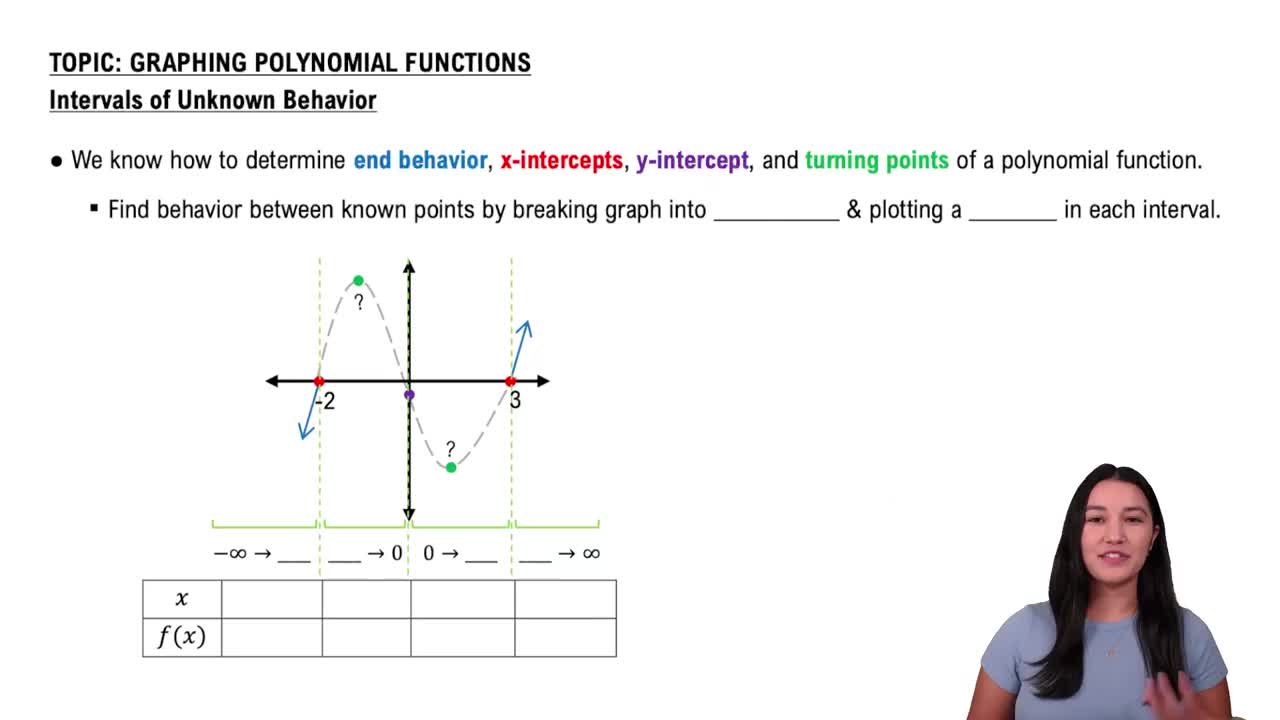
Identifying Intervals of Unknown Behavior
Watch next
Master Graphing Rational Functions Using Transformations with a bite sized video explanation from Patrick
Start learningRelated Videos
Related Practice
Textbook Question
427
views