Start by rewriting the equation to clearly identify the terms: \(\sqrt{4x} - x + 3 = 0\).
Isolate the square root term on one side of the equation: \(\sqrt{4x} = x - 3\).
Square both sides of the equation to eliminate the square root: \((\sqrt{4x})^2 = (x - 3)^2\), which simplifies to \$4x = (x - 3)^2$.
Expand the right side using the binomial formula: \$4x = x^2 - 6x + 9$.
Rearrange the equation to standard quadratic form by bringing all terms to one side: \$0 = x^2 - 6x + 9 - 4x\(, which simplifies to \)0 = x^2 - 10x + 9$.
Verified video answer for a similar problem:
This video solution was recommended by our tutors as helpful for the problem above
Video duration:
5m
Play a video:
Was this helpful?
Key Concepts
Here are the essential concepts you must grasp in order to answer the question correctly.
Square Root Equations
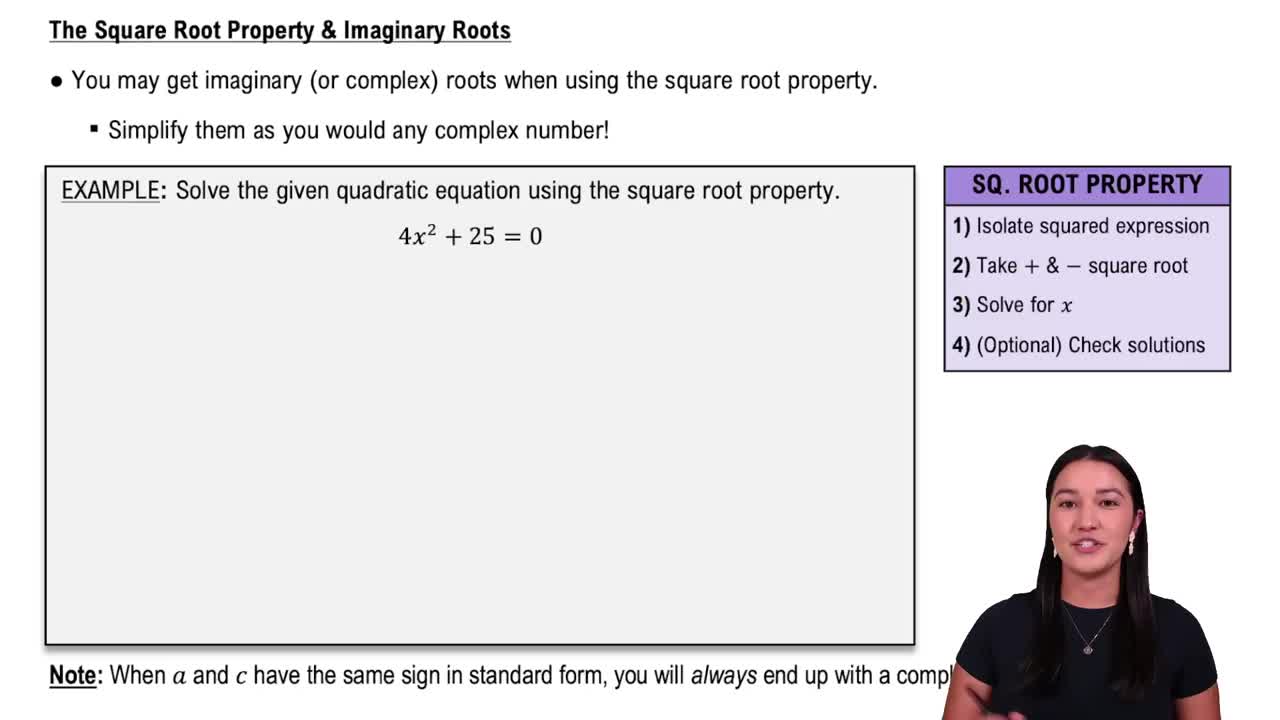
Square root equations involve variables inside a radical sign. To solve them, isolate the square root expression and then square both sides to eliminate the radical. This process may introduce extraneous solutions, so checking all solutions in the original equation is essential.
Isolating the variable means manipulating the equation to get the variable alone on one side. This step is crucial before squaring both sides to avoid complicating the equation and to ensure accurate solutions.
Squaring both sides of an equation can introduce solutions that do not satisfy the original equation. After solving, substitute each solution back into the original equation to verify its validity and discard any extraneous solutions.