In Exercises 55–58, find the indicated function values for each function.
___
f(x) = ³√x−1; f(28), f(9), f(0), f(−63)
Verified step by step guidance
1
Identify the function given: \( f(x) = \sqrt[3]{x} - 1 \).
To find \( f(28) \), substitute \( x = 28 \) into the function: \( f(28) = \sqrt[3]{28} - 1 \).
To find \( f(9) \), substitute \( x = 9 \) into the function: \( f(9) = \sqrt[3]{9} - 1 \).
To find \( f(0) \), substitute \( x = 0 \) into the function: \( f(0) = \sqrt[3]{0} - 1 \).
To find \( f(-63) \), substitute \( x = -63 \) into the function: \( f(-63) = \sqrt[3]{-63} - 1 \).
Verified video answer for a similar problem:
This video solution was recommended by our tutors as helpful for the problem above.
Video duration:
5m
Play a video:
0 Comments
Key Concepts
Here are the essential concepts you must grasp in order to answer the question correctly.
Cube Root Function
The cube root function, denoted as f(x) = ³√x, is a mathematical function that returns the number which, when multiplied by itself three times, gives the original number x. This function is defined for all real numbers, including negative values, and is characterized by its odd symmetry about the origin.
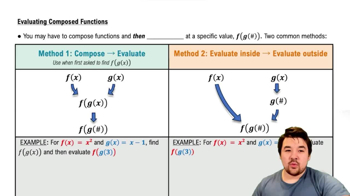
Function evaluation involves substituting a specific value into a function to determine the output. For example, to find f(28) for the function f(x) = ³√x−1, you replace x with 28, resulting in f(28) = ³√28 - 1. This process is essential for calculating specific function values.
The domain of a function refers to the set of all possible input values (x-values) for which the function is defined. For the cube root function, the domain is all real numbers, meaning it can accept any real number, including negative numbers, which is important when evaluating the function at various inputs.

 5:05 minutes
 Verified step by step guidance
 02:20
02:20