Use the rules for radicals to perform the indicated operations. Assume all variable expressions represent positive real numbers. √14 • √3pqr
Verified step by step guidance
1
Recognize that the expression involves multiplying two square roots: \( \sqrt{14} \) and \( \sqrt{3pqr} \).
Use the property of radicals that states \( \sqrt{a} \cdot \sqrt{b} = \sqrt{a \cdot b} \).
Apply this property to combine the radicals: \( \sqrt{14} \cdot \sqrt{3pqr} = \sqrt{14 \cdot 3pqr} \).
Multiply the numbers and variables under the radical: \( 14 \cdot 3pqr = 42pqr \).
Express the result as a single radical: \( \sqrt{42pqr} \).
Verified video answer for a similar problem:
This video solution was recommended by our tutors as helpful for the problem above
Video duration:
1m
Play a video:
Was this helpful?
Key Concepts
Here are the essential concepts you must grasp in order to answer the question correctly.
Properties of Radicals
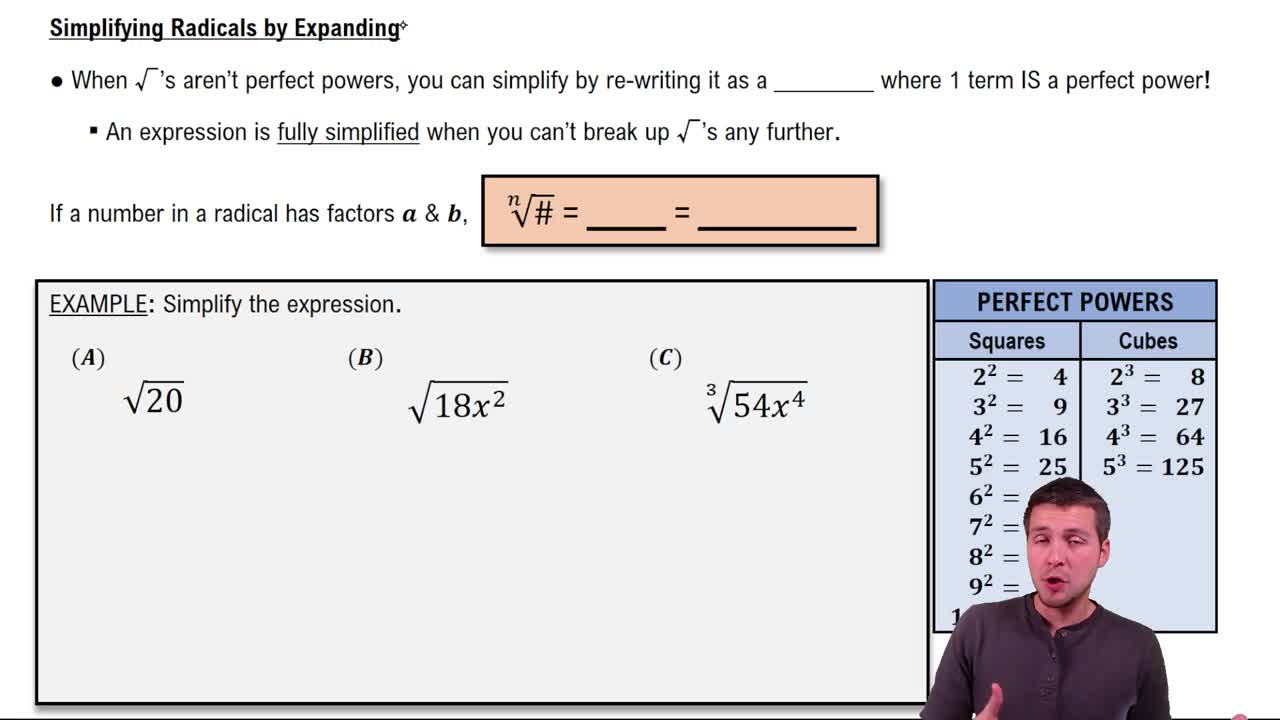
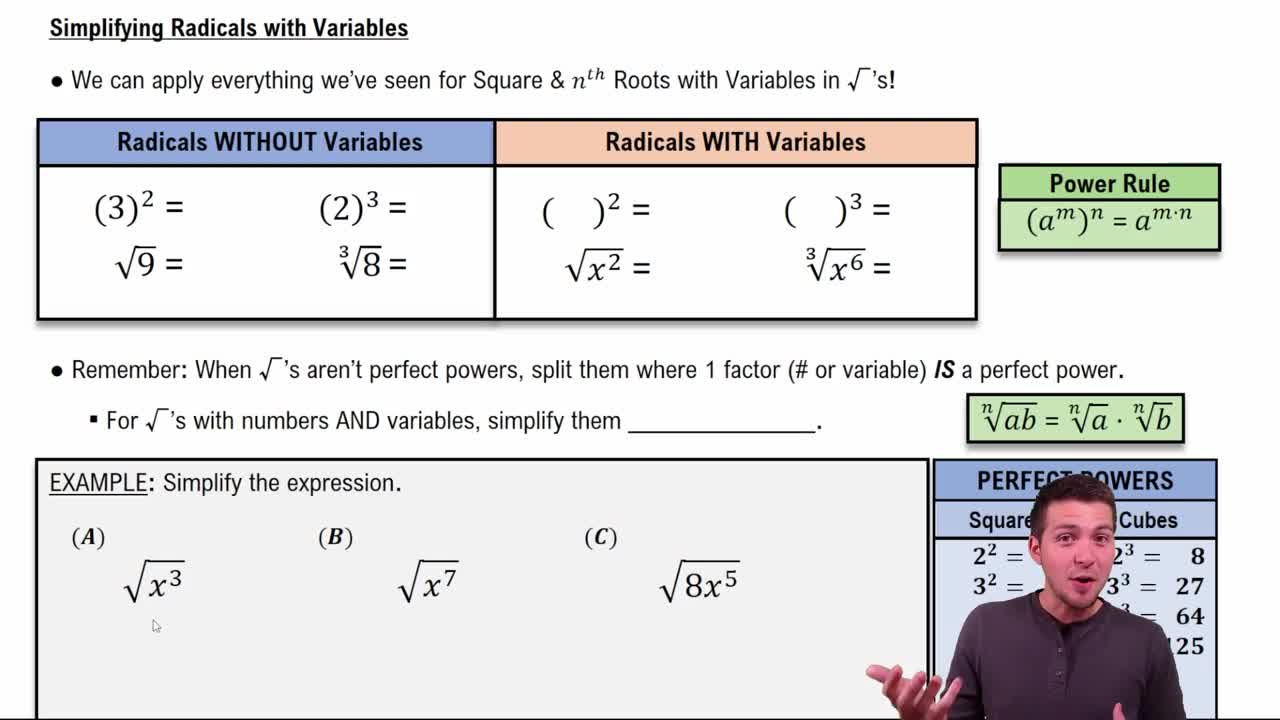
The properties of radicals include rules for simplifying and combining radical expressions. Key rules state that the product of two square roots can be expressed as the square root of the product of the radicands, i.e., √a • √b = √(a*b). This property is essential for performing operations involving square roots.
Simplifying radicals involves reducing the expression under the square root to its simplest form. This often includes factoring out perfect squares from the radicand. For example, √(a*b) can be simplified if 'a' or 'b' is a perfect square, making calculations easier and clearer.
Adding & Subtracting Unlike Radicals by Simplifying
Assumption of Positive Real Numbers
In this context, assuming all variable expressions represent positive real numbers is crucial for ensuring that the operations performed on radicals yield valid results. This assumption avoids complications that arise from taking square roots of negative numbers, which are not defined in the set of real numbers.