Identify the expression to rationalize: \(\frac{11}{\sqrt{7} - \sqrt{3}}\).
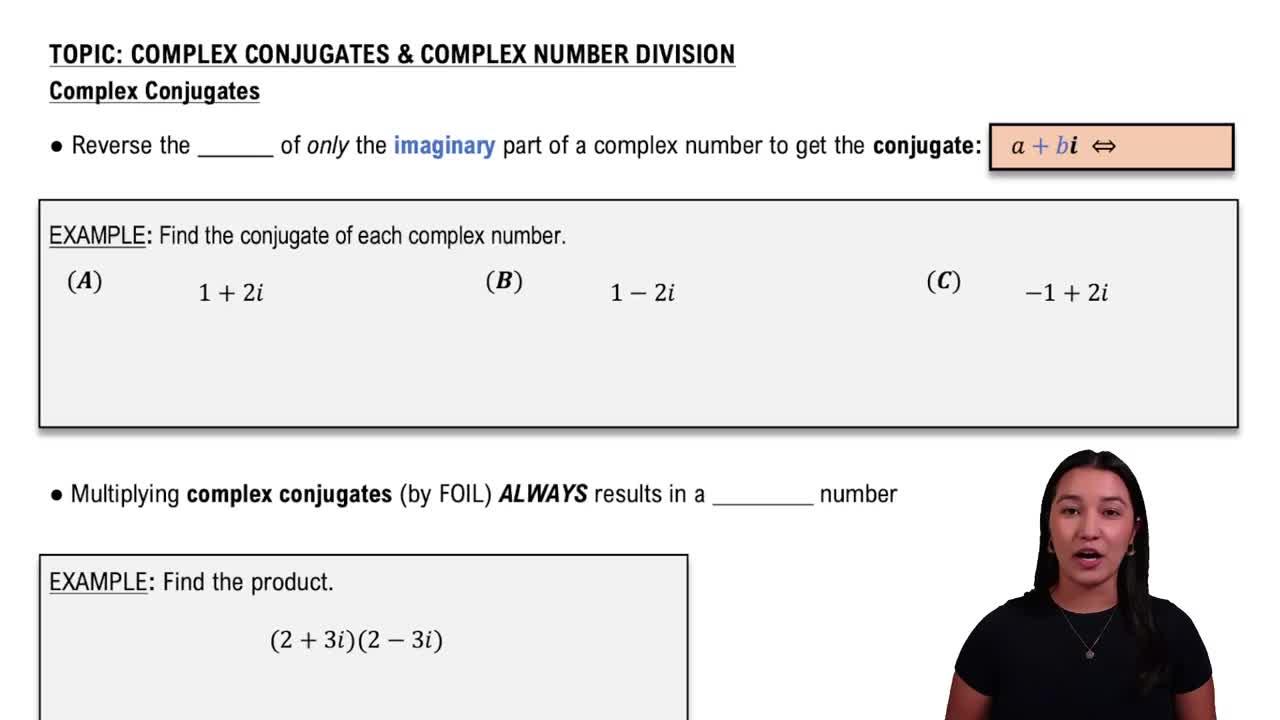
Recognize that the denominator is a binomial involving square roots, so multiply numerator and denominator by the conjugate of the denominator to rationalize it. The conjugate of \(\sqrt{7} - \sqrt{3}\) is \(\sqrt{7} + \sqrt{3}\).
Multiply numerator and denominator by the conjugate: \(\frac{11}{\sqrt{7} - \sqrt{3}} \times \frac{\sqrt{7} + \sqrt{3}}{\sqrt{7} + \sqrt{3}}\).
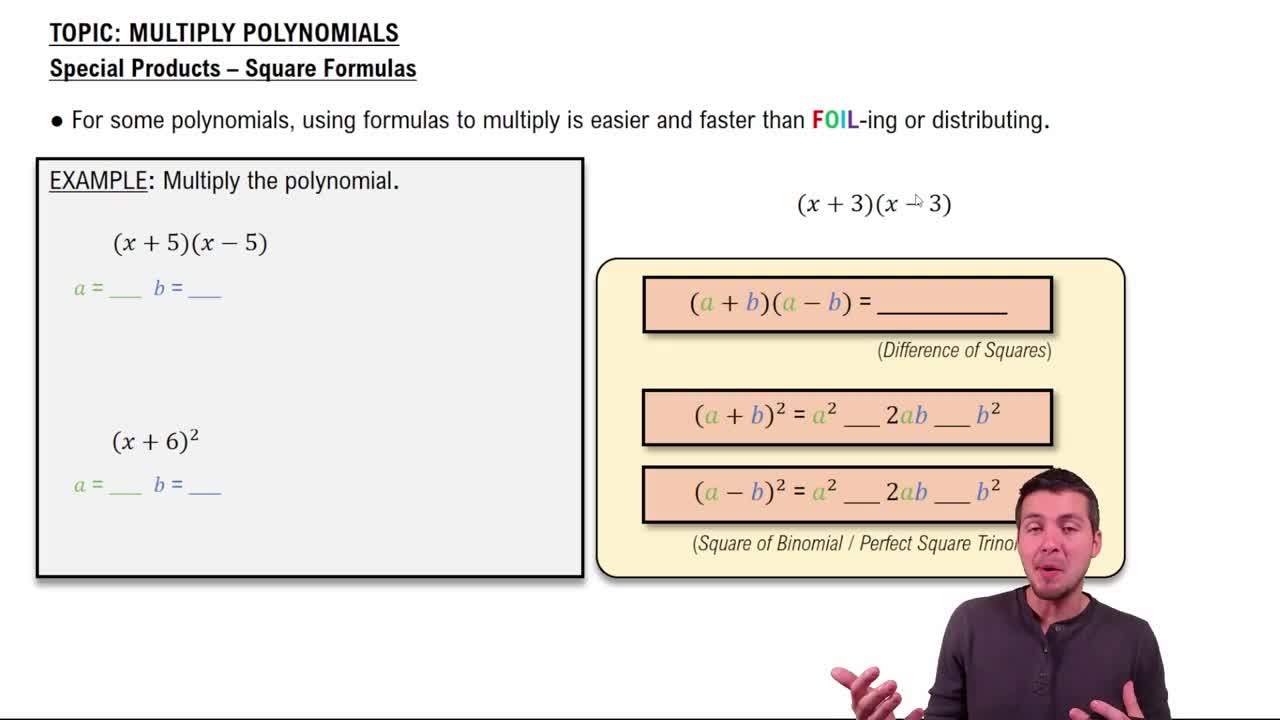
Apply the difference of squares formula to the denominator: \((a - b)(a + b) = a^2 - b^2\). Here, \(a = \sqrt{7}\) and \(b = \sqrt{3}\), so the denominator becomes \$7 - 3$.
Write the new expression as \(\frac{11(\sqrt{7} + \sqrt{3})}{7 - 3}\) and simplify the denominator to complete the rationalization process.
Verified video answer for a similar problem:
This video solution was recommended by our tutors as helpful for the problem above
Video duration:
3m
Play a video:
Was this helpful?
Key Concepts
Here are the essential concepts you must grasp in order to answer the question correctly.
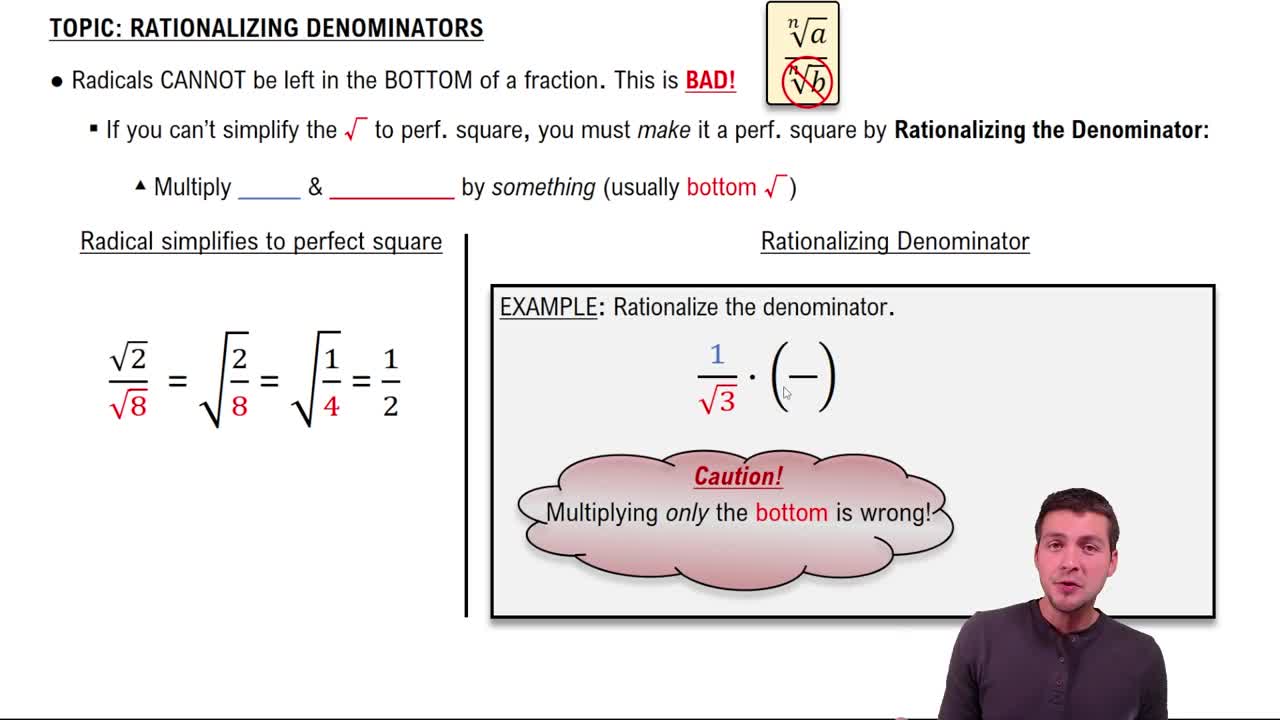
Rationalizing the Denominator
Rationalizing the denominator involves eliminating any radicals (square roots) from the denominator of a fraction. This is done to simplify the expression and make it easier to work with. For denominators with square roots, multiplying numerator and denominator by a suitable expression removes the radical.
The conjugate of a binomial expression like (√7 − √3) is (√7 + √3). Multiplying a binomial by its conjugate uses the difference of squares formula, which eliminates the square roots in the denominator by producing a rational number.
The difference of squares formula states that (a − b)(a + b) = a² − b². This property is used to simplify expressions involving conjugates, especially when rationalizing denominators containing square roots, by turning the product into a difference of perfect squares.