A statement Sn about the positive integers is given. Write statements S1, S2 and S3 and show that each of these statements is true. Sn: 1 + 3 + 5 + ... + (2n - 1) = n2
Verified step by step guidance
1
Step 1: Understand the statement S_n, which says that the sum of the first n odd numbers is equal to n squared. In other words, \(1 + 3 + 5 + \ldots + (2n - 1) = n^2\).
Step 2: Write out the statements for \(S_1\), \(S_2\), and \(S_3\) by substituting \(n = 1, 2, 3\) respectively:
\(S_1: 1 = 1^2\)
\(S_2: 1 + 3 = 2^2\)
\(S_3: 1 + 3 + 5 = 3^2\)
Step 3: Verify \(S_1\) by calculating the left side and right side separately:
Left side: 1
Right side: \(1^2 = 1\)
Since both sides are equal, \(S_1\) is true.
Step 4: Verify \(S_2\) by calculating the left side and right side separately:
Left side: \(1 + 3 = 4\)
Right side: \(2^2 = 4\)
Since both sides are equal, \(S_2\) is true.
Step 5: Verify \(S_3\) by calculating the left side and right side separately:
Left side: \(1 + 3 + 5 = 9\)
Right side: \(3^2 = 9\)
Since both sides are equal, \(S_3\) is true.
Verified video answer for a similar problem:
This video solution was recommended by our tutors as helpful for the problem above.
Video duration:
3m
Play a video:
0 Comments
Was this helpful?
Key Concepts
Here are the essential concepts you must grasp in order to answer the question correctly.
Mathematical Induction
Mathematical induction is a proof technique used to verify statements for all positive integers. It involves two steps: proving the base case (usually n=1) is true, and then proving that if the statement holds for n=k, it also holds for n=k+1. This method confirms the statement for all natural numbers.
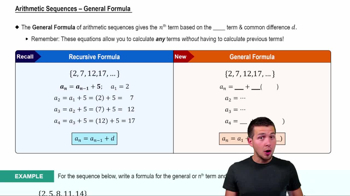
An arithmetic sequence is a list of numbers with a constant difference between consecutive terms. The given series 1 + 3 + 5 + ... + (2n - 1) is an arithmetic sequence of odd numbers with a common difference of 2. Understanding this helps in recognizing patterns and summing the terms.
The sum of the first n odd numbers is equal to n squared (n^2). This is a well-known formula that can be proven by induction or visualized geometrically. It shows a direct relationship between odd numbers and perfect squares, which is the core of the given statement.


 Verified step by step guidance
 05:17
05:17