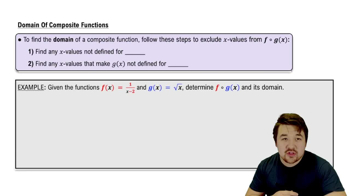
Step 1: Understand the concept of the domain of a function. The domain refers to all possible values of x for which the function is defined. For most algebraic functions, this means identifying any restrictions on x, such as division by zero or square roots of negative numbers.
Step 2: Analyze the given function f(x) = -2(x + 5). This is a linear function because it involves a constant multiplied by a linear expression (x + 5). Linear functions are defined for all real numbers since there are no restrictions like division by zero or square roots.
Step 3: Confirm that there are no restrictions on x. In the function f(x) = -2(x + 5), the expression (x + 5) is a simple addition operation, and multiplying by -2 does not introduce any restrictions.
Step 4: Conclude that the domain of the function is all real numbers. This means x can take any value from negative infinity to positive infinity.
Step 5: Express the domain in interval notation. The domain of f(x) = -2(x + 5) is (-∞, ∞), which represents all real numbers.
Verified video answer for a similar problem:
This video solution was recommended by our tutors as helpful for the problem above
Video duration:
1m
Play a video:
Was this helpful?
Key Concepts
Here are the essential concepts you must grasp in order to answer the question correctly.
Domain of a Function
The domain of a function refers to the set of all possible input values (x-values) for which the function is defined. For polynomial functions like f(x) = -2(x + 5), the domain typically includes all real numbers, as there are no restrictions such as division by zero or square roots of negative numbers.
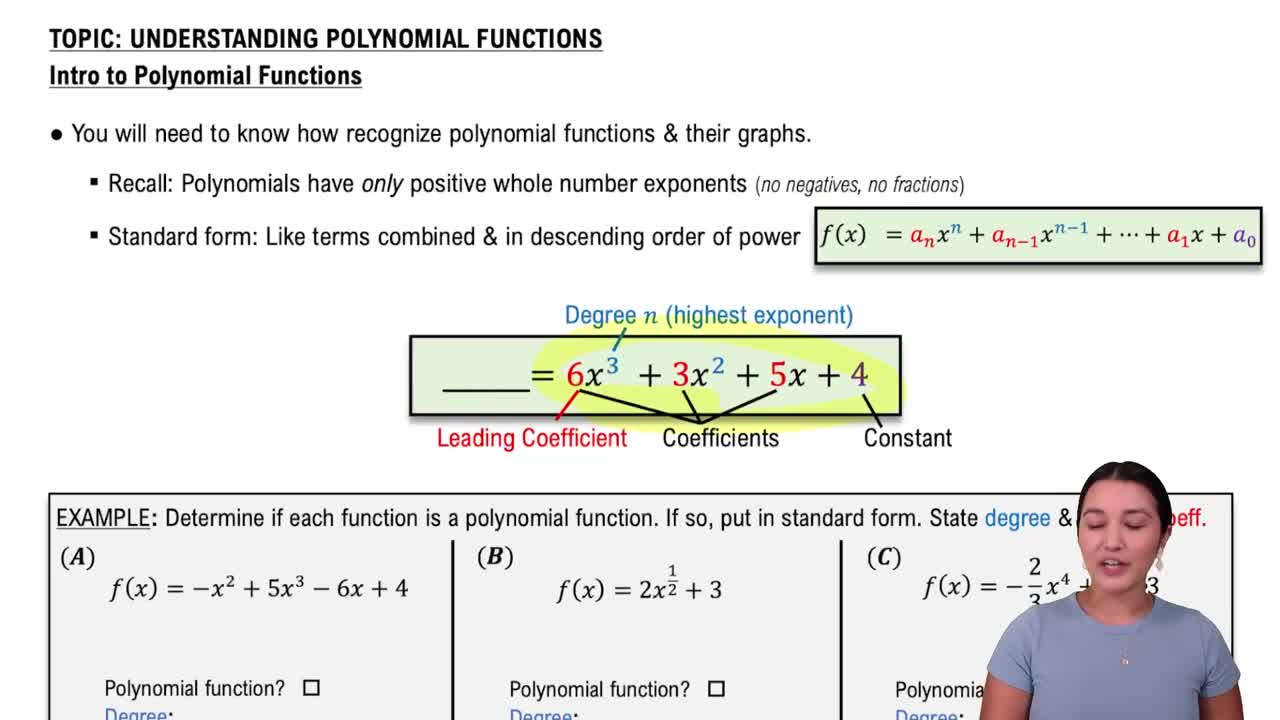
Polynomial functions are mathematical expressions that involve variables raised to whole number powers, combined using addition, subtraction, and multiplication. The function f(x) = -2(x + 5) is a linear polynomial, which means it is a first-degree polynomial and is defined for all real numbers, contributing to its unrestricted domain.
Graphing linear functions involves plotting points that satisfy the function's equation and connecting them to form a straight line. The graph of f(x) = -2(x + 5) will be a straight line, and understanding its slope and y-intercept can help visualize the function, reinforcing that its domain is all real numbers.