For each polynomial function, identify its graph from choices A–F. ƒ(x)=-(x-2)2(x-5)2
Table of contents
- 0. Review of Algebra4h 18m
- 1. Equations & Inequalities3h 18m
- 2. Graphs of Equations1h 43m
- 3. Functions2h 17m
- 4. Polynomial Functions1h 44m
- 5. Rational Functions1h 23m
- 6. Exponential & Logarithmic Functions2h 28m
- 7. Systems of Equations & Matrices4h 5m
- 8. Conic Sections2h 23m
- 9. Sequences, Series, & Induction1h 22m
- 10. Combinatorics & Probability1h 45m
4. Polynomial Functions
Understanding Polynomial Functions
Problem 62
Textbook Question
Show that the real zeros of each polynomial function satisfy the given conditions. See Example 6.
; no real zero less than -2
Verified step by step guidance1
First, understand the problem: we need to show that the real zeros of the polynomial function \(f(x) = 3x^4 + 2x^3 - 4x^2 + x - 1\) are all greater than or equal to \(-2\), meaning there are no real zeros less than \(-2\).
Evaluate the polynomial at \(x = -2\) to check the sign of \(f(-2)\). Substitute \(x = -2\) into the polynomial: \(f(-2) = 3(-2)^4 + 2(-2)^3 - 4(-2)^2 + (-2) - 1\).
Next, analyze the behavior of \(f(x)\) for values less than \(-2\). One way is to check the sign of \(f(x)\) at a value less than \(-2\), for example at \(x = -3\), by substituting \(x = -3\) into the polynomial.
If \(f(-2)\) and \(f(-3)\) have the same sign (both positive or both negative), then by the Intermediate Value Theorem, there is no zero between \(-3\) and \(-2\). Repeat this for other values less than \(-2\) if necessary to confirm no sign changes occur.
Finally, conclude that since the polynomial does not change sign for \(x < -2\), there are no real zeros less than \(-2\). This shows all real zeros satisfy the condition of being greater than or equal to \(-2\).
Verified video answer for a similar problem:This video solution was recommended by our tutors as helpful for the problem above
Video duration:
6mPlay a video:
Was this helpful?
Key Concepts
Here are the essential concepts you must grasp in order to answer the question correctly.
Real Zeros of Polynomial Functions
Real zeros of a polynomial are the values of x for which the polynomial equals zero. These zeros correspond to the x-intercepts of the graph. Finding real zeros often involves factoring, using the Rational Root Theorem, or applying numerical methods.
Recommended video:
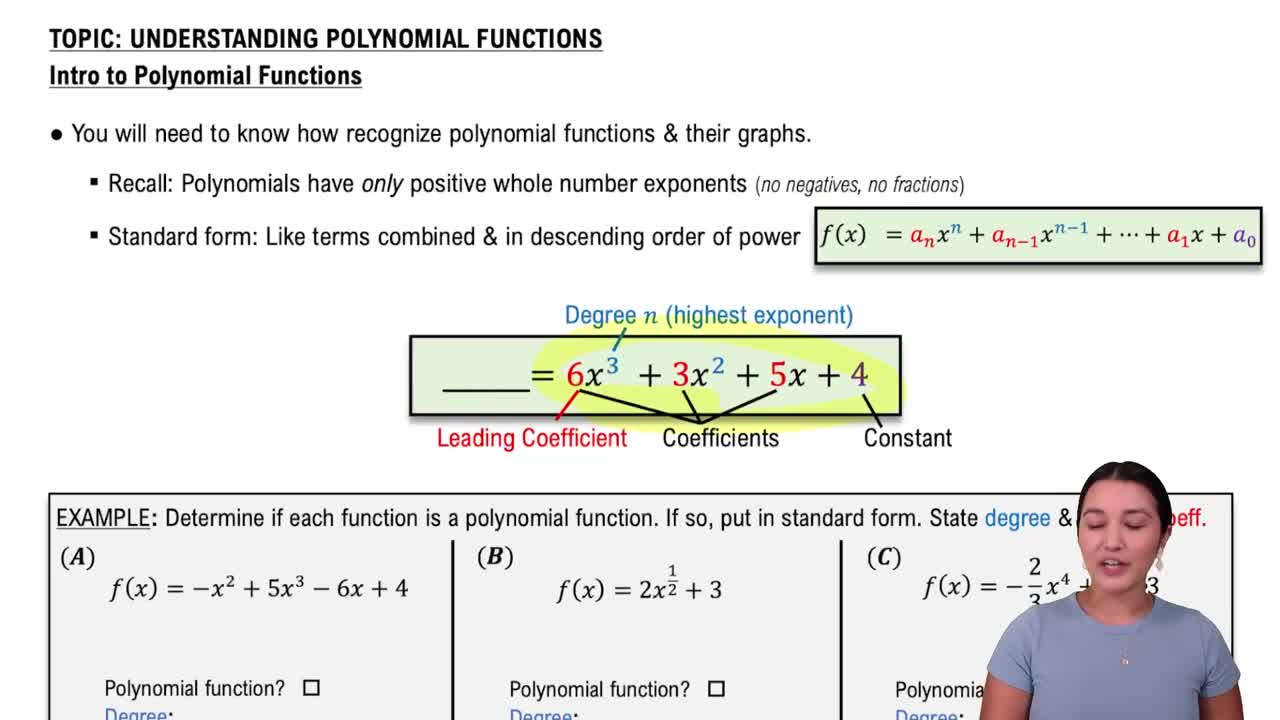
Introduction to Polynomial Functions
Evaluating Polynomial Values to Test Inequalities
To verify conditions on zeros, such as no real zero less than a certain value, evaluate the polynomial at strategic points and analyze sign changes. This helps determine intervals where zeros may lie, using the Intermediate Value Theorem.
Recommended video:
Guided course
Example 2
Intermediate Value Theorem
The Intermediate Value Theorem states that if a continuous function changes sign over an interval, it must have a zero within that interval. This theorem is essential for locating zeros and confirming their position relative to given bounds.
Recommended video:
Introduction to Hyperbolas
Watch next
Master Introduction to Polynomial Functions with a bite sized video explanation from Patrick
Start learningRelated Videos
Related Practice
Textbook Question
655
views