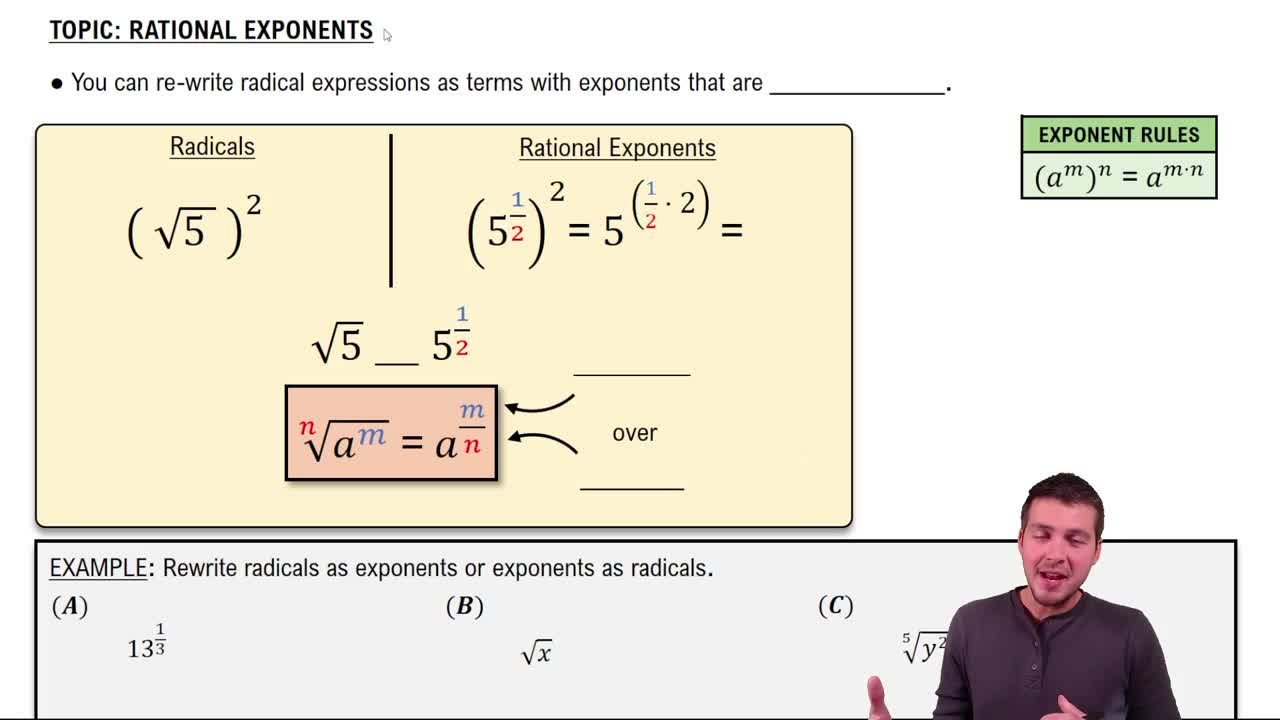
Recall that the cube root of a number can be expressed as an exponent with a fractional power. Specifically, the cube root of a number \(a\) is written as \(a^{\frac{1}{3}}\).
Rewrite the cube root of 64 using this exponent form: \(\sqrt[3]{64} = 64^{\frac{1}{3}}\).
Express 64 as a power of a smaller base if possible. Since \(64 = 2^6\), rewrite the expression as \(64^{\frac{1}{3}} = (2^6)^{\frac{1}{3}}\).
Use the power of a power property of exponents, which states \((a^m)^n = a^{m \times n}\), to simplify the expression: \((2^6)^{\frac{1}{3}} = 2^{6 \times \frac{1}{3}}\).
Multiply the exponents: \(6 \times \frac{1}{3} = 2\), so the expression simplifies to \(2^2\). This is the simplified form of the cube root of 64.
Verified video answer for a similar problem:
This video solution was recommended by our tutors as helpful for the problem above
Video duration:
4m
Play a video:
0 Comments
Key Concepts
Here are the essential concepts you must grasp in order to answer the question correctly.
Radicals and Rational Exponents
A radical expression like the cube root (∛) can be rewritten using rational exponents. Specifically, the cube root of a number is the same as raising that number to the power of 1/3. This allows us to convert root expressions into exponent form for easier manipulation.
Exponentiation rules govern how to work with powers, including fractional exponents. Understanding that a^(m/n) means the nth root of a^m helps in simplifying expressions. This concept is essential for rewriting and evaluating expressions involving roots and powers.
Evaluating powers involves calculating the numerical value of an expression with exponents. For example, 64^(1/3) means finding the number which, when cubed, equals 64. Recognizing perfect powers like 64 = 4^3 simplifies the evaluation process.

 4:36 minutes
 Verified step by step guidance
 04:06
04:06