In Exercises 105–108, evaluate each expression without using a calculator. log2 (log3 81)
Verified step by step guidance
1
Identify the expression to evaluate: \( \log_2 \left( \log_3 81 \right) \). This means you first need to evaluate the inner logarithm \( \log_3 81 \), then use that result as the argument for the outer logarithm with base 2.
Evaluate the inner logarithm \( \log_3 81 \). Recall that \( \log_b a = c \) means \( b^c = a \). So, find the exponent \( c \) such that \( 3^c = 81 \).
Express 81 as a power of 3. Since \( 81 = 3^4 \), it follows that \( \log_3 81 = 4 \).
Substitute the inner logarithm result back into the original expression: \( \log_2 4 \). Now, evaluate \( \log_2 4 \) by finding the exponent \( d \) such that \( 2^d = 4 \).
Recognize that \( 4 = 2^2 \), so \( \log_2 4 = 2 \). This completes the evaluation of the original expression.
Verified video answer for a similar problem:
This video solution was recommended by our tutors as helpful for the problem above
Video duration:
2m
Play a video:
0 Comments
Key Concepts
Here are the essential concepts you must grasp in order to answer the question correctly.
Logarithmic Functions
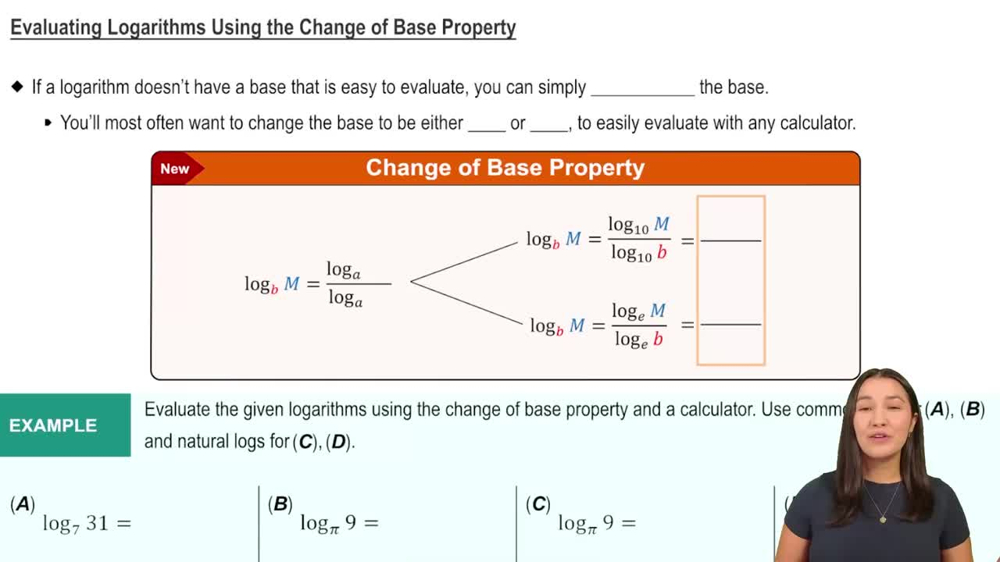
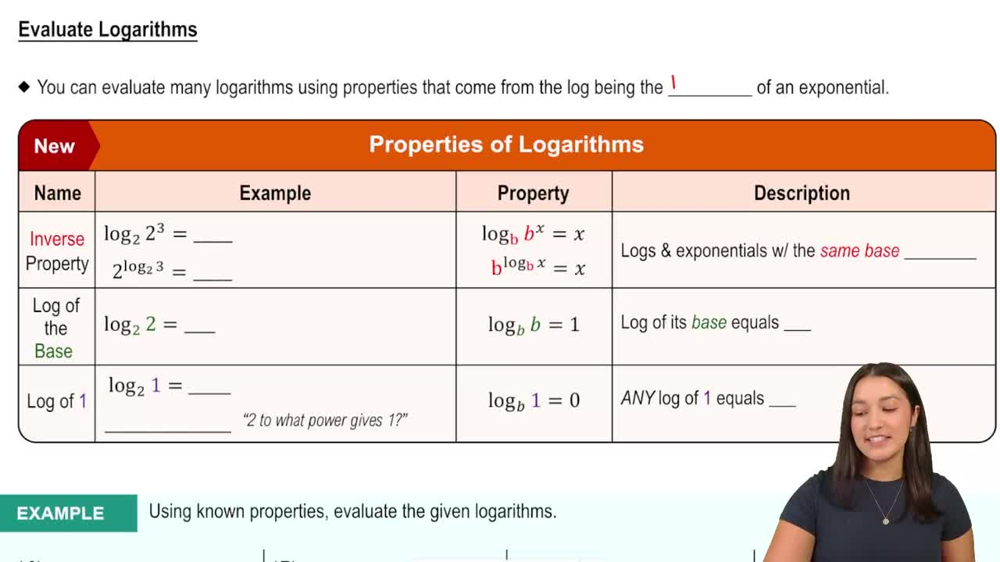
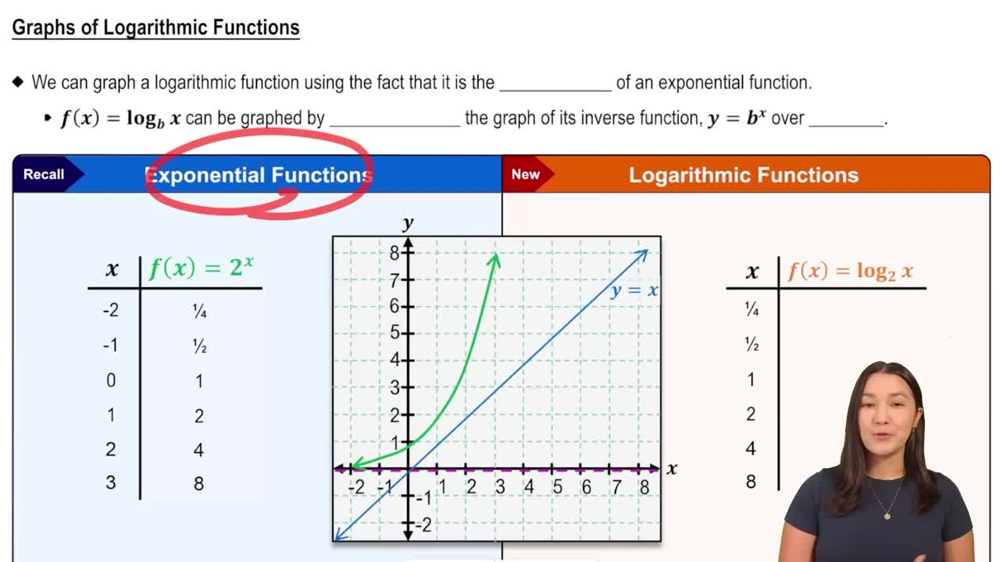
A logarithmic function is the inverse of an exponential function. It answers the question: to what exponent must the base be raised to produce a given number? For example, log_b(a) = c means b^c = a. Understanding this relationship is essential for evaluating nested logarithms.
Simplifying logarithmic expressions often involves rewriting numbers as powers of the base. For instance, recognizing that 81 = 3^4 allows you to simplify log3(81) to 4. This step is crucial before evaluating the outer logarithm.
Nested logarithms require evaluating the inner logarithm first, then using that result as the input for the outer logarithm. In this problem, you first find log3(81), then use that value to compute log2 of the result, applying the properties of logarithms sequentially.

 2:18 minutes
 Verified step by step guidance
 5:26
5:26